





This article was first published on The Bit Journal.
The age of “vibe coding” is no more just an Internet meme as it is emerging as a genuine force in the Web3 space .
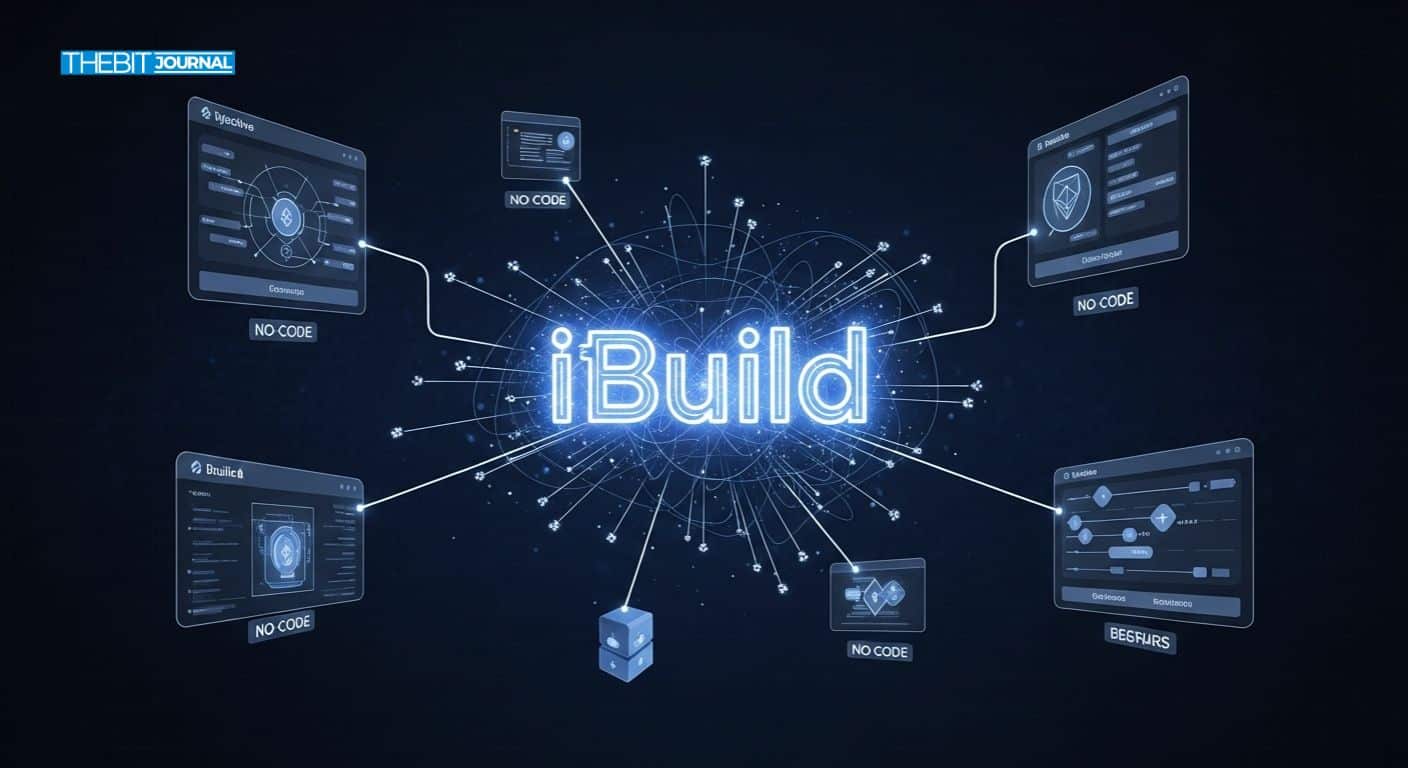
Injective just announced the launch of iBuild, a no-code and AI-driven platform enabling users to build and deploy fully on-chain decentralized applications simply through natural language input.
This reduces the barrier to entry for creating Web3 apps. In a world that until now had been left to experienced engineers, iBuild promises to enhance the ability for creators, be it an eager beginner or seasoned developer, to construct DeFi protocols, prediction markets, or tokenized applications in minutes versus months.
What Is Vibe Coding and Why It’s Important in Web3?
Vibe coding is the concept of building software by communicating in plain language about what one wants. Instead of typing lines of code, users enter “prompts,” which an A.I. system converts into working applications.
Injective’s cofounder, Eric Chen offers a description of it as something that enables “almost everyone … to ship products with just very simple text commands.”
This is super powerful in web3 as it eliminates jargon and speeds up the dev cycle. Until now, the barrier to entry for on-chain apps came in the form of deep blockchain and coding expertise. With vibe coding, developers as well as individuals without programming skills can fast-track their journey from idea to creation.
Injective’s iBuild is specifically designed for this: it mingles rapid prompt-based development with on-chain deployment.

Inside Injective’s iBuild: Build Apps in Minutes
Injective’s iBuild is the first of its kind on Web3. Announcing what it calls the “ultimate” DeFi system, with the new tools, it is possible to build decentralized perpetual exchanges, lending apps, prediction markets and any other kind of financial contract, without writing a single line of code.
At the backend, iBuild utilizes Injective’s MultiVM structure which enables it to deploy across both WebAssembly (WASM) and native EVM environments.
It has an audited open source plug and play finance modules, including its core products such as liquidity pools, oracles and permissioned assets which reduces engineering risk complexity.
Eric Chen demonstrated what iBuild can do. In a community demo, he put together an on-chain lottery app in minutes, and that same lottery app became a production game by Hyper Ninjas.
He also made a viral app called “Pushin’ P” with natural-language prompts, illustrating how expressive and quick vibe coding can be.
The IBC Safety Layer: Injective’s Fine Balance of Speed and Security
Security is one of the major concerns related to no-code, AI-driven development. If anyone can create smart contracts using a prompt, how does one guard against exploits or bad code?
Injective addresses this problem by applying fixed, audited modules on the protocol level.
So even if the AI “hallucinates” and makes nonsensical inferences, core financial rails (say payments or token transfers) are constructed on top of well-vetted secure primitives, Chen explains.
This provides iBuild with better security than generic no-code platforms since the key infrastructure is codified on-chain, instead of being generated ad-hoc.
Also important is that it uses proven execution environments: EVM and WASM, which means iBuild enjoys broad reach of compatibility and Injective recently launched native EVM, making it easier for developers to get familiar Ethereum-like apps deployed.
Real-World Impact: Who’s Building with iBuild and Why
Vibe coding with iBuild is no hand-wavy thought experiment. Already, it’s allowing actual developers and creators to realize visions.
Through community participation, Injective has observed users create a variety of applications, including not just simple apps but financial primitives like DEXs and savings protocols.
At a recent Injective hackathon, over 20 Web3 dapps were launched within the span of 24 hours in this new development workflow.
According to Chen, the simplicity of iBuild’s pay-as-you-go pricing model is what makes it reachable. One is charged by API usage only with no monthly commitment.
That makes it perfect for creators, startups or anyone looking to do some experimenting in Web3.
Challenges and Next Steps: The Future of Vibe Coding
Vibe coding sounds exciting but it has its faults. An academic paper explains that AI-generated projects are likely to accumulate technical debt, insecure code and logic contradictions because LLMs privilege user commands over consistent structure.
The researchers suggest incorporating formal verification, essentially adding on a “sidecar” system that formally verifies generated code against specifications.
The community, for its part, has expressed concerns about security. Some developers in vibe-coding forums caution that apps generated are often based on fragile defaults and loose treatment of authentication and access controls.
Others say AI-produced code can be hard to maintain or debug, at scale.
Injective’s shift toward a safer architecture with audited modules and its MultiVM framework mitigates many of these issues.
In addition to this, its recently launched EVM version provides developers with even more powerful tools to create diverse and interoperable applications.
With more creators integrating vibe coding, the industry might see a flood of new Web3 apps constructed from strong and composable primitives.
Conclusion
Vibe coding Web3 is no longer a new thing. With iBuild from Injective, it is a rapidly emerging multi-platform.
Injective is democratizing development by allowing non-technical users to create complex, secure, on-chain applications with natural language prompts.
Despite obstacles around verification and sustainability, AI co-existing with modular Web3 primitives in a flexible blockchain architecture is very powerful.
For anyone who’s ever wanted to build a DeFi app or blockchain game, but didn’t know how to code, the dreams are getting real.
Glossary
Vibe coding: The art of building software using real-language prompts and an AI engine behind the scenes.
No-code platform: A development option that enables making apps without coding written in the form of computer code.
MultiVM: A blockchain infrastructure with support for multiple VMs (e.g., WASM and EVM) to allow flexible application deployment.
Formal verification: Using mathematical proofs to demonstrate that code fulfills its specification, in an effort to minimize bugs or security flaws.
Technical debt: The hidden fee for a future refactoring or fixing due to fast or not perfect implementation.
On-chain modules: Pre-built and audited components that can be installed at the protocol level so teams do not have to re-create common functions such as liquidity pools or oracles.
Frequently Asked Questions About Vibe Coding in Web3
Do i have to be a coder to use vibe coding on ibuild?
No, that’s the idea. Built on top of Injective, iBuild lets users construct decentralized applications with nothing more than natural-language prompts. No need to have any technical knowledge.
Can iBuild apps take care of advanced functions in finance?
iBuild comes with pre-built modules for DEXs, yield vaults, lending protocols and other dapps to assemble in reality what they pitch in a whitepaper.
Is vibe-coded code safe?
Injective incorporates independently audited modules on the protocol level, but as with all code that is generated, AI output should be thoroughly vetted. Formal verification might be used to eliminate long-term pitfalls.
How does Injective profit from iBuild?
iBuild operates on a pay-as-you-go model: you pay for use of the API (rather than paying a fixed monthly cost).
What does Injective’s native EVM and the launch of iBuild mean?
Building on the EVM, iBuild users can create apps running both in WASM and EVM to enjoy developer friendly interface along with strong on-chain interoperability.
References