




Tether (USDT) has achieved a massive milestone with 500M users internationally. Paolo Ardoino, credits the surging figure to generating wider global demand.
The development underscores Tether’s growing importance in the world of digital money. It also paves the way for more growth.
Tether’s Strategic Focus Drives USDT Adoption Growth
Expansion of Tether’s USDT seems to have heavily focused on the emerging markets. The company is focused on enhancing remittance and day-to-day transactions to populations with limited access to traditional banking.
USDT demonstrates that stablecoins can and should be intermediaries to financial access, Ardoino said. His comments echo the underlying principle of Tether’s goal to increase access to financial services among the unbanked masses.
Also Read: Tether’s $175B Liquidity Bridge Puts Solana Back on the Path to $300
Tether’s approach has centered on partnerships with local communities in underserved areas. The company’s bottom-up strategy is aimed to encourage the use of USDT as an everyday medium of exchange and cross-border payments.
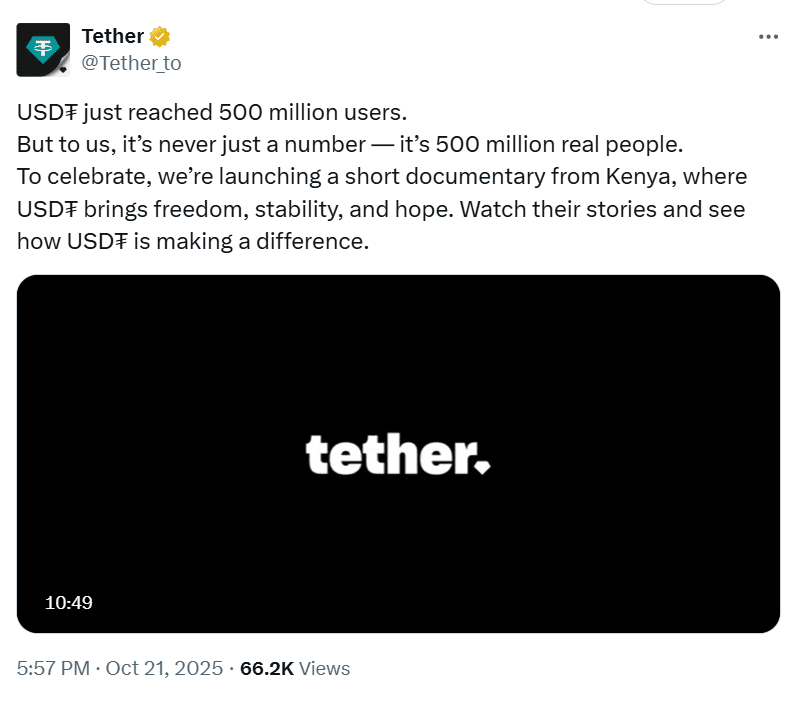
USDT Adoption Growth in Latin America, Africa, and Southeast Asia
Tether’s penetration of Latin America, Africa and Southeast Asia has also expanded massively. These so-called soflo infrastructural areas, the study notes, which have volatile local currencies and limited banking access have witnessed a surge in USDT adoption growth.
Use of the stablecoin in retail payments and person-to-person transfers is also growing. Tether is doubling down on the effort to target unbanked populations around the world.
Though by the World Bank’s count 1.4 billion adults worldwide still don’t have a bank account. Legal: Solution Cryptos in the likes of USDT come to the rescue. With nothing more than a cellphone, people can download a crypto wallet and receive funds they can store securely.
Tether’s Vision: Financial Inclusion and Beyond
There’s more to Tether than just stablecoin use. By focusing on those who have typically been shut out of banking, the company seeks to increase financial inclusion.
USDT has been a vital part of daily communication in areas where there is insufficient access to financial services. Its expansion into these regions would strengthen the proposition that stablecoins can help end financial exclusion.
Plans for USAT and Increased Investment
Tether will introduce a new, U.S. dollar-backed stablecoin to the market with the launch of USAT. CEO Bo Hines said Tether will not raise external capital for the initiative, which could be less than a year away. Instead, new equity will be provided, while the existing investors will retain their shares.
It is raising another $20 billion in a deal that would value the company at $500 billion. The development suggests rising investor demand for Tether’s, and its hegemony in the space.
Tether’s Financial Performance
Tether’s finances have been getting good grades. The company also announced its second-quarter profit of $4.9 billion, which is more than the previous record of $4.52 billion.
The platform is also one of the largest holders of U.S. government debt, a sign of its financial strength, he added. This enthusiasm is drawing fresh investor interest, even as regulatory scrutiny increases in some markets.
Regulatory Challenges and Compliance Efforts
Tether has encountered some difficulties, especially in Europe. The EU’s MiCA regulation for digital assets, which is live by April 2025, might have an effect on USDT’s footprint in the region.
The company is however considering regulatory initiatives to be compliant with MiCA and continues to look at markets outside the EU, where USDT adoption growth has significantly increased.
The Need for Full Audits
But no major firms such as Deloitte or PwC have conducted a full audit of Tether, despite its financial heft. Tether’s leadership is attempting to fix this and become more transparent. For now the company depends on quarterly attestations from BDO Italia.
USDT’s Competition in the Stablecoin Market
Tether is coming under pressure from traditional banks like JPMorgan and Citigroup, which are vying to enter the stablecoin market. But Ardoino thinks Tether’s technology and solid market understanding is an edge.
Conclusion
The ascent of Tether’s has made the firm a major player in digital finance. Its global presence, particularly in developing regions, illustrates the growing need for stablecoins.
While Tether is expanding, it’s still committed toward financial inclusion and the unbanked. In the face of adversity and competition, Tether is posting a resilient performance that guarantees USDT will continue to play a major role in the stablecoin sector.
Also Read: Tether Co-Founder Predicts the End of Fiat: Stablecoins To Dominate
Appendix: Glossary of Key Terms
USDT Adoption Growth – The increasing number of users and transactions involving Tether’s stablecoin, USDT, especially in emerging markets.
Financial Inclusion – Enabling underserved populations to access secure digital financial services, bypassing traditional banking systems.
Emerging Markets – Developing regions with unstable currencies and limited banking access, driving USDT adoption.
USAT – Tether’s upcoming dollar-backed stablecoin aimed at expanding its stablecoin portfolio for the U.S. market.
Regulatory Compliance – Tether’s efforts to meet legal requirements, including the EU’s MiCA regulation, while expanding into non-EU markets.
Stablecoin – A type of cryptocurrency pegged to an asset like the U.S. dollar to maintain stability, such as USDT.
Frequently Asked Questions About USDT Adoption Growth
1. What is USDT adoption growth?
USDT adoption growth refers to the increasing number of users and transactions involving Tether’s stablecoin, USDT, particularly in emerging markets.
2. How does Tether promote financial inclusion?
Tether helps promote financial inclusion by enabling people in underserved regions to access secure and stable digital financial services, bypassing traditional banking systems.
3. Which regions are driving USDT adoption growth?
USDT adoption growth has been especially significant in Latin America, Africa, and Southeast Asia, where local currencies are unstable and banking access is limited.
4. What are Tether’s future plans for stablecoins?
Tether plans to launch USAT, a new dollar-backed stablecoin for the U.S. market, and aims to raise $20 billion in a deal that would increase its valuation to $500 billion.