





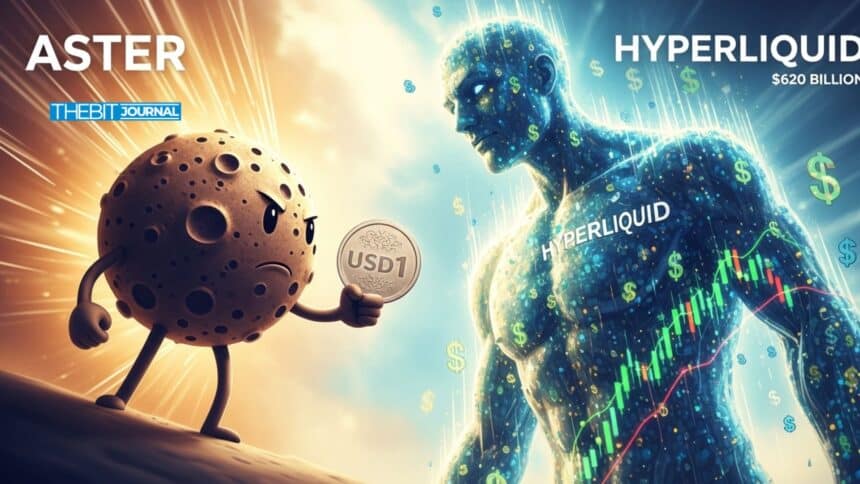

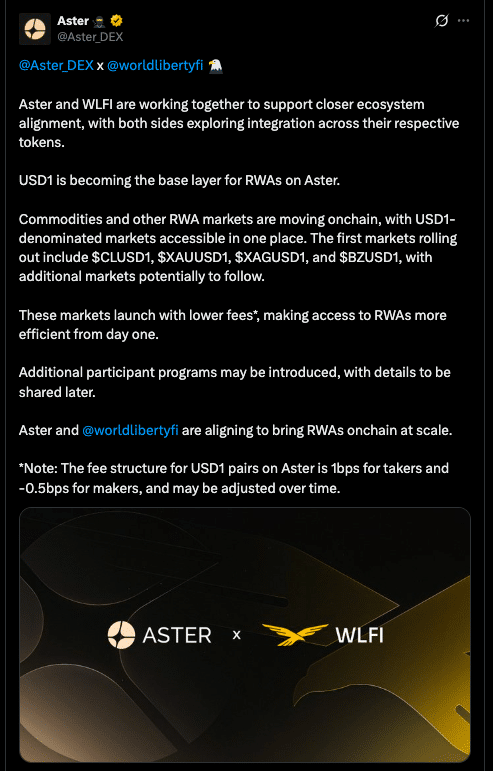
ASTER’s recent partnership with World Liberty Financial (WLFI) has put USD1, WLFI’s native stablecoin at the core of the economy for both perpetual markets and RWA exposure.
This has raised speculation about ASTER vs Hyperliquid, questioning ASTER’s capacity to take on Hyperliquid’s dominance, especially in a market where macroeconomic headwinds and a cooling of trading activity affects market behavior.
The 34.3% gains that USD1 has made so far this year compared to the negligible increase of USDT at just +1.6% suggests that market participants are drifting towards stablecoins which have realistic potential to integrate with traditional finance and DeFi.
With the USD1 peg now at the forefront of its ecosystem, ASTER is looking to grow beyond speculative trading activity into real-world asset markets, bringing it closer to Hyperliquid which still maintains dominance in perpetual volumes.
USD1 Strengthens ASTER’s Market Position
The ASTER vs Hyperliquid competition is now being defined by infrastructure and token activity. USD1 is the settlement layer for ASTER’s perpetual markets and is used as collateral for tokenized real-world assets like oil, gold, and silver.
This design increases liquidity flowing into the protocol and develops a capital flow within traditional finance markets and decentralized markets more efficiently.
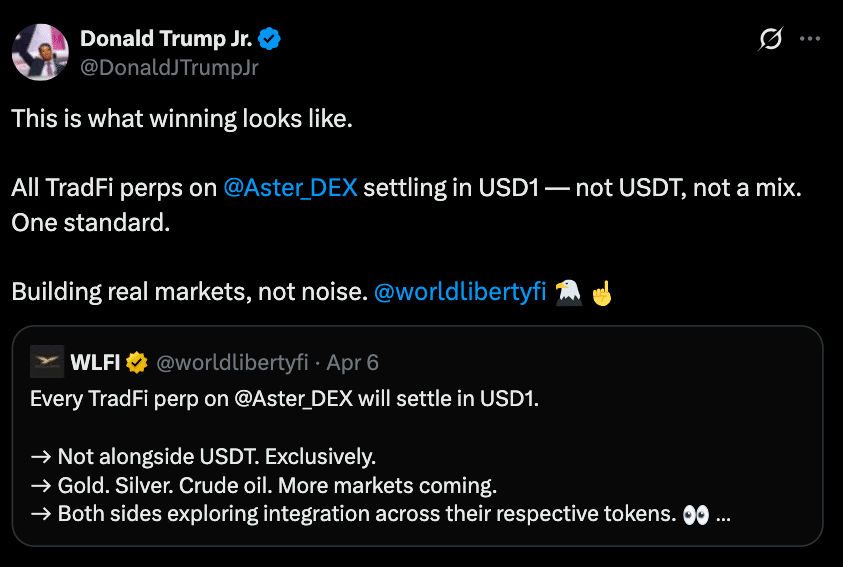
Commenting on the news recently, Donald Trump Jr. calls the partnership a “win for both networks”, sharing early optimism about the move’s ability to attract new users and institutional interest.
In comparison, Hyperliquid’s lead is driven almost exclusively by derivatives volume, especially for commodity trading.
With the integration of USD1, ASTER is set for more stable and structured growth.
Trading Volumes Highlight Hyperliquid’s Lead
Hyperliquid remains a formidable competitor. According to reports, Hyperliquid saw $620 billion in trading volume for perps in Q1 2026. Oil perps were among the main drivers of activity. ASTER on the other hand reported $318 billion during the same period, which emphasizes the difference in scale.
This can be seen in the token performance too. Hyperliquid’s HYPE was up 43% after Q1 while ASTER dropped by 3.32%. The gap between Aster vs Hyperliquid shows the struggle ASTER faces in the fight with Hyperliquid.
While ASTER has strategic advantages in integrating stablecoins as a component of DeFi processes, Hyperliquid’s deep position in derivatives markets will be a solid hurdle for ASTER to maintain consistent trading activity and keep up with the pace.
Real-World Assets Bring a Competitive Advantage
ASTER looks to be competitive in its alignment with real-world asset markets. Tokenized real-world assets grew 35% this year, showing that demand for structured DeFi products beyond simple speculation is increasingly strong.
Further, USD1 serves as a base layer enabling ASTER to give exposure on commodities, tokenized securities and other tangible assets, resulting in a differentiating value proposition.
According to reports, various perpetual contracts on ASTER already use USD1 as collateral (it includes BTC, ETH and SOL).
With a unified liquidity layer that is applicable to both trading and RWA efforts, ASTER could potentially reach Hyperliquid levels of capital efficiency, allowing it to compete both on the trading front with Hyperliquid and also expand into different market segments.
Technical Positioning and Market Sentiment
ASTER vs Hyperliquid are both operating in a difficult macro environment. ASTER’s assets currently trade right above critical support levels, under early-October highs, showing cautious sentiment. Hyperliquid remains relatively bullish due to consistently remaining active in derivatives.
The USD1 integration has created reactions across market indicators and social sentiment. Initial responses have been positive, but only results will tell if it translates into noticeable increases.
Success in improving liquidity, increasing trading volume and attracting institutional engagement will decide the success of ASTER in the ASTER vs Hyperliquid competition.
Conclusion
The ASTER vs Hyperliquid competition is getting into the phase where strategy and integration matter. The 34.3% growth of USD1 opens the floor for ASTER to explore new opportunities in real-world asset markets and enhance liquidity in perpetual trading.
Hyperliquid however recorded a Q1 volume with $620 billion and strong token performance. The challenge for ASTER is to convert the strategic position into tangible market share, using USD1 adoption to attract liquidity and user engagement.
Time will tell over the next few months whether ASTER’s new approach and strategy of using a high-growth stablecoin at its ecosystem core and of designing for structured financial products can shake up competitive positions.
Glossary
Perpetual Contracts: Derivatives enabling traders to speculate on asset prices without expiry.
Stablecoin: type of Cryptocurrency designed to maintain price stability and often linked to fiat currency.
RWAs: Tokenized real-world assets like traditional financial products (e.g., commodities and bonds).
Liquidity: Ease of purchasing or disposing of a property without influencing its price
Market Cap: The value of a cryptocurrency, obtained by multiplying price and supply.
Frequently Asked Questions About ASTER vs Hyperliquid Rivalry
What Powers the ASTER vs Hyperliquid Rivalry?
While Hyperliquid ranks first in derivatives trading volume, ASTER prioritizes stablecoin integration and real-world asset access.
What has been the growth of USD1 for the year?
There is an increase of 34.3% for USD1, compared to USDT’s growth of 1.6%, suggesting that we have strong adoption in structured markets.
What are ASTER vs Hyperliquid trading volumes?
In Q1, Hyperliquid had $620 billion in perpetual volume while ASTER saw a total of $318 billion.
Why are real-world assets relevant, in the context of this?
Tokenized RWAs represent a structured exposure and bridge that connects the traditional finance with DeFi, expanding use cases on each side of the equation allowing for institutional capital to flow into DEX.
Can ASTER overtake Hyperliquid?
Success depends on whether USD1 integration improves liquidity and adoption outstrips that of derivatives trading.
References