






The crypto bill delay has changed how people see the future of US digital asset regulation after the Senate Banking Committee confirmed that market structure legislation will now be taken up in early 2026.
This move shows a temporary pause, not a failure, as lawmakers continue discussions privately. For the crypto industry, timing is critical, and this delay adds more uncertainty to a market that is already moving carefully.
What does the crypto bill delay mean for US crypto regulation?
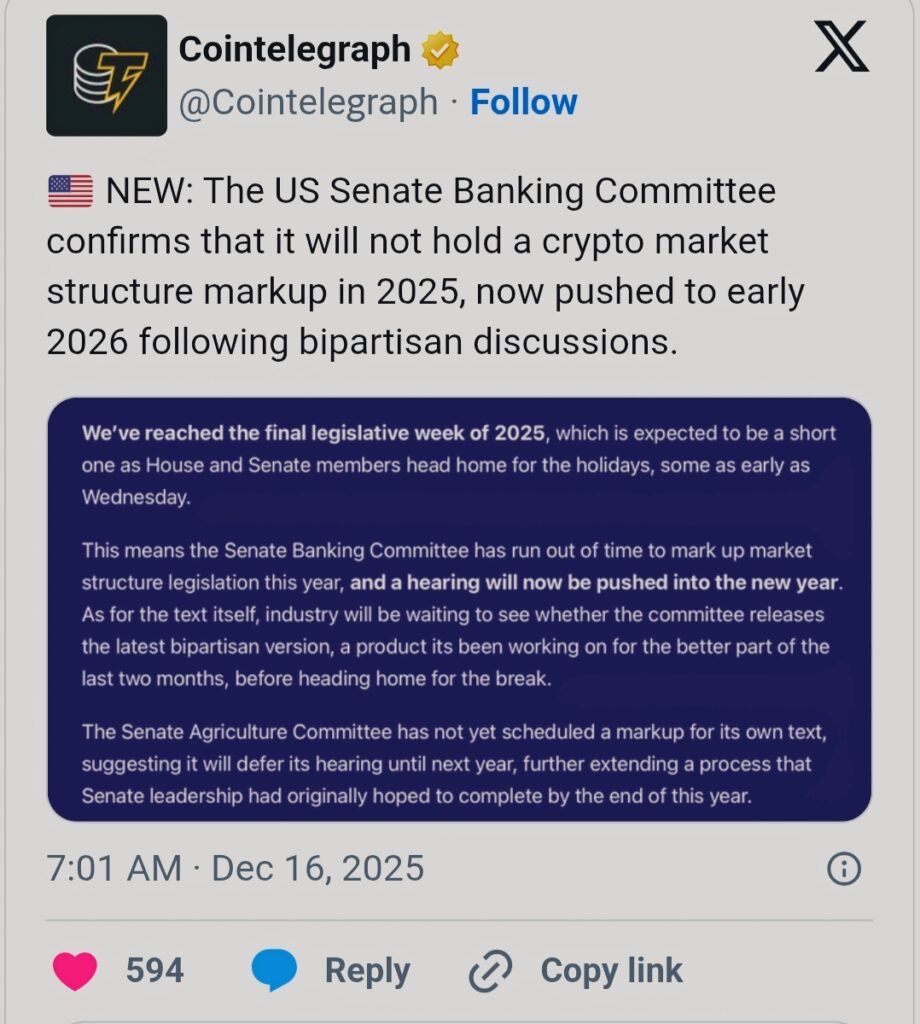
In simple terms, the decision means there will be no Senate Banking Committee markup on crypto market structure legislation in 2025. A spokesperson for Committee Chair Tim Scott confirmed on Monday that the hearings initially expected this year will not take place.
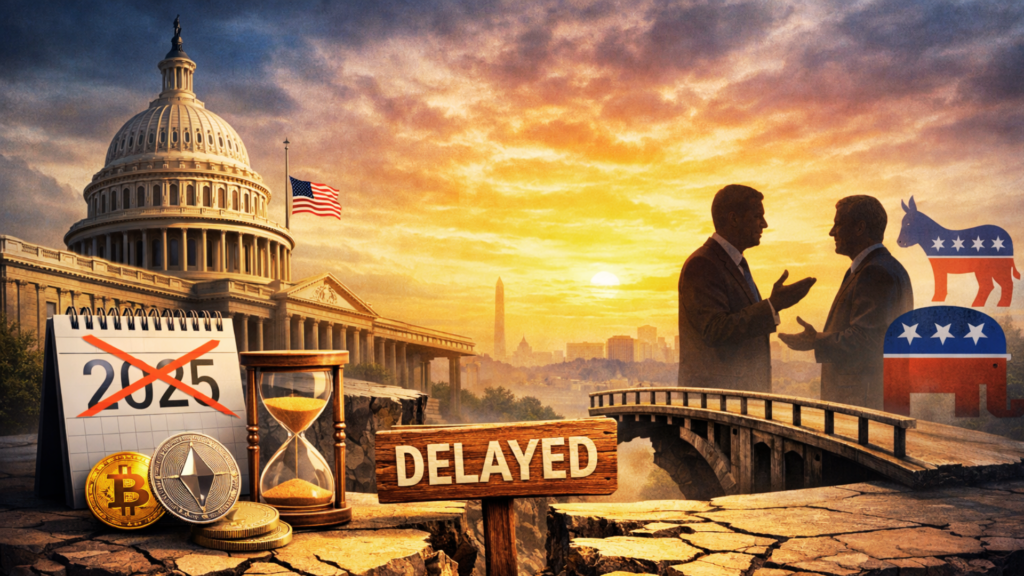
Lawmakers are now aiming to move the bill forward in early 2026. The committee said discussions are still ongoing and that progress has been made with Democratic members. The spokesperson added that Chair Scott has stressed that any legislation must be bipartisan.
He has consistently and patiently worked with others to develop a framework that provides clarity for the digital asset industry while helping the United States become a global crypto hub.
Why was the crypto bill delay pushed to 2026?
The main reason for the delay is unresolved bipartisan negotiations. Even though there was some momentum earlier in the year, lawmakers could not finalize an agreement before the session ended.
The crypto bill delay reflects a careful choice to avoid rushing or passing a one-sided bill. Senate aides said negotiations are still ongoing, with the hope that a stronger and more lasting bill can be marked up next year.
Experts note that market structure legislation is complicated. It aims to clarify how the Securities and Exchange Commission and the Commodity Futures Trading Commission share oversight, with the CFTC set as the main regulator for spot crypto markets.
What role does Chairman Tim Scott play in the delay?
Chairman Scott has taken a careful but deliberate approach. Committee officials emphasized that Scott considers bipartisan support essential. The crypto bill delay in this context is seen as a result of patience rather than political deadlock.
Supporters say this approach could prevent sudden changes in regulation later. Critics, however, argue that the industry has already waited long enough for clear federal rules.
How are midterm elections complicating the timeline?
The 2026 midterm elections add another layer of uncertainty. All House seats and 33 Senate seats will be up for election, which often slows down bipartisan legislation. Some analysts say that even early 2026 may be an optimistic timeline.
Crypto investor and researcher Paul Barron expressed doubt, noting that the market structure bill struggled during the markup phase in the Senate and that early 2026 could also face challenges.
This political schedule is one of the reasons the crypto bill delay has disappointed industry participants who had hoped 2025 would bring regulatory clarity.
Could federal funding deadlines push crypto lower on the agenda?
Yes, at least in the short term. When Congress returns from its holiday break, funding the federal government will be the top priority. The current funding bill expires on Jan. 30, which could push crypto legislation to the sidelines again.
Policy analysts point out that even with cooperation from both sides, busy legislative schedules often determine what gets done. The crypto bill delay may therefore go beyond procedural matters and extend into wider fiscal discussions.
How did markets react to the regulatory uncertainty?
Crypto prices dropped sharply after the news. On Monday, the broader crypto market fell by 3.6%, with about $150 billion leaving the market in just a few hours during late trading. Bitcoin lost nearly $5,000, falling from just under $90,000 to around $85,000. Bitcoin is currently trading near $86,167.49 and has not yet recovered.
Traders said the sell-off was driven by a combination of regulatory frustration and general risk-off sentiment. Analysts noted that the crypto bill delay reinforced concerns that clear rules are still far off, keeping institutional investors cautious.
What does this mean for exchanges and institutional investors?
Regulatory uncertainty continues to affect strategic decisions. Exchanges, token issuers, and institutional investors in the US remain in a holding pattern. Without clear federal rules, companies must navigate overlapping guidance from multiple regulators.

The crypto bill delay extends this uncertainty, potentially slowing innovation and expansion plans. However, some legal experts say that a well-designed bill, even if delayed, is better than fragmented enforcement. They note that lasting clarity is more valuable than speed that leads to confusion.
Conclusion
The crypto bill delay is both a disappointment and a recalibration. While absence of progress in 2025 frustrates industry participants, lawmakers insist that bipartisan groundwork is being laid. Early 2026 now stands as the next critical window, though elections and fiscal deadlines loom large.
For now crypto sector remains in wait-and-watch mode. Markets have reacted, policymakers are negotiating, and the promise of regulatory clarity is deferred rather than denied. Whether this pause results in stronger legislation or further delays will define the next chapter of US crypto regulation.
Glossary
Bipartisan Agreement: A plan agreed on by both Democrats and Republicans.
Midterm Elections: Elections in the middle of a presidential term that can change Congress.
CFTC: The US agency regulating futures, derivatives, and some crypto markets.
Crypto Bill: Proposed US law that sets rules for cryptocurrencies.
Frequently Asked Questions About Crypto Bill Delay
Why was the crypto bill delayed to 2026?
It was delayed as lawmakers could not agree on a bipartisan plan before the session ended.
Who is responsible for the delay?
Senate Banking Committee Chair Tim Scott and other lawmakers. As they work to reach a bipartisan agreement
How do midterm elections affect the timeline?
The midterm elections may slow down bill as many Senate and House seats are up for election.
How did markets react to delay?
Crypto prices fell. Bitcoin dropping nearly $5,000 as investors reacted to regulatory uncertainty.
Sources