



Last updated: November 5, 2026
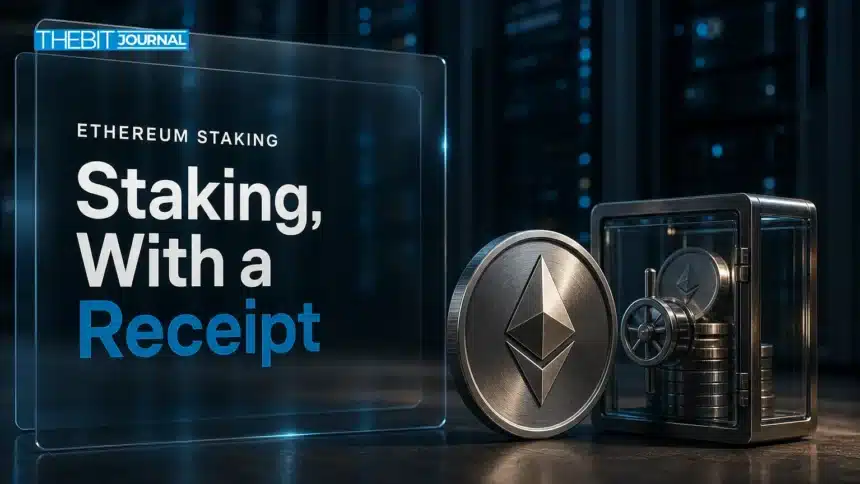
Liquid staking tokens represent a share of crypto deposited into a staking pool while remaining transferable in many cases. On Ethereum, they let participants receive a token for pooled, staked ETH without running a solo validator. But the token’s market price and redemption terms can differ from the ETH it represents.
TL;DR
- A liquid staking token is a receipt for pooled assets and rewards, not a promise that it can always be sold for the same value.
- Protocols account for rewards differently: some adjust token balances, while others change the ETH redeemable for each token.
- Market discounts, withdrawal delays, validator penalties and protocol or smart contract failures can affect what holders receive.
How liquid staking tokens work
Users deposit crypto into a protocol that coordinates staking and issues tokens representing their share of the pool. The tokens can typically be transferred or traded while the underlying ETH remains staked, according to Ethereum.org’s guide to pooled staking.
Instead of running a solo Ethereum validator, which requires 32 ETH, a participant can use a pool that accepts smaller deposits. The token represents a pool position under the protocol’s rules. It does not give the holder control of a particular validator or ensure immediate access to a specific amount of ETH.
Liquid staking tokens are often Ethereum ERC-20 tokens, which compatible wallets and applications can handle. But ERC-20 is a token standard, not a description of the rights or controls attached to a token.
How liquid staking tokens record rewards
Protocols display rewards in different ways. A rebasing token such as stETH can increase a holder’s displayed balance as rewards accrue. An exchange-rate token such as rETH generally keeps the balance fixed while increasing the ETH redeemable for each token. As a result, wallet balances and displayed values can behave differently.
Lido’s documentation says stETH is minted at a 1:1 ratio when ETH is deposited. Its balances normally update daily after an oracle reports consensus-layer ETH balances, and rewards or validator penalties can affect the token supply, according to the Lido tokens integration guide. This describes Lido, not every protocol. Rates and outcomes vary, and rewards are not assured.

Trading and redeeming a staking token
A holder may exit by selling on a secondary market or using the protocol’s withdrawal process, if available. A sale can be faster when buyers are present, but the token may trade above or below its associated ETH value.
Direct redemption is not always immediate. It can depend on liquidity, protocol rules and Ethereum’s validator exit queue, as Ethereum.org explains. Lido’s withdrawal route, for example, uses a first-in, first-out queue. A request locks stETH and issues an NFT, which the requester can use to claim ETH after finalization. This is Lido’s process and may take time.
“Liquid” means a token can be transferred or traded, not that a buyer will always be available, its exchange rate is fixed or redemption is instant. Its market price may differ from what a holder would receive through a protocol withdrawal.

Key risks to understand
Liquid staking adds protocol and market risks to the risks of holding crypto. A smart contract flaw, compromised infrastructure or operational failure could disrupt a pool. Validators can incur penalties that reduce the assets supporting a token. In extreme cases, holders could lose some or all of their deposited value.
There is also price and liquidity risk. A token trading below its underlying ETH value may not quickly return to parity, and selling at a discount can lock in a loss. Redemption queues can delay access, while exchange or wallet problems can create separate barriers to moving or selling. Fake tokens and phishing sites may imitate established protocols, so a familiar name or symbol alone does not verify a token.
Regulation varies by country and may depend on the product and how it operates. This is general information, not legal or tax advice. Local rules differ, so readers with questions can consult a qualified professional.
Pros and cons of liquid staking tokens
| Potential benefit | Trade-off or risk |
|---|---|
| Access to pooled staking without Ethereum’s 32 ETH solo-validator minimum. | Users rely on the pool’s contracts, operators and withdrawal rules. |
| The receipt token can be traded while ETH remains staked. | Its market price can diverge from the underlying ETH value. |
| Some tokens can be used in compatible applications while representing a staking position. | Other applications add separate contract and liquidity risks. |
| Rewards may appear through a changing balance or exchange rate. | Different accounting methods can make rewards harder to track. |
As of October 16, 2026, Ethereum.org described liquid-staking protocols as accounting for around one-third of all staked ETH. This is a dated snapshot, not a measure of future adoption or a statement about any protocol’s safety.

Who liquid staking may be for, and who it may not be for
The model may suit people who want pooled staking and understand that a receipt token can have a different price, use and redemption timeline from ETH. It also offers an option for people who do not have the 32 ETH needed to run a solo Ethereum validator.
It may not suit someone who needs immediate access to the underlying asset, cannot tolerate price swings or does not want additional protocol exposure. A liquid staking token is not cash, and being tradable does not remove the risk of loss. Reward displays also vary by token design.
Bottom line
Liquid staking tokens turn a pooled staking position into a transferable receipt, with rewards and withdrawals handled according to each protocol’s design. Check how a token accounts for rewards, how redemption works and what risks the pool discloses. Neither its name nor market price establishes a fixed value or instant access to ETH.
Sources
- Liquid & pooled staking (ethereum.org)
- Lido Tokens Integration Guide (docs.lido.fi)
- Glamsterdam on Hoodi Postponed (blog.ethereum.org)
This article is for informational purposes only and does not constitute financial or investment advice. Cryptocurrencies are highly volatile; always do your own research before investing.