

Last updated: November 26, 2026
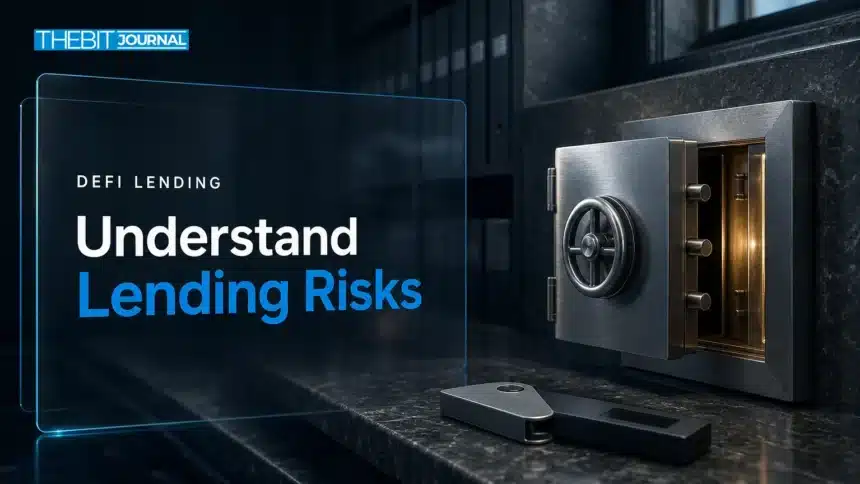
DeFi lending can differ from a fixed-rate loan. Collateral values, interest rates and liquidity can change, affecting a position even when a borrower takes no new action. Understanding health factors, oracles and withdrawal terms helps explain these risks, but no protocol or asset is risk-free.
Key Takeaways
- A health factor below 1 makes an Aave position eligible for liquidation, according to Aave.
- Variable borrow interest accrues immediately and can increase debt over time.
- Supplied assets may not be immediately withdrawable when a reserve is fully utilized.
- Oracles and connected smart contracts can add risks beyond collateral price movements.
How DeFi lending mistakes become costly
In an overcollateralized lending market, a borrower deposits crypto and borrows another asset against it. Collateral does not prevent losses: its value can fall, debt can grow, or protocol rules can change a position’s status. DeFi lending mistakes often come from tracking only the amount borrowed and overlooking the conditions attached to the debt.
Aave defines health factor as collateral value multiplied by the weighted-average liquidation threshold, divided by debt. Its example uses $10,000 in ETH collateral at an 80% threshold and $6,000 borrowed, resulting in a 1.333 health factor. Below 1, a position is eligible for liquidation. The Aave FAQ explains health factor and how it applies to a position.

Borrowing errors: health factor and interest
DeFi lending mistakes include borrowing near the limit
Borrowing close to the maximum leaves less room for a collateral price drop. A position can move toward liquidation without any additional borrowing. Aave’s example illustrates the calculation, but its thresholds and parameters do not necessarily apply to other protocols or assets.
Aave Insights says liquidators may repay up to 50% of a borrower’s debt when the health factor is above 0.95 and both the collateral and debt are at least $2,000. Liquidation can reach 100% when the health factor is 0.95 or lower, or either balance is below $2,000. The liquidator receives a collateral bonus that varies by asset. These are Aave-specific rules, not universal lending-market terms.
Ignoring variable interest and growing debt
Aave says borrowing interest starts accruing immediately. Rates change with utilization and governance-set parameters, and accumulated interest can lower a borrower’s health factor. Treating a variable rate as fixed, or overlooking a growing debt balance, can leave less collateral room than expected.
The terms at loan opening don’t describe the full life of a position. Rates and balances can change while the loan is open, with the effects depending on the protocol, asset and collateral.

Assuming supplied funds are always available
Supplying assets isn’t the same as having a deposit that can always be withdrawn on demand. Aave’s documentation says that when a reserve reaches 100% utilization, suppliers cannot withdraw that asset until borrowers repay or new liquidity arrives. It also says borrow rates rise sharply above the reserve’s optimal utilization.
The displayed value of a supplied position may not mean the underlying asset is immediately accessible. Withdrawal availability can depend on a protocol’s liquidity and withdrawal terms, particularly when funds are needed quickly.
Trusting oracle prices and connected protocols
Oracles deliver external or on-chain data to smart contracts, but an on-chain price isn’t automatically accurate. On July 11, 2026, Bonzo Lend reported that an accepted oracle update priced SAUCE roughly 12 orders of magnitude above its real value. Eight seconds later, an account used the mispriced collateral to borrow far more than it was worth.
In a January 2025 joint report, ESMA warned that incorrect oracle data can cause erroneous valuations or improper liquidations. It also said smart-contract composability can spread vulnerabilities across protocols and identified missing or improper input validation as a common cause of exploitation.
Connected applications can add failure points. A lending position that relies on another protocol, token or contract may face risks beyond those visible in its lending interface. The Bank of Canada’s February 2026 working paper, based on Aave V3 transaction data, reported that many users engage in recursive leverage despite overcollateralization requirements, and that liquidations occur in concentrated waves.

Misjudging liquidation and protocol risk
Overcollateralization doesn’t remove liquidation risk, and a current health factor cannot guarantee that a position will remain above the threshold. Collateral prices, debt balances, liquidity and protocol parameters can affect the outcome. The details vary by platform.
Under Aave’s system, liquidation can cost the borrower collateral because the liquidator receives a bonus. The exact mechanics vary by asset and protocol. Smart-contract failures, oracle problems, exchange or protocol outages, regulation and scams are additional risks that collateral ratios don’t address. Crypto assets can lose value, and deposited funds can be lost.
Protocols set their own collateral thresholds, interest rates, liquidation terms, withdrawal limits and smart-contract rules. These terms aren’t interchangeable between platforms. A displayed rate or health score alone does not capture all of these risks.
Frequently asked questions
What is the most common DeFi lending mistake?
A frequent mistake is borrowing near the liquidation threshold without accounting for collateral price changes or interest that accrues over time. The risk depends on the protocol and assets involved.
Can a DeFi loan be liquidated if the borrower makes no new withdrawals?
Yes. A collateral price decline or an increase in accrued debt can lower a position’s health factor. On Aave, a health factor below 1 makes the position eligible for liquidation.
Can supplied crypto be unavailable for withdrawal?
Yes. Aave says suppliers cannot withdraw an asset from a reserve at 100% utilization until borrowers repay or new liquidity arrives. Other protocols may set different terms.
Does overcollateralization make DeFi lending safe?
No. It can reduce some lending exposure, but it doesn’t eliminate liquidation, smart-contract, oracle, liquidity or connected-protocol risks. Rules and protections differ, and losses can occur.
Sources
- FAQs | Aave (aave.com)
- Borrow Tokens | Aave (aave.com)
- Aave Protocol Risks, Aave Docs (aave.com)
This article is for informational purposes only and does not constitute financial or investment advice. Cryptocurrencies are highly volatile; always do your own research before investing.