




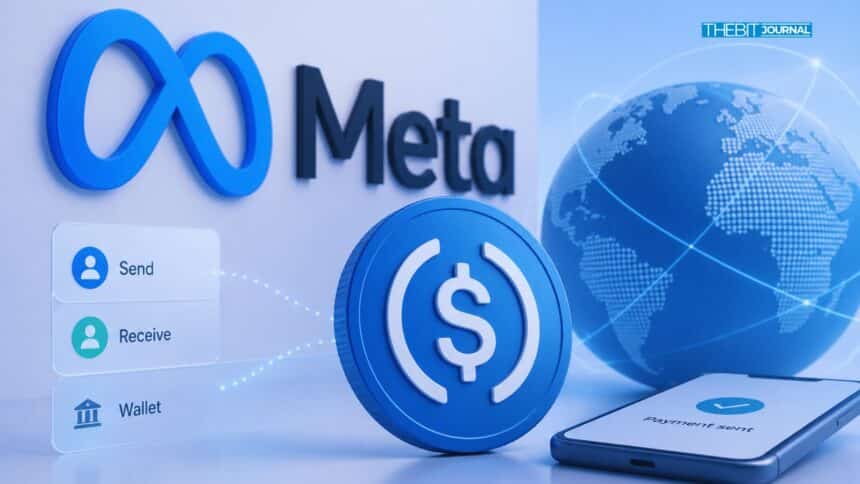

This article was first published on The Bit Journal. Meta Platforms is cautiously returning to the digital asset space but this time through a more strategic and collaborative approach. The company has unveiled a program that allows creators on its platforms to receive payouts in stablecoins, several years after it abandoned plans to develop its own cryptocurrency. This underscores the importance of Meta USDC payouts in the creator economy.
The company has provided details that Meta is partnering with Stripe to provide payments in USD Coin (USDC), a USD-backed stablecoin from Circle. The program will first serve creators in Colombia and the Philippines, but could expand to other locations based on regulatory approval and initial success. As the trial runs, Meta USDC payments may become a valuable tool for creators worldwide.
Meta USDC Payouts Use Blockchain Networks
In the new process, creators will be paid in USDC using blockchain networks like Solana and Polygon. While this allows for near real-time settlement and reduced costs, Meta does not include conversion services. The company will leave it up to the user to convert the income to their local currency with a third-party exchange.
This strategy enables Meta to benefit from the speed and cost-effectiveness of blockchain payments with fast settlement and low fees, while avoiding the regulatory challenges of creating its own digital currency. Meta’s USDC payouts exemplify this approach of innovation and regulation.
Stablecoins Enable Faster Global Payments
Stablecoins such as USDC have a 1:1 ratio with the U.S. dollar and are pegged with reserves, which makes them an effective method to send money across borders. This may resolve the long-standing problems of delayed payouts and high remittance rates to creators in developing markets, which are a part of conventional banking systems.
By incorporating Meta USDC payouts, the company is providing a faster option, especially in markets where financial systems might be less stable or expensive.
Nothing has changed; there is still no Meta stablecoin. This is about enabling people and businesses to make payments on our platforms using their preferred method. https://t.co/h2fNKofAmr pic.twitter.com/O8CFDsc2wy
— Andy Stone (@andymstone) February 24, 2026
Meta Focuses on Existing Payment Systems
Although Meta has returned to the cryptocurrency world, it has explicitly stated it will not pursue its own cryptocurrency. The company’s earlier attempt Libra (Diem) was officially shelved in 2022 after facing intense scrutiny from regulators and central banks worldwide. At the time, concerns revolved around financial stability, privacy and the potential for a global currency to be controlled by a tech company.
In a recent statement, a Meta spokesperson reiterated the company’s current focus on “leveraging existing payment systems” rather than developing a new token, emphasising the need for partnerships in the case of Meta USDC payouts.
Circle Introduces Nanopayments Across Blockchains
The launch of the system comes at a time when Circle has added a “nanopayments” capability to its platform. This allows for transactions as small as $0.000001 across various blockchain networks, such as Ethereum, Arbitrum, Optimism, Avalanche and others.

This technology allows users to batch transactions off-chain and settle them on-chain, reducing the cost of transactions, enabling new use cases such as pay-per-use, API calls, and automated payments between AI systems further improving the economy of Meta USDC payouts.
Meta’s announcement is a trend towards leveraging existing blockchain technologies rather than developing new cryptocurrencies. As the trials roll out, regulators and experts will watch. A successful launch may see Meta’s USDC payments as a use case for wider blockchain payments.
Conclusion
The Meta launch highlights a measured but targeted return to digital assets, through partnerships instead of tokens. Regulators and industry will monitor adoption and scalability during trials. If adopted, Meta USDC payouts may offer a model for blockchain creator payments to go worldwide.
Follow us on Twitter and LinkedIn, and join our Telegram channel to be instantly informed about breaking news!
Summary
- Meta launches USDC payouts pilot for creators via Stripe in select countries.
- Blockchain enables fast, low-cost Meta USDC payouts without Meta issuing its own crypto.
- Circle’s nanopayments boost microtransactions as Meta USDC payouts face global regulatory review.
Glossary of Key Terms
Meta USDC Payouts
Meta’s system for paying creators in USDC via blockchain.
Stablecoin
Crypto pegged to a stable asset like the U.S. dollar.
USDC (USD Coin)
Dollar-backed stablecoin issued by Circle.
Stripe
Payment processor partnering with Meta for payouts.
Circle
Company that issues USDC and blockchain tools.
Blockchain Networks
Decentralized systems for recording digital transactions.
Solana
Fast, low-cost blockchain network.
Polygon
Ethereum scaling network for cheaper transactions.
Cross-Border Payments
Payments sent between different countries.
Libra (Diem)
Meta’s discontinued cryptocurrency project.
Nanopayments
Ultra-small blockchain transactions.
Frequently Asked Questions about Meta USDC payouts
1. What are Meta USDC payouts?
A system where Meta pays creators in USDC stablecoins via blockchain.
2. Which countries are included?
The pilot starts in Colombia and the Philippines, with possible expansion.
3. Which blockchains are used?
Payments run on Solana and Polygon networks.
4. Does Meta support conversion to cash?
No, users must use third-party exchanges to convert USDC.
References
Disclaimer
The article is purely informational and it is not a financial, investment, or a trading advice. Cryptocurrencies are extremely risky and volatile. Before investing, the readers are to conduct personal research and seek the advice of a qualified financial expert.