





This article was first published on The Bit Journal.
An order book is a real-time, electronic ledger of all buy (bid) and sell (ask) orders for a specific asset. In order book trading, every pending order is stacked by price and time, creating a public view of supply and demand.
An order book shows both the price buyers and sellers are willing to pay, as well as how many discrete units they seek to buy or sell at each price.
Almost every modern exchange for stocks, bonds, currencies or cryptocurrencies uses an order book trading system. Because exchanges match buyers and sellers continuously, the order book is the mechanism that automatically turns many individual trading intentions into one coherent market price.
Every trade waiting to happen sits here, stacked by price, making the order book the heart of how [crypto] trading works.
How Order Book Trading Works
In an order book, every limit order is either a bid (buy) or an ask (sell) at a specified price. The best bid (highest buy price) and best ask (lowest sell price) form the top of the book, and their gap is the bid-ask spread. That spread is the immediate cost of crossing the market. A buyer who wants an instant fill pays the ask, and a seller takes the bid.
As an instance, if the best bid is $99.90 and the best ask is $100.10, the spread is $0.20 (meaning a buyer would pay $100.10 to sell immediately, or a seller would accept $99.90 to buy now).
Order-matching follows strict rules. Better prices have priority, the highest bids fill first, and the lowest asks fill first. If two orders at the same price compete, most exchanges use time priority. Earlier orders execute before newer ones.
For instance, Nasdaq’s rules explicitly state that trades occur “at the best available price and, among resting orders at the same price, are allocated by price then time priority”. Thus an order book is not merely a price list, but a ranked queue of willing buyers and sellers.
When a new order arrives, it is matched against the opposite side of the book. A market order consumes liquidity by immediately trading against the best available quotes. For example, a market buy for 1.5 BTC will first take the entire 1 BTC sitting at the lowest ask, then “walk” up the book to fill the remaining 0.5 BTC at higher prices.
However, a limit order that cannot immediately match will simply join the queue at its specified price level, adding liquidity.
Order books improve transparency. Traders see at a glance how many shares (or tokens) are bid/asked at each level. They also reveal market depth. Nasdaq’s TotalView depth feed displays over 20× more liquidity than basic Level II quotes.
In short, order book trading is the standard method by which most markets operate, letting anyone be it retail or institutional, gauge supply/demand and enter or exit positions based on the visible queue of orders.
| Price (USD) | Bid Volume | Ask Volume |
| 100.20 | – | 100 |
| 100.10 | – | 250 |
| 100.00 | 50 | 150 |
| 99.90 | 300 | – |
| 99.80 | 150 | – |
| 99.70 | 80 | – |
Table 1: Example order book (market depth) showing bid (buy) and ask (sell) volumes at each price. The best bid is $99.90 for 300 units and the best ask is $100.00 for 150 units (spread $0.10). Larger orders below/above indicate further depth.
Key Components: Bids, Asks, and Liquidity
Bids are buy orders, asks (also called offers) are sell orders. They form the supply (asks) and demand (bids) at each price. The depth of the book is how much volume sits at various price levels. Shallow depth, i.e. few shares at each price means that even modest orders can move the price.
A deep order book with many bids and asks signals high liquidity. Prices won’t jump much if a trade is placed. As one source notes, markets with “tight bid-ask gaps and deep order books signal high liquidity. Conversely, wide spreads and low depth indicate illiquid conditions.
Liquidity also depends on how orders are placed. Limit orders at better prices (more aggressive orders) “make” liquidity by adding depth, while market orders “take” liquidity by removing it. This maker-taker reason is important in exchange design.
Makers set prices and get rebates; takers get immediate fills but usually pay higher fees. Passive traders post limit orders and wait, while aggressive traders cross the spread to get executed.
Many exchanges provide multiple depth levels to professional users. Level I data shows only top-of-book (best bid and ask). Level II (or “market depth”) shows several levels on each side. Having full depth helps advanced traders assess real supply/demand: a second of data can reveal whether a quoted “100 BTC” bid is one giant order or many smaller ones.
Order Book and Market Structure
Order book trading is the norm on major exchanges. Equities markets (NYSE, Nasdaq), futures (CME, Eurex), options and FX platforms all use central limit order books. Eurex explicitly states that its main market model is a central limit order book where all orders enter. Even traditional OTC products like FX have adopted central LOBs. Cboe launched a new FX central limit order book in 2020, with matching on strict price/time rules.
However, not all trading is visible. Large institutions often use dark pools or iceberg orders to hide their intentions.
Dark pools are private venues that execute big orders off the public book; this avoids shocking the visible market but means hidden volume is invisible to traders. Dark pools reduce the utility of the order book trading because the public book no longer shows true supply/demand.
An iceberg order places only a fraction of its total size in the book at any time. Exchanges may allow traders to replenish only small “tips” of large orders, camouflaging total size from others. These features help minimize price impact for large trades but reduce full transparency.
In crypto trading, centralized exchanges like Coinbase, Binance or Kraken still use classic order books. Decentralized exchanges (DEXs) offer an alternative. Many DEXs use automated market makers (AMMs) instead of order books. AMMs (such as Uniswap) rely on liquidity pools and pricing formulas, so they don’t list bids/asks at individual prices.
AMMs run on math, fed by shared money pots rather than bid-ask lists, whereas order book platforms have prices closer to reality. Crypto traders typically get tighter pricing on centralized order-book exchanges, but AMMs provide continuous trading even with few counterparties.
Hybrid on-chain order book models are now emerging, though this is still a niche as of 2026.

Advanced Analysis and Market Dynamics
Beyond basic definitions, researchers study the microstructure of order book trading. Many facts have been observed. For instance, order sizes tend to be heavy-tailed, meaning many small orders and a few very large ones, and liquidity often forms a “hump-shaped” profile.
It is also common that most limit orders are canceled rather than executed, especially in high-frequency trading environments. These patterns arise from strategic behavior: traders revise or cancel orders rapidly in fast markets.
Academics also apply AI to LOB data. A 2025 study introduced an open-source “LOBFrame” tool and applied deep learning to forecast price moves from high-frequency order book data. They found that while neural models can predict mid-price changes, high accuracy doesn’t always translate to profitable signals.
In other words, crisp statistical forecasts may not yield actionable trades because real execution involves transaction costs and slippage. This exposes a key point: the order book is a rich data source, but understanding it fully often requires complex modeling and live testing.
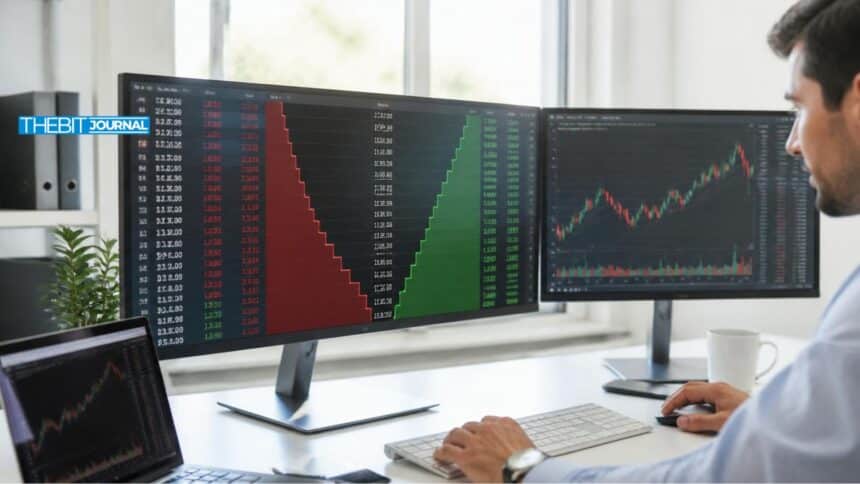
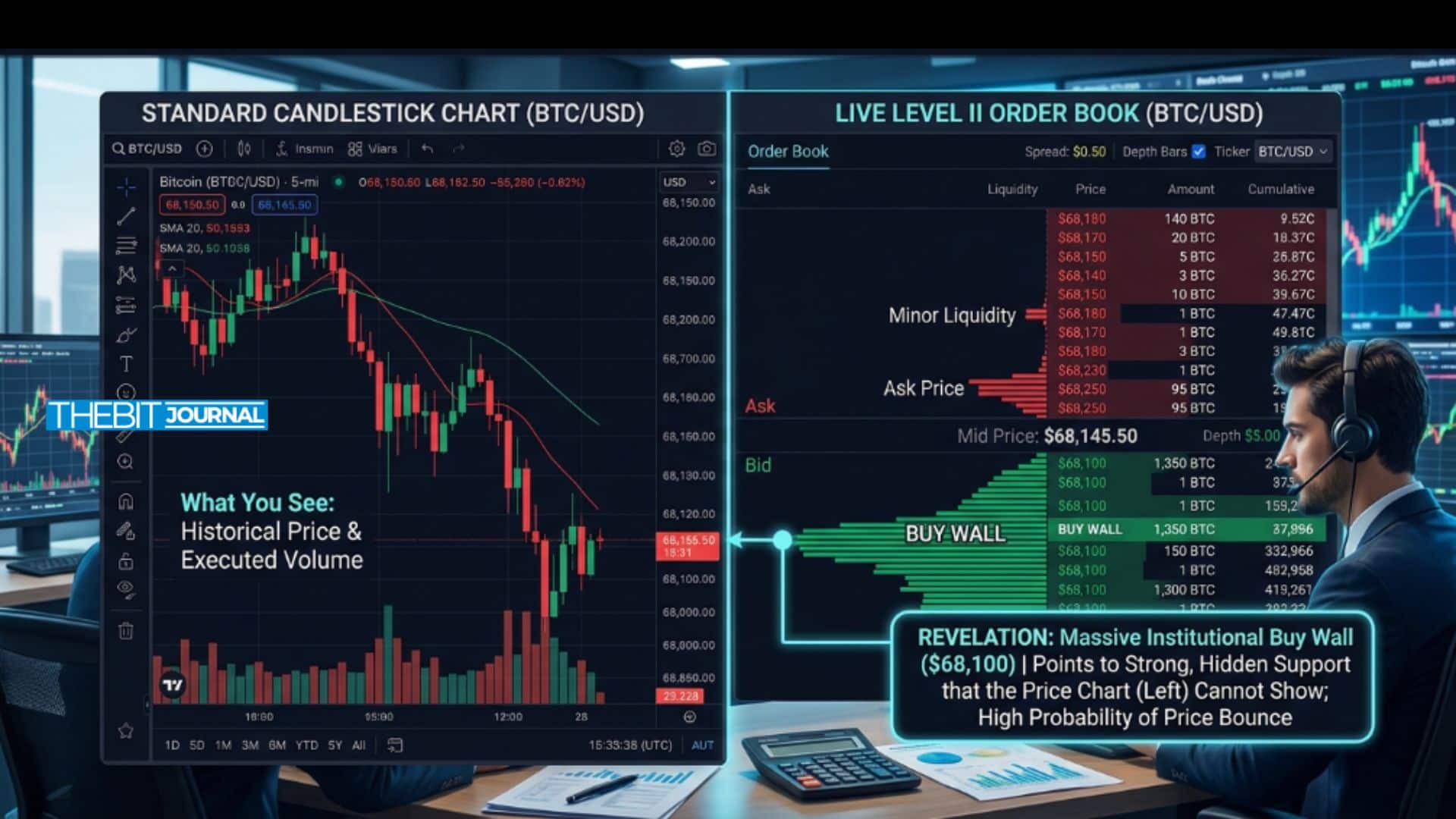
Practical trading tools have evolved too. Modern platforms display order books with visual depth charts or heatmaps, helping traders see the “walls” of bids and asks at a glance.
Price charts alongside order books show how liquidity levels change over time. Traders often monitor order flow which is the stream of trades hitting the book to infer momentum.
For example, an imbalance (more sell volume than buy volume near the top) can mean downward pressure.
Still, it is important to remember that these are clues, not certainties: major news or hidden orders can quickly flip the picture.
Best Practices and Takeaways
Order Book = Supply and Demand: The book makes market supply/demand explicit. Best bids and asks determine current price formation.
Liquidity and Spread Matter: Deep books with narrow spreads imply easy trading; shallow books mean high impact and volatility.
Priority Rules: Strict price-time priority means earlier and better-priced orders trade first.
Watch Volume Imbalances: Traders read walls of orders for support/resistance cues (e.g., heavy bids at one level can “prop” price).
Data Depth: Full order book data (Level II/III) gives the clearest picture but requires advanced data feeds.
Hidden Factors: Not all liquidity is visible. Dark pools and iceberg orders can hide real supply and demand.
Always cross-check order book signals with overall market context and risk controls. Order books update every millisecond in today’s electronic markets, so stale snapshots quickly change.
Conclusion
Order book trading remains the bedrock of modern financial markets. From stock exchanges to crypto platforms, continuously updated order books power price formation and liquidity. Current trends like AI analysis of order flow and new on-chain matching systems are coming up, but the core concept which is matching bids and asks in real time is unchanged.
Understanding the order book helps traders and institutions gauge market conditions, optimize execution, and manage risk.
However, readers should note this article is informational and not financial advice. Real-world trading involves costs (fees, slippage) and unseen factors (hidden orders, news shocks) that can override pure order book signals. Always use multiple tools and professional guidance when making trading decisions.
Glossary
Order Book: A real-time list of all standing buy (bids) and sell (asks) orders for a trading instrument. It shows prices and quantities for each side of the market.
Bid/Ask: The bid is the price buyers are willing to pay; the ask is the price sellers want.
Spread: The difference between the best ask and best bid.
Market Depth: The volume available at each price level in the order book.
Limit Order: An order to buy or sell at a specified price or better. It rests in the order book until matched or canceled.
Market Order: An order to buy or sell immediately at the best available price(s).
Liquidity: How easily an asset can be traded without moving its price.
Dark Pool: A private trading venue where orders are hidden from the public order book.
Automated Market Maker (AMM): A decentralized exchange model (common in crypto) that uses liquidity pools and formulas instead of a traditional order book to set prices.
Frequently Asked Questions About Order Book Trading
How do bids, asks, and the spread work in order book trading?
The order book lists bids (buy orders) and asks (sell orders) at each price. The highest bid and lowest ask are the top-of-book prices. Their difference is the bid-ask spread, which represents the immediate cost of trading. Buyers taking liquidity pay the ask; sellers taking liquidity receive the bid.
Why is an order book important in trading?
An order book provides transparency into market supply and demand. It helps traders see how much can be traded at each price level (market depth) and guides decisions on order placement.
What is the difference between a limit order and a market order?
A limit order adds an instruction to the order book at a specified price; it may sit unfilled if the market doesn’t reach that price. A market order executes immediately at the best available price. Limit orders provide liquidity (making orders), while market orders take liquidity (crossing the spread).
How are order books used in cryptocurrency vs stock markets?
Both asset classes use similar limit order book systems on centralized exchanges. However, many crypto platforms (especially decentralized ones) may use automated market makers (AMMs) instead, which operate without a traditional book. In centralized exchanges (e.g., Coinbase, Binance), crypto order books function just like stock order books, matching bids and asks.
Where can I see order book data?
Retail traders often see the top levels of the order book on trading platforms or Level II data feeds. Professional or institutional traders can subscribe to full-market-depth feeds (often called Level II or Level III data). APIs like those of Interactive Brokers or exchange-specific APIs allow programmatic access to live order book updates. Some data vendors also offer aggregated depth-of-book snapshots for research.
References
Financial Disclaimer: This article is for educational purposes only. Nothing here constitutes investment advice. Trading carries risk, and readers should conduct their own research or consult a professional before making trading decisions.