




The wallet conversation looks different in 2026 because crypto ownership now stretches across more chains, more devices, and far more risk points than it did a few years ago. A trader might hold Bitcoin for long-term savings, use Ethereum for DeFi, keep stablecoins ready for transfers, and still need quick access to newer ecosystems from one interface.
That convenience has improved, but so has the attack surface as Hardware devices now offer better screens, more mobile support, secure elements, and air-gapped signing, while software wallets have grown into multichain control centers with swaps, staking, bridge access, and tighter account security. Choosing the best crypto wallet 2026 is no longer about picking the flashiest brand. It is about matching the wallet to the user’s habits, risk tolerance, and the value being protected.
Hot Wallet vs Cold Wallet: Which Do You Need?
A hot wallet stays connected to the internet through a browser extension, desktop app, or mobile app. It is faster for trading, bridging, minting, staking, and daily chain interaction. A cold wallet keeps private keys offline and requires physical confirmation on the device before funds move. That simple difference changes everything.
For someone who signs frequent transactions, a hot wallet feels practical. For someone storing large balances, a cold wallet reduces exposure because malware, fake pop-ups, and phishing pages cannot directly reach the private key. In plain terms, the best crypto wallet 2026 for active use is often a software wallet paired with a hardware signer, while the best one for long-term storage is usually a dedicated hardware wallet.

Best Crypto Wallet 2026: Hardware Wallets That Still Set the Standard
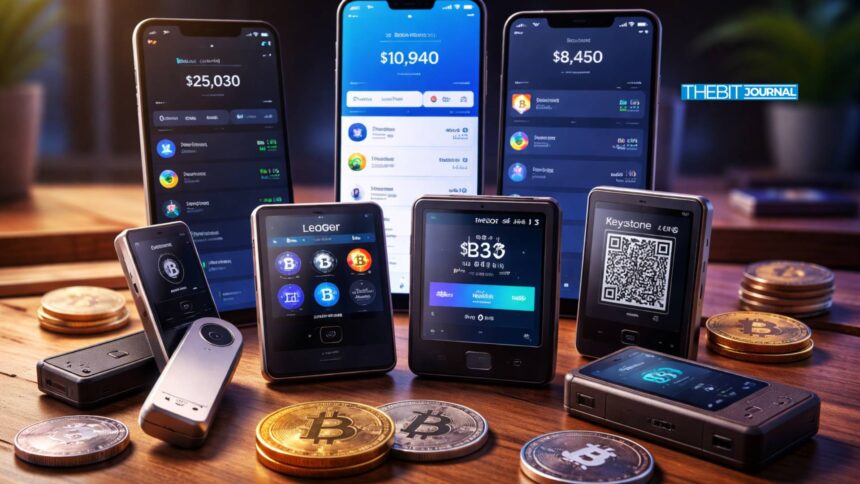
Hardware wallets remain the strongest choice when the goal is self-custody with lower online exposure. Ledger continues to cover a wide range of price points, with its lineup spanning roughly $50 to $400 and newer touch-based devices such as Flex and Stax aimed at users who want a smoother signing experience across many assets. Trezor stays strong with open-source positioning and newer models such as Safe 3 and Safe 5, with the Safe 5 listed at $169 and the company emphasizing on-device confirmation and transparent code.
Keystone 3 Pro stands out for air-gapped QR signing, three security chips, and a listed price of $149, which makes it especially attractive for people who do not want USB or Bluetooth data paths. Tangem appeals to users who prefer card-based convenience and minimal setup friction, while SafePal remains the budget-minded option for people who want offline signing without spending premium money.
Ledger makes sense for users who want broad ecosystem support and a polished companion app. Trezor fits buyers who care deeply about open-source transparency and trusted display verification. Keystone is arguably the most security-focused choice for people who want air-gapped operation and QR flows.
Tangem works well for mainstream holders who value speed and portability more than advanced desktop controls. SafePal remains a solid entry-level option for smaller holdings or secondary wallets. In that sense, the best crypto wallet 2026 on the hardware side depends less on branding and more on whether the user values air-gapping, open-source design, touchscreen usability, or a lower entry price.
Top 5 Software Wallets: MetaMask, Trust Wallet, Exodus Compared
Software wallets are still the front door to Web3, and in 2026 they are far more capable than simple token holders.
MetaMask now supports default networks far beyond Ethereum, including Bitcoin, Solana, Tron, Polygon, Base, Arbitrum, Avalanche, and others, while its multichain model aims to reduce the old habit of juggling separate wallets for each ecosystem.
Trust Wallet remains attractive for mobile-first users because it supports broad chain coverage, cross-chain swaps, app lock, and recovery options, though it still requires careful backup discipline. Exodus keeps its strength in usability and pairs that polished interface with hardware support on desktop and mobile.
Rabby has become a favorite for EVM-heavy users who want open-source transparency and stronger transaction review habits. Phantom, once seen mostly through a Solana lens, is now fully multichain across networks such as Solana, Ethereum, Base, Polygon, Bitcoin, Sui, Monad, and HyperEVM.
For daily use, MetaMask remains strong for DeFi and browser-based app access. Trust Wallet is better for users who want broad mobile coverage and simpler onboarding. Exodus is the easiest on the eyes and one of the smoothest for newcomers. Rabby is excellent for power users who spend most of their time in EVM-based apps and want more transparency around what they are signing.
Phantom is now one of the cleanest options for users who move across Solana, Bitcoin, Ethereum, and newer chains from one place. That is why the best crypto wallet 2026 on the software side is really a use-case decision: DeFi traders lean one way, beginners another, and multichain mobile users often choose differently again.
How to Set Up a Hardware Wallet Step by Step
A proper setup is less complicated than many beginners fear, but it has to be done carefully. First, the user should inspect the box, connect the device, and follow the official initialization flow. Then the wallet generates a new recovery phrase on the device itself. That phrase must be written down offline in the exact order shown.
After that, the user sets a PIN or passcode, installs firmware if required, adds the assets needed, and confirms the first receiving address on the device screen before transferring funds. The big rule is simple: the device should generate a brand-new seed during setup. Importing an old hot-wallet seed into a hardware wallet defeats much of the security benefit. Anyone looking for the best crypto wallet 2026 should understand that setup discipline matters almost as much as the device choice itself.
Seed Phrase Security: Where and How to Store It
Most wallet losses do not begin with advanced hacking as they begin with sloppy backup habits. Official wallet guidance remains consistent on this point: recovery phrases should not be stored in screenshots, email drafts, cloud drives, chat apps, or random notes on a phone. They should be written offline, checked for accuracy, and kept somewhere only the owner can reliably access.
For larger holdings, a metal backup solution makes more sense than plain paper because it handles fire, water, and long-term wear better. A seed phrase is the master key. If someone sees it, the funds are exposed. If the owner loses it and the device fails, the funds may be gone for good. That is why seed storage is not a side issue in the best crypto wallet 2026 discussion. It is the core of the entire security model.
Multi-Sig Wallets: When You Need Extra Protection
Multisig wallets require more than one approval before a transaction can go through. A common setup is 2-of-3 or 3-of-5, which means a threshold of signers must approve movement of funds. That makes multisig especially useful for treasuries, funds, family offices, business partnerships, and anyone storing a large amount that should not depend on one device or one person.
It also helps spread risk across geography and hardware. In practice, the best crypto wallet 2026 for an individual with a modest portfolio may not need multisig at all, but for shared custody, long-term reserves, or corporate operations, multisig is one of the cleanest ways to reduce single-point failure.
Common Wallet Mistakes That Get People Hacked
The pattern behind many wallet losses is painfully familiar as people approve transactions without reading them. They type a recovery phrase into fake pop-ups. They reuse an old seed on multiple apps. They keep all funds in one hot wallet. They trust copied addresses without checking the full string. They chase airdrops from random messages and sign permissions they do not understand.
Wallet makers now warn heavily about phishing, address poisoning, fake support agents, and malicious transaction requests because the human weak point, not the cryptography, is usually what breaks first. Anyone serious about finding the best crypto wallet 2026 should worry less about marketing language and more about avoiding these everyday mistakes.
Verdict: Best Wallet by Use Case and Budget
For long-term holders with meaningful balances, a hardware wallet is the better answer. For active traders and DeFi users, a software wallet remains necessary, but it should ideally connect to hardware for transaction signing. For beginners, Exodus, Trust Wallet, and Phantom offer smoother learning curves. For EVM-native users, MetaMask and Rabby remain especially relevant.
For security-first buyers, Trezor and Keystone deserve serious attention, while Ledger still offers one of the broadest overall ecosystems. For lower budgets, SafePal remains a reasonable entry point. Put simply, the best crypto wallet 2026 is the one that matches the way funds are actually used, not the one with the loudest reputation. A $149 device can be smarter than a premium one if it fits the owner’s habits, and a free hot wallet can still be dangerous if used carelessly.
Conclusion
There is no perfect wallet, only the right fit between convenience and control. In 2026, the safest path for most serious holders is a layered setup: a hardware wallet for core savings, a software wallet for daily use, separate accounts for risky interactions, and airtight recovery phrase storage. That approach is less glamorous, but it works. The best crypto wallet 2026 is not built on hype. It is built on habits, verification, and the simple discipline of keeping private keys out of harm’s way.
FAQs
What is the best crypto wallet 2026 for beginners?
For beginners, the best crypto wallet 2026 is usually one with a simple interface, easy backup flow, and clear transaction screens. Exodus, Trust Wallet, and Phantom are strong choices for that reason, while a beginner with larger holdings may be better off pairing a simple software wallet with a hardware device.
Is a hardware wallet safer than a software wallet?
Yes, in most storage scenarios it is. Hardware wallets keep private keys offline and require physical confirmation on the device, which reduces exposure to malware and phishing-led key theft. Still, bad backups and careless signing can undermine that advantage. For many users, the best crypto wallet 2026 setup is both, with each doing a different job.
Does a free wallet mean lower security?
Not necessarily. Most software wallets are free to install, but security depends on the user’s device hygiene, backup discipline, and ability to recognize risky transactions. The wallet may cost $0, but a single bad approval can still be expensive.
Glossary of Key Terms
Seed phrase
A seed phrase, also called a recovery phrase or wallet backup, is the word sequence that restores access to a wallet if the device is lost or replaced. Anyone with it can control the funds.
Hot wallet
A hot wallet is a wallet connected to the internet through mobile, desktop, or browser software. It is convenient for frequent use but carries more online exposure.
Cold wallet
A cold wallet stores private keys offline and signs transactions through a dedicated device, lowering direct online attack risk.
Multi-sig
Multisig means a wallet requires multiple approvals to move funds, often in setups like 2-of-3 or 3-of-5. It is common for treasuries, teams, and high-value shared custody.
Self-custody
Self-custody means the user, not an exchange or outside company, controls the private keys and therefore the assets.
Sources
Disclaimer:
This article is for educational and informational purposes only and should not be treated as financial, legal, cybersecurity, or investment advice.