

Quantum resistant cryptography has become one of the most discussed topics in blockchain security over the past few years. The development of quantum computing research has reached a point where experts can now assess present-day cryptographic systems for their protection. Cryptography serves as the fundamental protection mechanism that enables blockchain networks to safeguard their assets while authenticating transactions and building user confidence. Digital finance systems, together with decentralized networks, face critical dangers from any innovation that compromises these cryptographic systems.
The scientific community, together with technology corporations and government agencies, has entered into a public dialogue about both the timetable and the hazards that quantum computing technology presents. Organizations such as the National Institute of Standards and Technology and IBM, and Google have published reports that demonstrate that organizations require preparation to start before they can access quantum computers that operate at massive scales. Blockchain protocols participate in global discussions because their security system depends on public key cryptography.
The article presents quantum-resistant cryptography using accessible language while examining how current blockchain systems address the hazards that quantum computing poses. The study shows actual data of research results and business activities that occur in the present time while avoiding predictions and untrue statements.
What Is Quantum Resistant Cryptography?
Quantum resistant cryptography refers to cryptographic methods that are designed to remain secure even when powerful quantum computers become available. Current cryptographic systems, which people use today, depend on mathematical challenges that classical computers fail to solve with their current capabilities. The two main mathematical challenges include the process of factoring large numbers and the task of solving elliptic curve equations. The security of these systems would require classical computers to spend thousands or millions of years to break the system, whereas quantum computers can solve the systems at much higher speeds.
The concern exists because Shor’s algorithm demonstrates that any quantum computer with sufficient power can break two common encryption methods, which include RSA and elliptic curve cryptography. These methods currently serve as protection for online data, which financial institutions use and which all major blockchain systems depend on. Quantum-resistant cryptography attempts to replace existing systems with new algorithms that quantum computers cannot break through their developed security measures.
Quantum resistant methods use mathematical problems that quantum machines still find difficult to solve as their foundation. The solutions to these problems require the understanding of lattice structures, which are complex, and hash-based constructions, and multivariate equations. The research focuses on problems that current quantum systems cannot solve because there are no better solutions available.
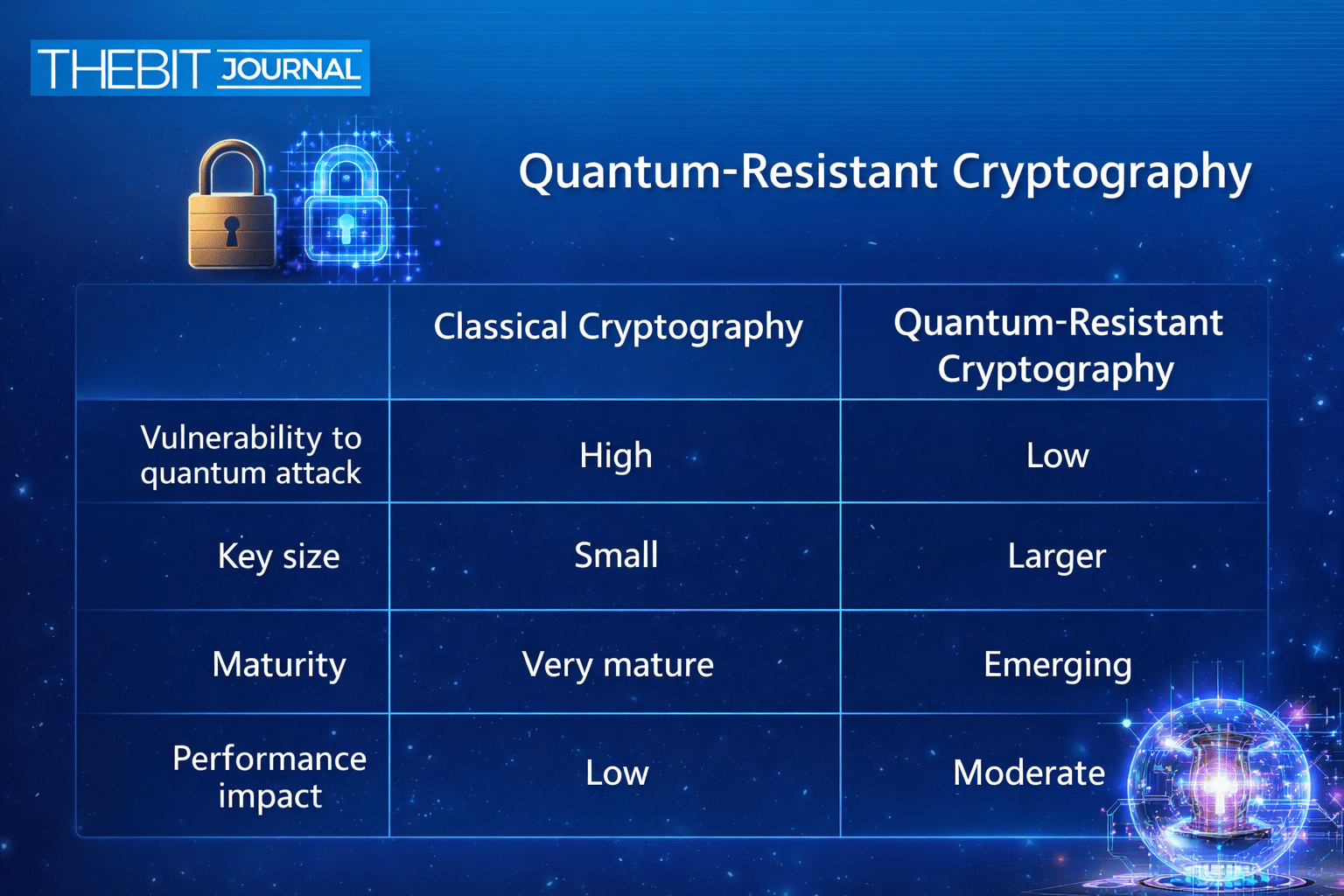
Classical vs Quantum Resistant Cryptography
| Feature | Classical Cryptography | Quantum Resistant Cryptography |
| Vulnerability to quantum attacks | High | Low |
| Key size | Small | Larger |
| Maturity | Very mature | Emerging |
| Performance impact | Low | Moderate |
Why Traditional Cryptography Is Vulnerable to Quantum Computers
Traditional cryptography was designed in a world where quantum computing did not exist beyond theory. Systems like RSA and ECDSA rely on assumptions about computational difficulty that hold true for classical machines, but these assumptions begin to fail when quantum algorithms enter the picture.
Research papers and government assessments have consistently shown that once a large-scale fault-tolerant quantum computer is built, existing public key systems could be broken in hours or days instead of centuries. The statement indicates that blockchain networks today operate in a secure state, yet their security requirements need to be evaluated for future threats.
Another concern is the concept often referred to as harvest now, decrypt later. Encrypted data can be captured today and stored until quantum computers become powerful enough to decrypt it. The permanent value storage requirements of blockchains create an unmanageable threat that must be addressed by their systems.
Why Blockchain Security Depends on Cryptography
The foundation of blockchain technology relies entirely on cryptographic methods. All transaction processes and wallet addresses, and consensus protocols need cryptographic elements to function correctly. The system experiences complete disruption when attackers succeed in breaching these fundamental security elements.
Public key cryptography functions as the method to establish fund ownership while enabling transaction approvals. Hash functions serve the purpose of connecting blocks while ensuring data security. Digital signatures establish permanent transaction records that remain unchanged after confirmation. A blockchain network needs all its elements to maintain security in order to function correctly.
The decentralized nature of blockchains prevents any central authority from reversing the damage which occurs when cryptographic systems fail. This makes proactive security planning even more important. Security breaches in the system cannot be reversed through a single switch like traditional systems.
How Public and Private Keys Protect Blockchain Networks
Private keys in blockchain systems serve as the mechanism for asset ownership control because these keys have a mathematical connection to public keys, which users can access through the network. The private key generates a signature for the transaction, which the network uses to validate the signature through its public key.
A quantum computer possesses the ability to create a public key, which it can use to generate a private key that enables it to perform financial transactions by pretending to be legitimate users. The system requires only the establishment of a new cryptographic framework, which will succeed in maintaining wallet security while it continues to protect the blockchain infrastructure.
The threat extends to all individuals who use the system as well as to exchanges, custodians, and decentralized applications which handle substantial financial assets. Blockchain developers focus their efforts on developing solutions that resist quantum attacks because these attacks have the potential to cause widespread damage.
What Happens to Blockchain If Cryptography Fails
The failure of cryptographic protections would result in major trust problems for blockchain networks. The system would allow unauthorized transactions to occur, while people would doubt the authenticity of past signatures and their trust in unchangeable records would start to decline.
The process of switching an entire network to different cryptographic standards presents great difficulties, but emergency upgrades can still be implemented. The system requires updates to millions of wallets and smart contracts. Experts believe that organizations should begin their preparations because quantum computers will soon create direct threats to security.
Estimated Quantum Threat Timelines
| Source | Estimated Timeline |
| Academic studies | 10 to 20 years |
| Government assessments | 10 to 15 years |
| Industry forecasts | 15 to 25 years |
How Close Are Quantum Computers to Breaking Blockchain Encryption
Researchers have made major advancements in quantum computing during recent years, but essential challenges remain unsolved. The existing machines function with restricted qubit capacities, and they experience substantial operational faults. Today, they lack the capacity to conduct extensive cryptographic assaults because of their existing constraints.
Current State of Quantum Computing in 2025 and 2026
As of 2025 and 2026, quantum processors typically operate with hundreds of qubits under controlled conditions. The system faces a primary obstacle because high fault rates continue to exist while its real-world use remains restricted to research activities and particular scientific simulations.
Public demonstrations have shown progress, but these systems are not capable of running Shor’s algorithm at the scale needed to break modern encryption. Experts generally agree that significant breakthroughs in error correction and scalability are still required.
What Is Post Quantum Cryptography and How It Works
Post-quantum cryptography establishes cryptographic algorithms that protect against both traditional and quantum computer-based attacks. The algorithms use mathematical problems that are considered difficult to solve, even when quantum computing power is available. Post-quantum cryptography operates on standard computer systems while quantum cryptography depends on quantum physics principles. This technology can be implemented across all current systems, which include blockchain technology.
Post-quantum algorithms require users to make compromise decisions according to their specific needs. The solutions need larger secret keys and create larger digital signatures while requiring increased processing power. The blockchain systems require operators to control their operational efficiency through their management of tradeoff decisions.
Key Takeaways
Quantum resistant cryptography addresses a real and widely acknowledged future risk. While quantum computers are not yet capable of breaking blockchain encryption, preparation is already underway across industries.
Blockchain protocols depend deeply on cryptography, which creates vulnerabilities to future computing advancements. The research conducted by international research organizations and standard development organizations establishes a framework for adaptation.
The process of modern blockchain development requires developers to implement quantum resistance measures for their long term security strategies. The challenge requires organizations to find an optimal solution that maintains system performance while enabling compatibility with present and future needs. The effectiveness of balance management will determine how blockchain networks maintain their operational capabilities throughout the next twenty years.
Frequently Asked Questions
What is quantum resistant cryptography in blockchain
Quantum resistant cryptography refers to cryptographic methods that maintain their security through the development of advanced quantum computing technologies. The methods develop protective mechanisms through blockchain systems, which safeguard their wallets and transactions and their network security against future quantum attacks that will invalidate current encryption methods.
Are blockchains currently vulnerable to quantum computers
Current blockchain networks remain safe from the quantum computing capabilities that exist today. The current quantum machines available for use today lack sufficient power to achieve the required stability, which would enable them to break modern cryptographic systems. The concern requires long term solutions, which bring about preparation work that begins at the present time.
Why does quantum computing pose a risk to blockchain security
Quantum computing introduces algorithms that enable computers to solve particular mathematical problems at a speed which exceeds the capabilities of traditional computer systems. These problems provide security for multiple blockchain systems. The system will face a security breach if those particular problems transition into an easily solvable state because this will lead to the discovery of private keys which will enable unauthorized transactions.
What is post quantum cryptography
Post quantum cryptography includes cryptographic algorithms designed to resist both classical and quantum attacks. These algorithms run on normal computers and do not require quantum hardware. They are being standardized globally to prepare for future threats.
Summary
The blockchain industry has started to treat quantum resistant cryptography as a planning issue after it existed only as an academic topic. The research progress in quantum computing has created permanent security problems for blockchain networks because they use traditional cryptographic methods to secure their systems. Experts agree that organizations need to start building defense systems against quantum threats because current quantum computers do not possess the capability to hack blockchain encryption. Public key cryptography serves as the fundamental security mechanism that enables blockchain protocols to authenticate transactions and establish wallet ownership, and build network trust.
The digital world will experience extensive damage if quantum computers succeed in breaching these systems because they protect all digital assets and decentralized finance operations, and permanent data authenticity. The danger has compelled government organizations and standards organizations, and technology companies to expedite their development of post-quantum cryptography solutions. Modern blockchain systems develop through research activities and testing activities, and their planning processes, instead of choosing to implement immediate system updates.
The research investigates hybrid cryptographic systems along with quantum-resistant wallet designs and backward-compatible protocol experiments. The network security efforts maintain operational performance while ensuring user accessibility through their security controls. Quantum-resistant cryptography protects blockchain systems from immediate threats yet remains essential for the future security of systems that will operate across multiple decades. The development of post-quantum standards and regulatory frameworks will establish quantum-safe security as a standard requirement that organizations must satisfy.
Blockchain networks that conduct early preparations will face fewer interruptions, and their customers will develop greater trust during the transitional period.