






Ripple CASP license approval has strengthened the company’s position in Europe’s regulated crypto market. Luxembourg’s Commission de Surveillance du Secteur Financier granted the authorization under the Markets in Crypto-Assets framework.
The approval arrived after Luxembourg’s MiCAR transition period ended on July 1, 2026. Firms without full authorization now face limits on serving customers across the European Economic Area.
Ripple CASP License Supports Wider EEA Operations
Ripple entered the post-transition period with full approval. Many rivals are still completing applications. The company now holds both a crypto-asset service provider authorization and an electronic money institution license.
The Ripple CASP license supports regulated crypto services. The EMI license supports payment and electronic money activities.
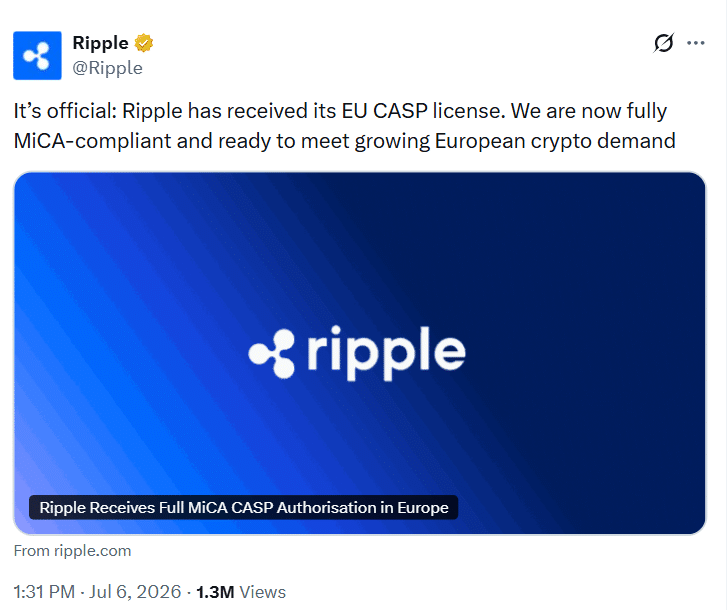
Together, these permissions give Ripple a wider legal base across the EEA.MiCA created a shared crypto rulebook for the European Union. It replaced many separate national systems.
The framework covers governance, customer protection, capital, risk management, and supervision. Approved firms may serve several European markets through passporting rights.
Ripple said its licensing structure supports regulated crypto payments across all 30 EEA countries. The company plans to serve banks, corporations, and payment firms.
Why the Approval Matters
The Ripple CASP license gives Ripple a clearer route to expand in Europe. Large institutions often avoid providers with unclear legal status.
They want licensed partners, strong controls, and accountable management. Ripple can now show that it meets Luxembourg’s MiCA standards.
Europe’s Deadline Changes the Market
Luxembourg’s transition period is closed. Firms without final approval must decide how to respond. They can speed up applications, restrict services, or leave the region.
The Ripple CASP license places Ripple on the authorized side of that divide. Larger companies may gain clients. Smaller firms may struggle with compliance costs.
EMI and CASP Licenses Serve Different Roles
Ripple’s two European approvals are not duplicates.
The EMI license covers payment services and electronic money. The CASP authorization covers crypto-asset services under MiCA.
A company with only one permission may face gaps in its product range. It may not offer a complete payment and crypto service.
Smaller Firms Face Higher Costs
MiCA demands more than a basic registration. Applicants must meet capital requirements. They need clear governance and strong internal controls. Senior managers also face direct responsibility.
These standards require money, skilled staff, and ongoing reporting. Large companies can absorb those costs more easily.
Smaller exchanges, custodians, and payment firms may find the process harder. Some may merge. Others may leave Europe.
Ripple Expands Its License Portfolio
Ripple says it holds more than 75 licenses and registrations worldwide. The Ripple CASP license adds another approval. It also strengthens the company’s European strategy.
Cassie Craddock, Ripple’s managing director for the UK and Europe, said the company is ready to scale. She said institutions want regulated digital-asset partners. Ripple believes its licensing base can meet that demand.

What It Means for Europe
Europe’s new rules are creating a clear split between approved and unapproved firms. Authorized companies can offer services with greater legal certainty. Unapproved firms face business disruption and higher regulatory risk.
The Ripple CASP license may strengthen Ripple’s reputation with banks and corporate clients. These groups often require strong compliance before adopting digital-asset services.
Conclusion
The Ripple CASP license gives Ripple a direct path to expand across Europe. Its EMI approval adds another layer of coverage. Together, both licenses support wider payment and crypto services. Crypto firms must now secure approval, limit services, or leave the market.
Appendix: Glossary of Key Terms
CASP: A licensed provider of regulated crypto-asset services under MiCA.
MiCA: The European Union’s legal framework for crypto markets.
MiCAR: The formal regulation that introduced MiCA rules across Europe.
CSSF: Luxembourg’s financial regulator responsible for supervising licensed firms.
EMI License: Authorization to provide electronic money and payment services.
EEA: The European Economic Area, covering EU states and selected partner countries.
VASP: A business offering virtual asset services under earlier registration systems.
Passporting Rights: Permission to provide approved services across multiple EEA markets.
Frequently Asked Questions About Ripple CASP license
1- What is the Ripple CASP license?
The Ripple CASP license is Ripple’s authorization to provide approved crypto-asset services under MiCA.
2- Why does Ripple need an EMI license?
The EMI license covers payment and electronic money services. The CASP approval covers regulated crypto activities.
3- What happens to firms without approval?
They may need to stop services, complete applications, or exit European markets.
4- What does the approval mean for Ripple in Europe?
The approval gives Ripple a clearer legal path to serve banks, companies, and payment providers across the European Economic Area.
References