
This article was first published on The Bit Journal.
Ripple GTreasury acquisition sets the tone for the company’s strategy at the start of 2026. The move shows Ripple’s growing focus on enterprise financial infrastructure.
Its treasury arm has acquired Solvexia, a firm known for no-code automation tools. The deal marks Ripple’s first confirmed acquisition this year.
The transaction was confirmed on January 7. Solvexia specializes in reconciliation and regulatory reporting automation. These functions remain a challenge for global finance teams.
Ripple GTreasury Acquisition Accelerates Enterprise Automation
The Ripple GTreasury acquisition brings Solvexia’s technology into Ripple’s expanding treasury platform. The goal is to reduce inefficiencies and operational risk.
The Ripple GTreasury acquisition combines treasury management with automated compliance workflows. Many finance departments still rely on spreadsheets and manual checks. These processes take days to complete. They also increase exposure to fraud and audit failures.
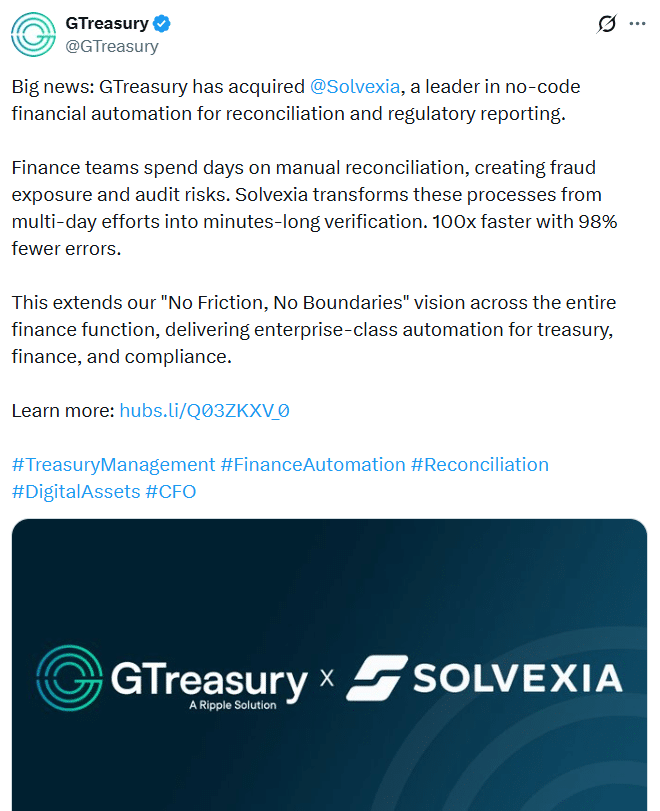
Solvexia’s tools shorten verification cycles. Tasks that once required days can now be completed in minutes. Company data suggests error rates fall sharply.
Also Read: Ripple RLUSD Stablecoin Launches Ethereum Layer-2 Pilot
Processing speed improves at scale. The Ripple GTreasury acquisition aims to standardize these gains across enterprises.
Why Reconciliation Remains A Challenge
Reconciliation sits at the center of corporate finance operations. Data flows through banks, payment systems, and internal ledgers. Manual oversight creates delays and inconsistencies. The Ripple GTreasury acquisition targets this long-standing issue.
Solvexia’s platform compares records across multiple systems. It flags mismatches automatically. This reduces human intervention. It also improves audit readiness for regulated firms.
Growing Regulatory Pressure On Enterprises
Regulatory scrutiny continues to increase across regions. Firms must meet stricter reporting and governance standards. This is especially true when digital assets are involved. The Ripple GTreasury acquisition responds to these conditions.
The combined platform supports governance and audit controls. Companies can maintain their existing systems. At the same time, they gain tools to manage digital assets responsibly. This lowers integration costs for traditional finance institutions.
Connecting Traditional Finance And Blockchain
Ripple has long focused on interoperability. The Ripple GTreasury acquisition supports that direction. It aligns treasury operations with blockchain-based settlement tools.
The platform now spans custody, liquidity, treasury, and payments. Reporting and compliance remain embedded throughout. This structure helps firms bridge traditional finance with digital assets without major disruption.
XRP And RLUSD In Settlement Workflows
Settlement assets play a central role in Ripple’s strategy. The Ripple GTreasury acquisition reinforces the use of XRP and RLUSD in enterprise environments. These assets are designed for speed and efficiency.
Ripple aims to support near real-time settlement across borders. Compliance checks occur alongside transactions. This model targets multinational firms managing complex payment flows.
Expansion Of Ripple’s Enterprise Platform
Ripple acquired GTreasury in late 2025 for one billion dollars. The Ripple GTreasury acquisition of Solvexia builds on that earlier move. GTreasury serves more than 1,000 customers. Its operations span over 160 countries.
With Solvexia added, the platform now includes reconciliation and audit controls. This expands Ripple’s reach into broader financial operations. The company continues to focus on enterprise infrastructure.
Executive Perspectives On Automation
GTreasury leadership highlighted the risks of manual processes. They pointed to fraud exposure and audit gaps. Solvexia executives noted rising regulatory pressure. Both sides emphasized the need for automation.
The Ripple GTreasury acquisition reflects shared priorities. Accuracy and transparency remain key goals. Automation is positioned as essential for modern finance teams.
Market Reaction And XRP Activity
XRP saw profit taking after a strong weekly rally. Prices declined over the past day. Trading volume also dropped. Futures open interest moved lower as well.
Analysts noted that the Ripple GTreasury acquisition targets long-term growth. It is focused on infrastructure rather than short-term market impact.
Conclusion
The Ripple GTreasury acquisition marks a strategic step in Ripple’s enterprise expansion. It strengthens automation across treasury and compliance functions.
It also deepens Ripple’s role in connecting traditional finance with blockchain-based settlement. The focus remains on scale, efficiency, and regulatory readiness.
Also Read: Mastercard, Ripple, and WebBank Team Up for On-Chain Credit Card Settlement Test
Appendix: Glossary of Key Terms
Ripple GTreasury Acquisition: The purchase of Solvexia by GTreasury, a Ripple-owned corporate treasury management firm.
Treasury Management: The oversight of an organization’s liquidity, cash flow, and financial risk.
Reconciliation Automation: Technology that matches financial records across systems with minimal manual effort.
Regulatory Reporting: The process of preparing financial disclosures to meet legal and compliance standards.
No-Code Automation: Software that enables workflow creation without traditional programming skills.
Enterprise Blockchain Infrastructure: Systems that allow large organizations to integrate blockchain technology.
Frequently Asked Questions About Ripple GTreasury Acquisition
1- What is the Ripple GTreasury acquisition?
It refers to GTreasury, a Ripple-owned company, acquiring Solvexia to expand automation in reconciliation and regulatory reporting.
2- Why is this acquisition important?
The Ripple GTreasury acquisition reduces manual financial processes and strengthens compliance for enterprises using both traditional and digital assets.
3- How does this affect XRP and RLUSD?
The acquisition supports their use in faster, compliant corporate settlement workflows.
4- Does this impact retail crypto users?
The focus is enterprise infrastructure, but broader adoption may indirectly support ecosystem growth.
References