





This article was first published on The Bit Journal.
The U.S. Securities and Exchange Commission (SEC) has released new guidance on tokenized securities, clarifying how federal securities laws apply to digital tokens that represent traditional financial assets on blockchain networks.
This provides the long-needed regulatory certainty as financial institutions and crypto developers continue to scale tokenization efforts for stocks, bonds and other securities products.
The guidance explains that existing laws still apply to these instruments and differentiates between two main structures of tokenization: issuer-sponsored and third-party tokenization models.
All to Know About Tokenized Securities
One point that the SEC guidance makes abundantly clear is that the blockchain format does not change the application of federal securities laws. Regardless of whether an ownership record for a security is held in a distributed ledger or on a conventional database, the regulatory requirements are unchanged.
The announcement, issued by the SEC’s Division of Corporation Finance, Division of Investment Management and Division of Trading and Markets says that the technology in itself “does not affect application of the federal securities laws.”
So fundamentally, a tokenized share of stock is still considered a security in the eyes of U.S. law.
This helps companies and organizations understand that the longstanding rules for reporting, registering and disclosing apply irrespective of whether the asset is in the form of a token on a blockchain.
This clarity was absent for years, leading to confusion about whether tokenized assets needed new or different regulatory treatment from that of traditional securities.
Issuer-Sponsored Tokenization
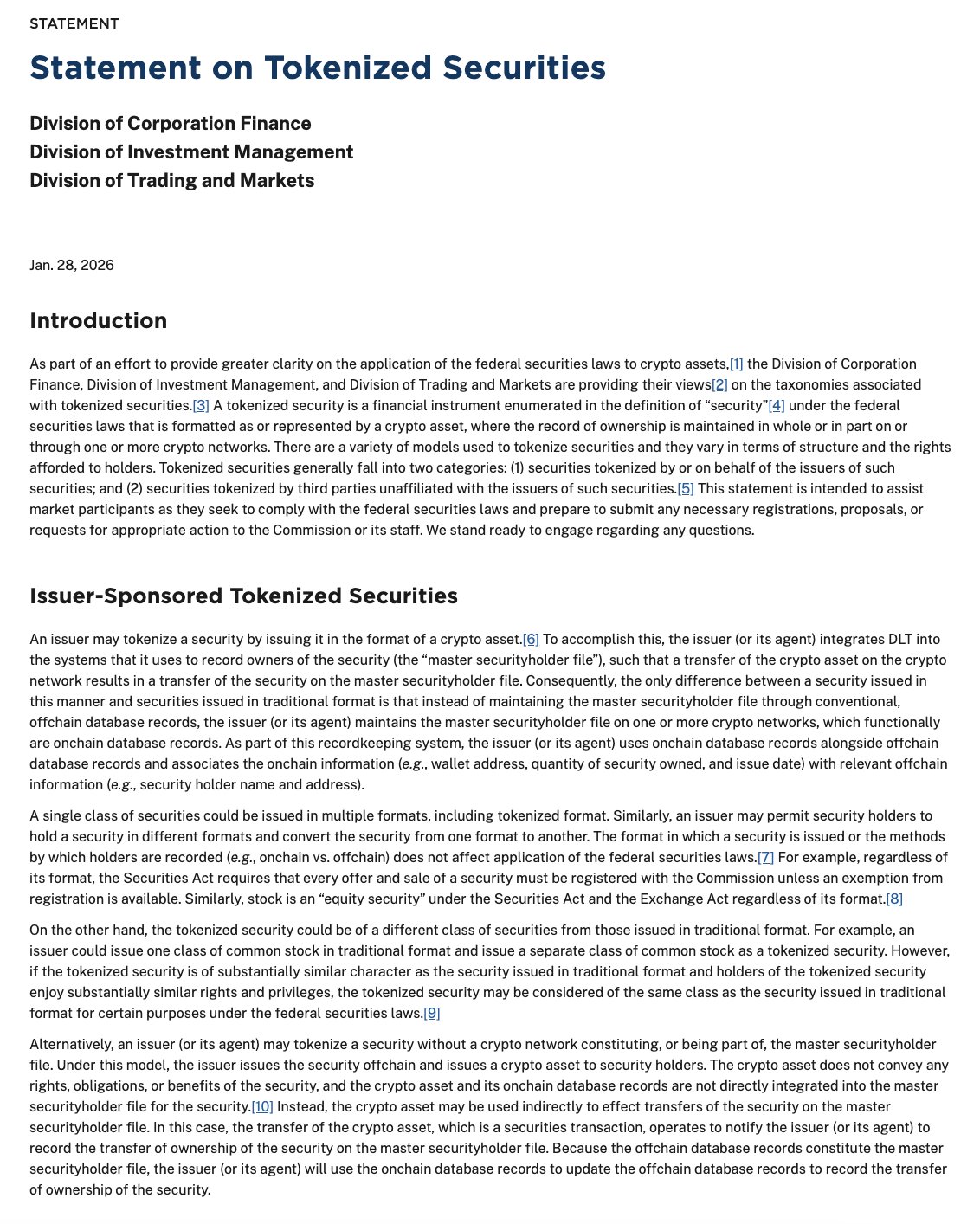
Another important part of the SEC guidance is issuer-sponsored model of tokenization. In this configuration, the issuer of the security token is directly going to be managing or issuing token.
According to the SEC, that’s what happens when the issuer (or its agent) connects distributed ledger technology DLT into its internal record keeping system so that transfers on blockchain are reflected in updates in issuer’s principal online or offline books.
The issuer-sponsored model, according to the guidance, does not alter the legal identity of a financial asset; it simply uses blockchain as an alternative record-keeping layer.
“The only difference… is that instead of maintaining the master security holder file through conventional, offchain database records, the issuer (or its agent) maintains the master security holder file on one or more crypto networks,” the SEC noted.
That is to say, the tokenized versions are still subject to Securities Act registration requirements and other securities laws that have always applied to traditional certificates.
This approach is widely considered by industry practitioners to be the most compliant route for institutional tokenization. It permits companies to use the benefits of blockchain, such as rapid settlement and shared ledgers, while existing within known legal constructs.
Third-Party Tokenization and the Need for Regulation
The SEC also considered third-party tokenization structures where a third party, not part of the original issuer would produce tokens based on existing securities. According to the guidance, these fall into two different categories: custodial tokenized securities and synthetic tokenized securities.
In the custodial model, the third party issues tokens representing ownership interests in traditional securities that are held in custody.
While the token is backed by the basic asset, a holder of such a token might still be exposed to solvency risk of the third party like bankruptcy due to increased complexities in custody relative to direct ownership.
In the synthetic model, third parties create a crypto asset that replicates economic exposure to the security but does not transfer ownership rights.
These structures may look like a derivative or linked instruments, such as security-based swaps.
The SEC clarified that, irrespective of the form, tokenized securities must comply with federal law unless expressly exempted. This includes registration, reporting, custody and investor protection responsibilities.
As the guidance makes clear, it is not possible to use blockchain as a means of working around securities law requirements merely by recording or transferring assets in a different manner.
Why This Guidance Matters Now
Now that tokenized financial instruments are taking off around the world, and other jurisdictions like South Korea have even put legal frameworks in place guiding what a tokenized security is.
It also indicates that SEC will consider tokenization as an extension of normal securities practice and not a pass from long-standing regulations.
Conclusion
The SEC’s tokenized securities guidance clarifies the compliance path for financial firms and technology entrepreneurs that want to use blockchain in recording and trading securities.
By differentiating between the issuer-sponsored and third-party tokenization models and reiterating that federal securities laws continue to apply irrespective of technology, the guidance fills an important vacuum in regulatory certainty.
This model is designed to place the U.S. in a leadership position to incorporate tokenized markets as pilot projects and institutional interest expands, meanwhile safeguarding investor protections and legal certainty, which is essential for mass market adoption of tokenized financial products.
Glossary
Issuer-sponsored tokenization: occurs when the original issuer of a security creates a blockchain token with an intrinsic direct link to its official ownership records.
Third-party tokenization: an unaffiliated entity issuing tokens representing securities, either through custodial or synthetic models.
Custodial tokenized securities: tokens backed by securities held by a custodian, where the token represents an indirect claim on those securities.
Synthetic tokenized securities: digitally facilitated instruments that offer exposure to the economics of securities, but do not carry any direct ownership rights.
Frequently Asked Questions About SEC Tokenized Securities Guidance
What is tokenized securities guidance?
It’s a regulatory directive from the SEC about how federal securities laws relate to digital tokens that represent traditional financial assets stored on a blockchain.
Does blockchain affect the way securities laws operate?
No. The SEC clarified that blockchain application does not change the security law rule.
Which are the main tokenization models?
The two primary models are issuer-sponsored tokenization – where the issuer uses blockchain to support ownership, or third-party tokenization, which can be either custodial or synthetic.
Do tokenized securities still require registration?
Yes, unless a valid exemption is available, tokenized securities must satisfy full registration and compliance obligations of the non-tokenized securities.
References