




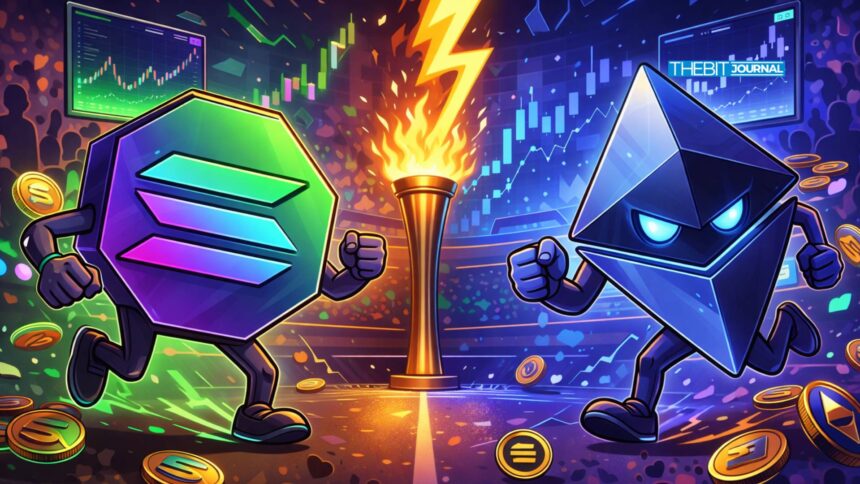

The Solana vs Ethereum argument has changed quite a bit in 2026 due to enormous differences in on-chain activity. Recent Q1 data indicates Solana processed 25.3 billion transactions, compared to Ethereum’s entire quarter at just 200 million.
That gap of more than 125x higher Solana activity reveals a deeper transformation in mode of utilization and scaling of blockchain networks.
Solana was designed with extremely high through and ultra-low fees in mind, this allows for much higher activity to occur without congestion. Even during volatile periods, average transaction fees stuck around $0.002, enabling users to participate without pricing pressure.
Ethereum, however, still leads in total value locked and institutional positioning (although the base-layer transactions are far lower). This is causing a contrast between value concentration (Ethereum) and usage scale (Solana). The result is a structural gap between Solana vs. Ethereum today.
Developer Migration Fuels Solana’s Momentum
More than raw transaction numbers, developer activity has emerged as the strongest signal determining the Solana vs Ethereum competition.
According to recent data, Solana added more than 4,100 new developers, which increased its ecosystem share to 23%, while Ethereum’s share decreased over the same period.
Why this shift is important can be observed in the fact that developer activity equals: More decentralized applications; More experimentation across DeFi and consumer apps; From the user end, help increase interaction and transaction flow.
Over 4,200 active monthly developers have contributed to infrastructure and application growth and developer engagement is also up by 38% year on-year.
This goes beyond short-term hype. It implies that builders are choosing environments where scalability and cost efficiency allow real-world deployment at scale.
On the other hand, Ethereum ecosystem has turned out to be spread across Layer 2 solutions which may dilute developer attention and slow down growth at the base layer.
This developer migration is turning into a big indicator of future dominance when it comes to the Solana vs Ethereum conversation.
Solana’s On-Chain Economy Grows with Stablecoin Expansion
Stablecoin activity is another major driver of the Solana vs Ethereum dynamic.
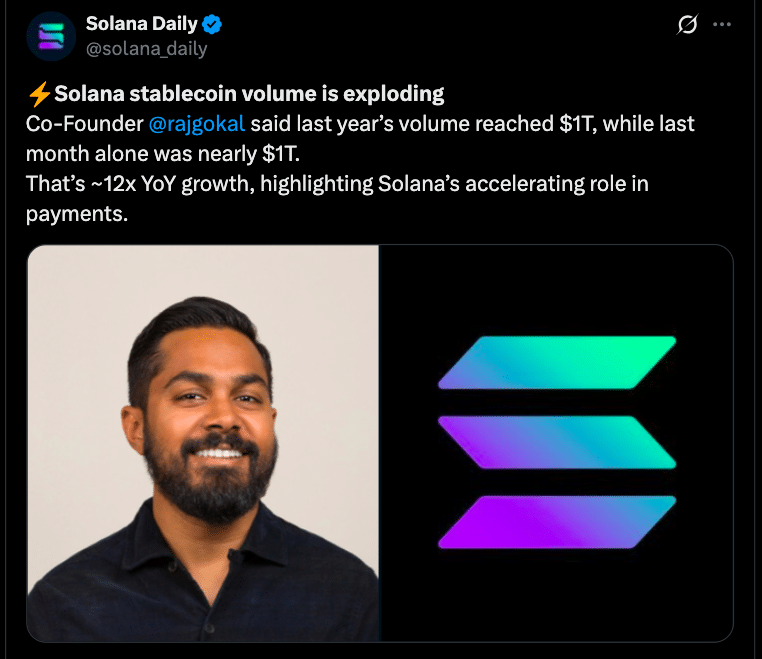
$1 trillion in stablecoin volume was recorded across the Solana ecosystem last year, with nearly the same volume processed in just one recent month, indicating roughly 12x year-on-year growth.
This surge is directly tied to Growing DeFi usage; Higher transaction throughput and Increased demand for settlement liquidity.
The financial backbone of blockchain ecosystems are stablecoins. The more applications are built, the more seamless value transfer is needed and thus, stablecoins.
In particular, with very low fees and high speed, Solana acts as a preferred option for high-frequency activity.
Meanwhile, earnings have historically had better performance on Ethereum; however, that is quickly moving towards chains without a volume-capacity friction .
Reasons Why SOL/ETH Price Still Lags Behind Fundamentals
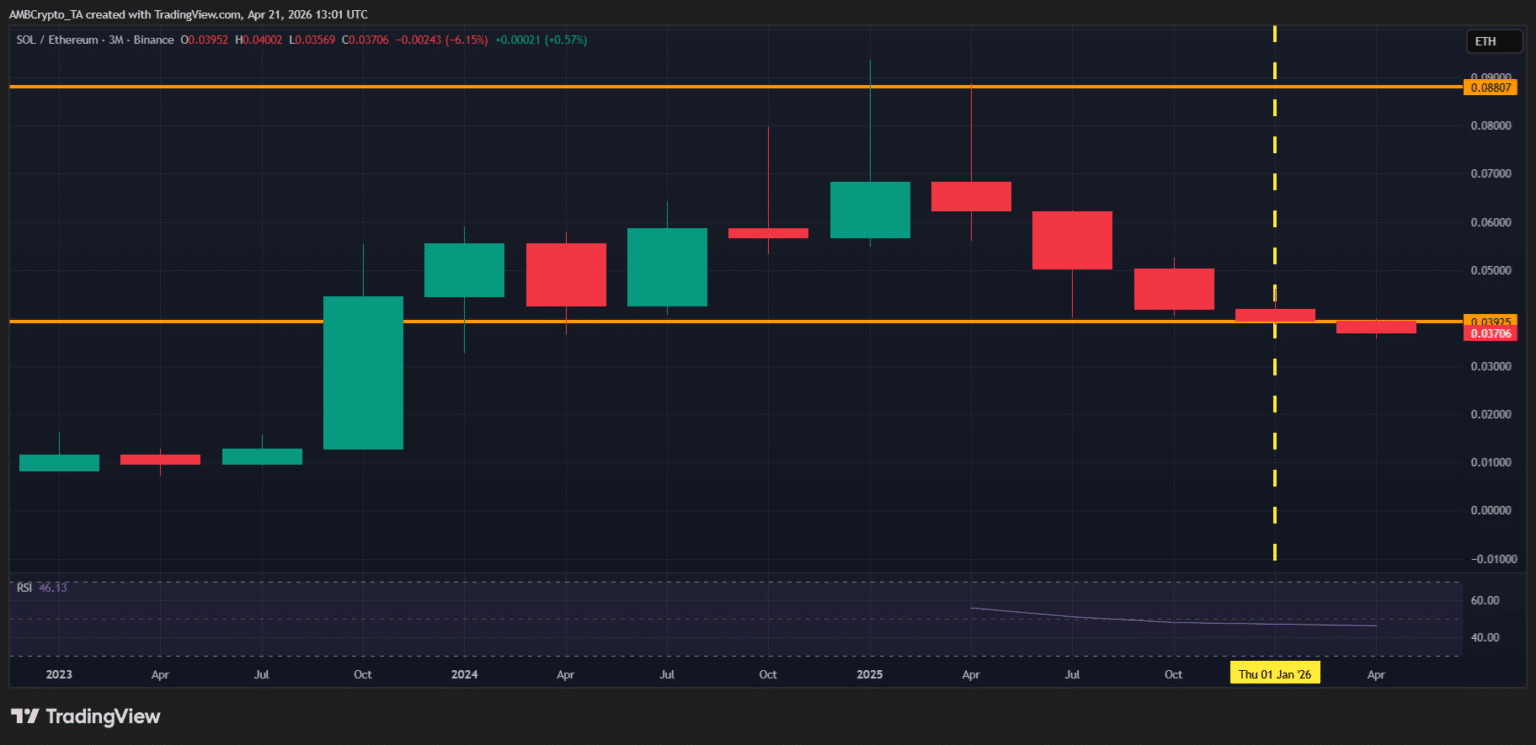
Although the fundamentals remained strong, SOL/ETH ratio recorded declines of 5.84% in Q1 suggesting that fundamentals remain disconnected from what is priced in the market. Why hasn’t price followed usage? Several factors explain this gap.
First, capital flows in crypto markets tend to lag behind on-chain data. Investors often wait for confirmation signals before reallocating funds, especially in volatile conditions.
Second, Ethereum’s place with institutions continues to anchor its pricing. Even with slower throughput, Ethereum remains deeply integrated into financial products, custody solutions, and regulatory frameworks.
Additionally, there is some debate about Solana’s transaction metrics. Some critics say part of its high volume includes validator-related activity, which may inflate raw figures compared to other chains.
However, even when controlled for these variables, Solana remains ahead in real usage metrics like application revenue and transaction throughput.
This creates what analysts call a valuation lag in which fundamentals improve more quickly than sentiment adjusts.
This discrepancy is exactly what powers the growing SOL/ETH breakout argument in the Solana vs Ethereum discourse.
Conclusion
Recent data suggests that the Solana vs Ethereum competition is being increasingly measurable by on-chain performance.
Solana builds upon a rapidly expanding developer ecosystem, unmatched transaction throughput and explosive stablecoin and DeFi growth.
Meanwhile, Ethereum continues to hold strong as institutions adopt and it possesses deep liquidity as well as a mature ecosystem.
The seeming divide between the on-chain strength of Solana and its relative price action suggests that perhaps these changes have not been fully priced in yet by markets.
If developer growth and network usage continues at the same pace, the SOL/ETH ratio could gradually change over time.
Glossary
On-chain activity: all of the transactions or interactions that are recorded directly onto a blockchain.
Stablecoins: Cryptocurrencies pegged to stable assets like the US dollar.
Developer activity: the number of builders building apps and infrastructure on a blockchain.
SOL/ETH ratio: This is simply the price of Solana against the price of Ethereum.
DeFi: Decentralized finance applications operating without intermediaries
Frequently Asked Questions About Solana vs Ethereum
How exactly is Solana processing more transactions than Ethereum?
The design allows for more transactions every second and a much lower fee for entering the system than on Ethereum’s base layer.
Is Solana superior simply because it has more transactions?
Not necessarily. Ethereum still leads in liquidity and institutional adoption as well as total value locked.
What is the SOL/ETH ratio?
It measures Solana’s price relative to Ethereum, often used to track which asset is outperforming.
Why is SOL price not pumping despite the strong data?
The lag between fundamentals and price is attributable to market sentiment, institutional positioning, and capital flow delays.
Could Solana overtake Ethereum long-term?
In some areas, especially usage and transactions but Ethereum still leads on better infrastructure and adoption.
References