





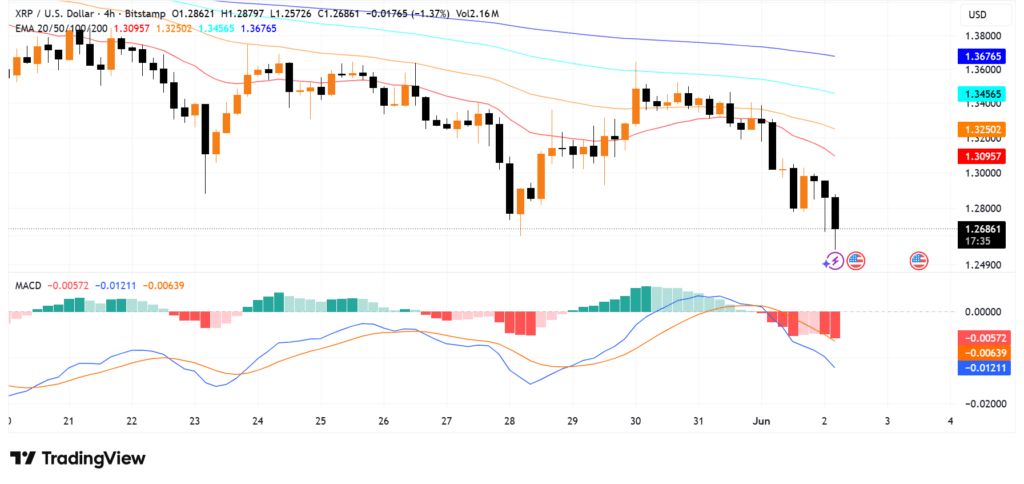
XRP price stayed under pressure after falling below $1.30 and touching its weakest level in nearly 15 weeks. The decline came even as spot XRP ETFs kept attracting capital, and late-May exchange data showed tokens leaving trading venues.
XRP traded near $1.26, with a market value of $78.77 billion. Its 24-hour volume stood near $2.34 billion. The token remained a top-five crypto asset by market value, but sellers controlled short-term direction.
ETF Inflows Fail to Shift XRP Price Control
Spot XRP ETFs remained the main bullish signal. SoSoValue data showed about $11.8 million in inflows on May 29. Cumulative net inflows were near $1.42 billion, showing continued demand for regulated XRP products.
The market is testing a clear contradiction. Flow data points to continued interest in XRP. Price action shows sellers have stronger control over live trading.
XRP price has not responded to the supportive data in a lasting way. ETF inflows show capital entering a wrapper. Exchange outflows can suggest custody or accumulation. Neither signal proves that enough buying is reaching spot order books.
ETF Inflows Keep Demand Visible
ETF demand remains the strongest bullish part of the setup. Capital has moved into spot XRP products despite the drawdown. That shows some investors still want regulated exposure.
However, ETF inflows are not the same as direct spot-market control. They show demand through a product structure. They do not confirm that buyers are lifting offers on exchanges.
Exchange Flows Send a Mixed Message
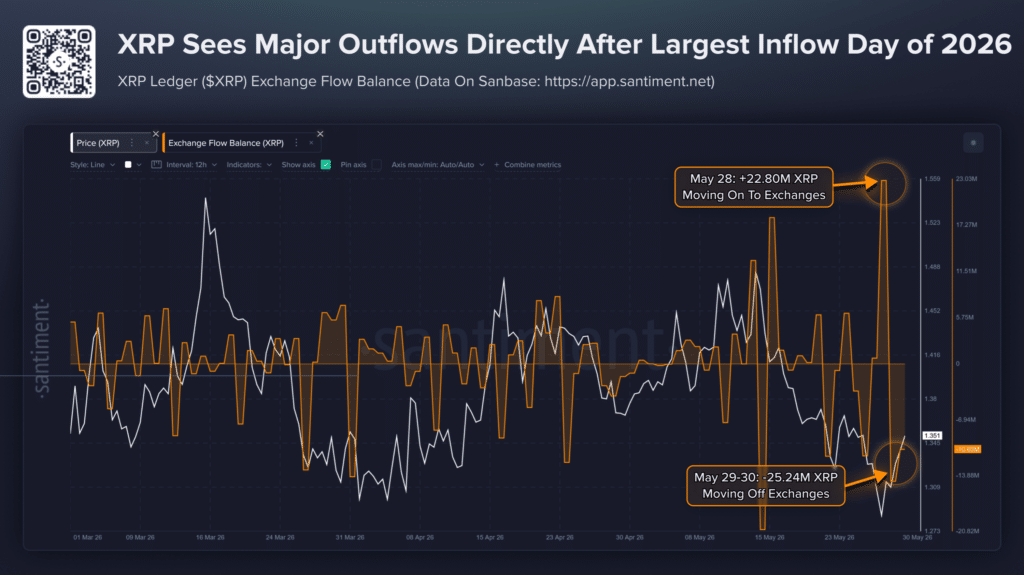
Exchange data gives a mixed message. Santiment showed a 22.80 million XRP inflow before the balance later reversed. After that, about 25.24 million XRP moved off exchanges in late May.
The outflow can look supportive. Tokens leaving exchanges may reduce the amount available for fast selling. It can suggest that some holders are moving assets into custody.
Still, the earlier inflow remains important. It showed that meaningful supply had moved toward exchanges before the reversal. That keeps sell-side pressure in view.
Spot Sellers Hold Control
The XRP price response shows that traders are not treating the flow signals as enough. The asset moved to a multi-month low even after the late-May outflow.
Exchange balances are only one part of the market. Spot demand, order-book depth, leverage, and confidence also shape short-term movement.
For now, rebounds are still being sold. That behavior suggests that some short-term traders may be using strength to exit rather than add exposure.
Thin Liquidity Raises Risk
Market structure may explain why supportive data has not changed direction. Recent liquidity data showed Binance’s 30-day XRP liquidity index near 0.043. That was described as its lowest level since January 2020.
Open interest was near $2.9 billion. Futures volume was about 6.8 times spot volume. This setup can increase volatility when traders crowd around the same levels.
In a deep market, ETF inflows and exchange outflows may help absorb selling. In a thinner market, smaller bursts of selling can still push prices lower.
Key Levels Remain Under Watch
The next test is not another bullish data point. It is whether buyers can turn those signals into a visible recovery.
A move back through the low-$1.30 would be the first sign of improvement. A reclaim of the $1.34 area would show stronger absorption of sell pressure.
Conclusion
The contradiction remains unresolved. XRP price is falling while ETF demand and exchange withdrawals continue to offer support on paper.
Flow data can help sentiment, but price control still depends on spot demand and liquidity. Until buyers reclaim key levels, sellers remain in charge of the trend.
Appendix Glossary of Key Terms
ETF Inflows: Funds being diverted to ETFs associated with XRP, a frequently utilized measure of institutional or regulated investors’ interest.
Exchange outflows: XRP leaving exchanges, which could indicate custody (in the case of longer-term holding) or a lower immediate supply to sell.
Spot Market: Represents a market where XRP is purchased and sold for immediate settlement; this makes it key to the real-time price direction.
Order Book: A running list of buy and sell orders on any exchange, showing the points where traders are placing demand and supply.
Liquidity: The ease with which XRP can be bought and sold without a steep rise or fall in the price of the market.
Open Interest: Open interest refers to the number of active futures contracts that have not been settled, often used for leverage and tracking trader positioning.
Frequently Asked Questions About XRP Price
1- What is causing weakness in XRP price?
Spot-market selling remains the main pressure. ETF inflows and exchange outflows have not outweighed live sell orders.
2- Why are ETF inflows not lifting XRP?
ETF inflows show demand through regulated products. They do not guarantee immediate buying strength on exchange order books.
3- What levels matter most?
Traders are watching the low below $1.30 and $1.34 area. Another failure may keep sellers in control.
4- Can XRP recover if liquidity improves?
A recovery may become easier if liquidity strengthens and buyers absorb sell pressure. Until then, sellers may keep control.
References