






According to Keyrock, stablecoins are on track to handle $1 trillion in annual cross-border payments by 2030. The firm’s latest report projects stablecoins will account for 12% of global cross-border flows within five years. This growth reflects lower transaction costs, faster settlement times, and increasing adoption by institutions worldwide.
Stablecoins Outpace Banks in Cost and Speed
Keyrock’s analysis shows stablecoins enable payments up to 13 times cheaper than traditional banking systems. Banks can charge about 13% for sending $200 and take several days to complete transfers. By contrast, stablecoins can process payments in minutes at a fraction of the cost.

The report notes that transaction efficiency appeals to both consumers and businesses seeking predictable settlement. Businesses increasingly look for faster capital movement to improve operational liquidity. This efficiency boosts institutional interest and drives long-term adoption.
Kevin de Patoul, Keyrock’s CEO, stated,
“The infrastructure is here, wallets, custody, and compliance rails all exist today.” He added that large institutions already use stablecoins without fanfare. “It’s just working. The opportunity now is to scale it,” he said.
DeFi Platforms Becoming Working Capital Engines
Keyrock highlights the role of decentralized finance in boosting liquidity turnover. Mansa Finance reports its capital turns over 11 times per month, far exceeding traditional fintech averages of 1-2 times annually. This faster cycle creates more productive use of funds.
Traditional banks hold significant idle deposits that earn nothing for businesses. About 21% of U.S. business bank deposits, or $3.85 trillion, do not accrue interest. Moving such funds to stablecoins could unlock yield opportunities and reduce idle cash.
The report reveals that over $600 million has been paid through yield-bearing stablecoins to date. However, U.S. regulations now prohibit stablecoin issuers from offering direct interest, which is shaping how yield-bearing products are structured in the market.
Regulation and Market Expansion Strengthen Stablecoins
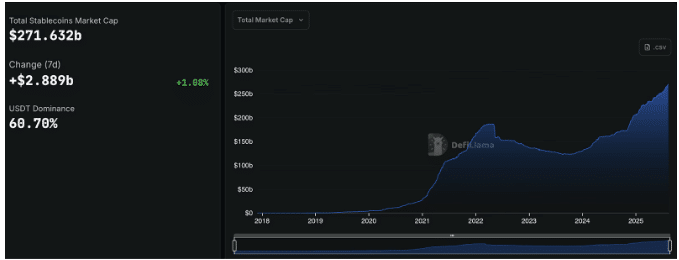
As of August 2025, the total stablecoin market capitalization has reached $271 billion, according to DefiLlama data. This marks a steep rise from around $5 billion in 2020. Regulatory clarity is expected to encourage institutional adoption further.
The U.S. recently passed the GENIUS Act, establishing a clear legal framework for stablecoin operations. Hong Kong also implemented a stablecoin regulatory structure this month. These developments provide more certainty for market participants.
Keyrock’s report emphasizes that stablecoins are already integrated into the financial system. However, broader recognition may lag behind actual adoption rates. The challenge now is scaling infrastructure and awareness in line with demand growth.
Summary
Stablecoins are on course to handle $1 trillion in annual cross-border payments by 2030, capturing 12% of global flows. Keyrock’s report cites lower costs, faster settlements, and DeFi-driven liquidity as key drivers. With regulations like the U.S. GENIUS Act and Hong Kong’s framework now in place, institutional adoption is accelerating. The stablecoin market has grown from $5 billion in 2020 to $271 billion in 2025, positioning it as a core financial system component.
For more crypto news, visit the platform.
FAQs
So what are stablecoins?
When cryptocurrencies are pegged to a stable asset, such as U.S. dollars, they are called stablecoins to ensure they are less price-volatile.
What makes stablecoins cheaper to pay with?
They do not require middlemen in the banking business, so transaction queries and charges are lower and faster.
What is the transaction velocity of stablecoins?
Transactions that process stablecoin take minutes, whereas bank transfers take a number of days.
Do stablecoins in the U.S. have regulations?
Yes. The GENIUS Act has given a regulatory outline of how they should be issued and utilized.
Do stablecoins have the capacity to provide interest to the holders?
Under new regulations, in the U.S., issuers are not allowed to provide direct interest.
Glossary of Key Terms
Stablecoins: Cryptocurrencies that are tied to other assets in order to stabilize the fluctuations.
DeFi (Decentralized Finance): Financial services created with blockchain technology without intermediaries.
GENIUS Act – an American bill that stipulates regulations of stablecoin issuance and functioning.
Cross-border payments: Financial transactions between parties in different countries.
Market capitalization: the sum of the value of the circulating supply of cryptocurrencies.
References: