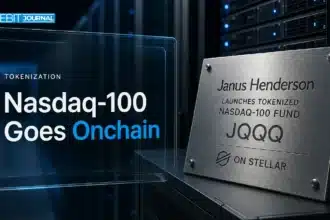

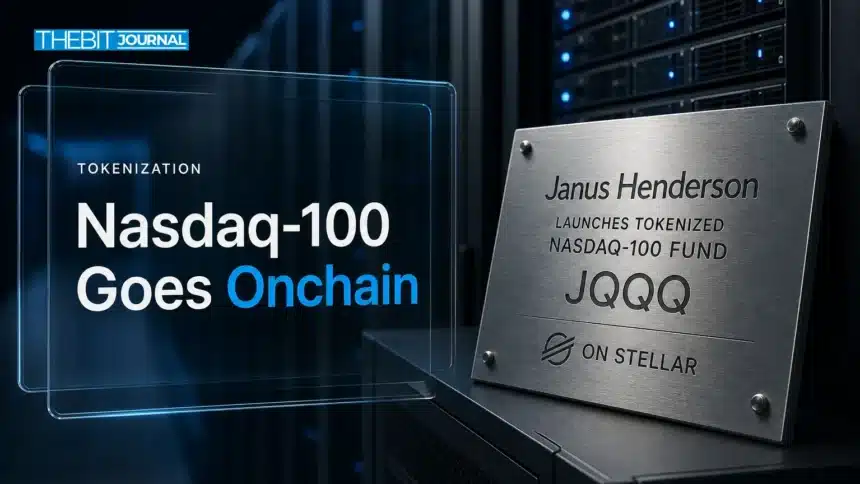

Janus Henderson and tokenization firm Centrifuge have launched JQQQ, a tokenized Nasdaq-100 fund that runs only on the Stellar network at launch. The product was announced on October 27, 2026. The index is licensed from Nasdaq and the fund is sponsored by the issuer itself, which sets it apart from synthetic tokens that simply claim a link to a stock index.
But this isn’t a retail product. It’s limited to eligible professional investors outside the United States, and the subscription window hadn’t opened yet at the time of early reporting.
- Launch: JQQQ launched on Tuesday, October 27, 2026, and seeks to track the Nasdaq-100 Index under a Nasdaq license, according to CoinMarketCap Academy.
- Structure: The fund is a segregated portfolio of Anemoy Capital SPC Limited, a British Virgin Islands investment company. Anemoy Asset Management is investment manager and Janus Henderson Investors US is sub-investment manager.
- Access: It is open only to eligible professional investors outside the US, with a reported minimum of $100,000 (100,000 USDC).
- Exposure: Holders get indirect index exposure and no direct rights in the underlying Nasdaq-100 securities.
- Lineup: JQQQ adds a second equity index to the firm’s onchain lineup, after the Janus Henderson Anemoy S&P 500 Fund (SPXA).
Timeline of the JQQQ launch
- 2025: Janus Henderson launches the Anemoy S&P 500 Fund (SPXA), its first onchain equity index fund, as noted by Bitcoin Foundation News.
- 2026 (year to date): Tokenized real-world assets on Stellar pass $4 billion, according to BigGo Finance.
- October 27, 2026: Janus Henderson and Centrifuge announce JQQQ, launched on Stellar only.
- Shortly after launch: The Defiant reports that Centrifuge’s investment portal still showed subscriptions as not yet open.
- October 29, 2026, 03:00 UTC: NewsBTC publishes its analysis, stressing the limits of the announcement.

Why a tokenized Nasdaq-100 fund matters for onchain finance
According to Stellar Development Foundation CEO Denelle Dixon, tokenization is moving from cash-equivalent assets toward the benchmarks that define global equity markets. A licensed equity index is a different kind of test. NewsBTC put it this way: the question is whether asset managers can use blockchain systems to serve qualified investors while keeping portfolio management, transfer rules and disclosures intact.
The legal wrapper is the key detail. Investors don’t own the underlying Nasdaq-100 shares through JQQQ. They own shares in a BVI segregated portfolio that seeks index exposure, as TradingView’s report explains. That’s a meaningful difference from holding the index constituents directly.
Janus Henderson isn’t a newcomer here. Nick Cherney, the firm’s Head of Innovation, said in a Centrifuge blog post that its onchain platform now holds more than $1 billion in institutional strategies across U.S. Treasuries, structured credit and public equities. He called Janus Henderson “a top five global provider of tokenized funds.” For scale, BigGo Finance says the firm manages roughly $500 billion in assets overall.
NewsBTC also pointed out that, for financial institutions, a technical link is only the beginning. They still have to settle liability, account for funds, control access and recover from a failed transfer. On that view, announced partnerships are best judged by their operating detail rather than by the number of logos in a press release.
Reactions from Nasdaq, Stellar and Centrifuge
The partners presented the launch as tokenization reaching mainstream equity benchmarks. Anil Sood, Centrifuge’s Chief Strategy and Growth Officer, said that with Janus Henderson and Nasdaq Global Indexes, Centrifuge is bringing the index onchain “as a licensed, issuer-sponsored institutional investment product,” according to Markets Media.
Putting the Nasdaq-100 onchain “shows how far tokenization has come,” said Denelle Dixon, CEO and Executive Director of the Stellar Development Foundation, describing a shift from cash-equivalent assets to the benchmarks that define global equity markets (via Markets Media).
Sean Wasserman, Nasdaq’s head of index product management, said investors exploring digital infrastructure keep looking for exposure to established, transparent benchmarks, Bitcoin Foundation News reported.
NewsBTC was more cautious. Its analysis noted that the fund can deviate from its reference index and may not trade as freely as an exchange-listed ETF. It also noted that future lending or collateral uses aren’t services Janus Henderson automatically provides. Such arrangements would depend on third parties and on the law.
Market reaction
The available data doesn’t show a clear price reaction to the launch. Our market snapshot doesn’t include XLM, and BigGo Finance reports the token is down about 16% this year. Bitcoin, Ether, XRP and Solana were lower over the 24 hours to 08:13 UTC on October 29, while BNB edged up 0.6%. The Crypto Fear & Greed Index stood at 51 (Neutral). Nothing in the data links those moves to JQQQ.
| Asset | Price (Oct 29, 2026, 08:13 UTC) | 24h change | 7d change |
|---|---|---|---|
| Bitcoin (BTC) | $79,974 | -1.33% | -3.19% |
| Ethereum (ETH) | $2,315.80 | -1.94% | -5.05% |
| XRP | $1.29 | -2.84% | -3.95% |
| Solana (SOL) | $99.95 | -2.19% | -4.59% |

Outlook for JQQQ and tokenized index funds
The next verifiable milestone is simple: the date subscriptions open on Centrifuge’s portal. After that, observers are likely to watch inflows and how closely the tokenized Nasdaq-100 fund tracks its benchmark. They will also watch whether any collateral use moves beyond the conditional status The Defiant described.
JQQQ is Stellar-only for now, and the reporting reviewed here mentions no plans for other networks. For Stellar, the fund joins a tokenized real-world asset base that BigGo Finance says passed $4 billion in 2026.
The risks are plain. Tokenization doesn’t remove market risk, and Nasdaq-100 exposure can fall sharply. Smart contract, custody and liquidity risks add to that. Rules for professional investors also differ by country, so eligibility and tax questions belong with a qualified adviser.
FAQ
Who can invest in the tokenized Nasdaq-100 fund?
Only eligible professional investors outside the United States, where lawful. US persons are excluded, and the reported minimum is 100,000 USDC ($100,000).
Does JQQQ give ownership of Nasdaq-100 stocks?
No. Holders own shares in a BVI segregated portfolio with indirect index exposure and have no direct rights in the underlying securities.
Which blockchain does JQQQ use?
At launch it runs only on Stellar, with Centrifuge providing the infrastructure for issuance and fund operations.
Sources
- Janus Henderson Launches Tokenized Nasdaq-100 Fund JQQQ on Stellar (NewsBTC)
- Janus Henderson and Centrifuge Launch Tokenized Nasdaq-100 Fund on Stellar (coinmarketcap.com)
- Janus Henderson Launches Tokenized Nasdaq-100 Fund JQQQ on Stellar, TradingView News (www.tradingview.com)
- Janus Henderson Announces Tokenized Nasdaq-100 Fund on Stellar (thedefiant.io)
- Janus Henderson and Centrifuge Bring Nasdaq-100 Onchain (centrifuge.io)
- Janus Henderson Offers Onchain Fund Tracking Nasdaq-100 – Markets Media (www.marketsmedia.com)
- JQQQ Tokenized Nasdaq-100 Fund Launches on Stellar (bitcoinfoundation.org)
- Janus Henderson Puts Nasdaq-100 on Stellar With First Licensed Tokenized Index Fund, BigGo Finance (finance.biggo.com)
This article is for informational purposes only and does not constitute financial or investment advice. Cryptocurrencies are highly volatile; always do your own research before investing.