






This article was first published on The Bit Journal.
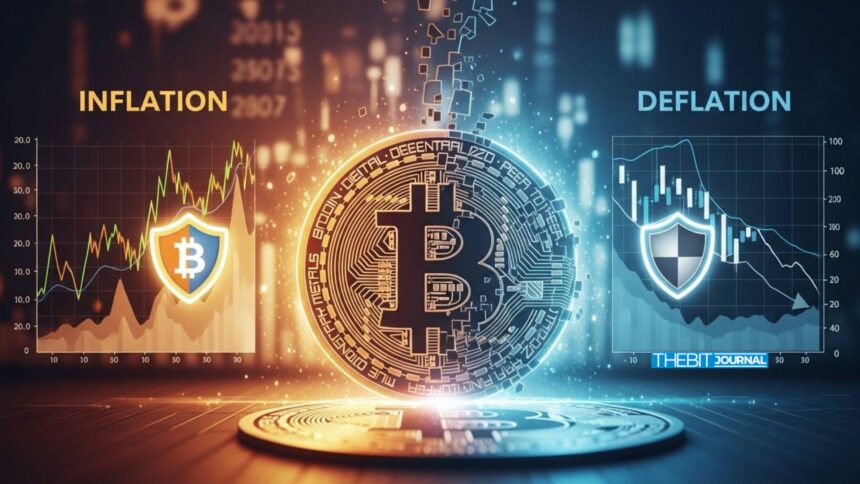
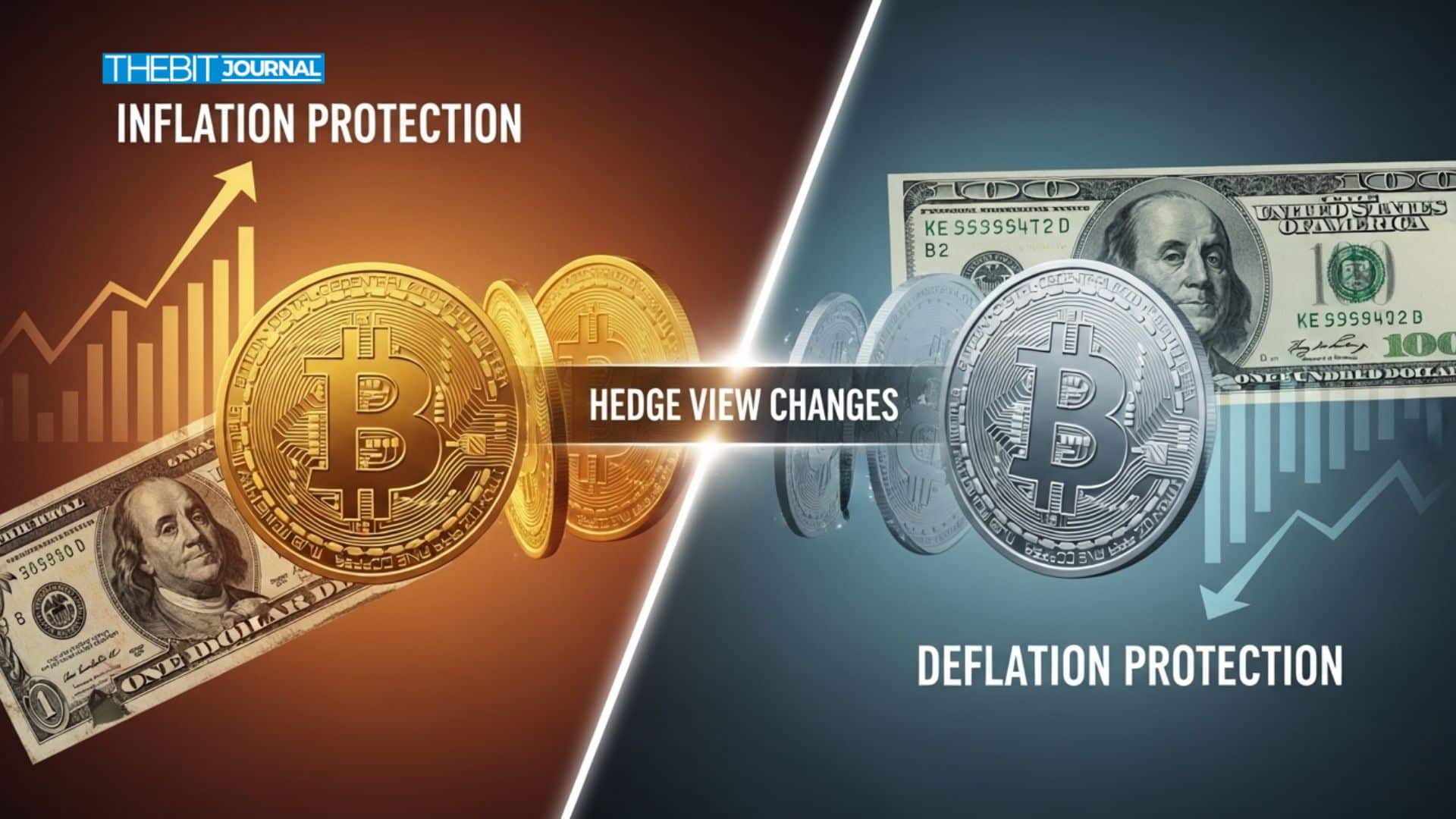
Cathie Wood, the CEO of ARK Invest, has publicly stated that, along with being an inflation hedge, Bitcoin is also a protection against deflation caused by rapid technological changes, particularly artificial intelligence (AI).
Her comments at Bitcoin Investor Week in New York and on podcast interviews with industry hosts have breathed new life into the discussions as to whether or not Bitcoin has a place in diversified portfolios during both inflation and deflation.
Wood’s views on Bitcoin hedge emphasize its fixed supply and decentralized nature as very beneficial qualities during times when established financial systems are under pressure.
Cathie Wood’s Take: Bitcoin Hedge View Beyond Inflation
The rationale for Cathie Wood’s Bitcoin hedge take is even more than the “digital gold” label that has long framed Bitcoin as a store of value in times when fiat currencies weaken.
During the Bitcoin Investor Week, Wood stated that Bitcoin can act as a hedge against inflation and deflation. Inflation protection is easy enough to understand: Bitcoin’s cap of 21 million in supply means it can’t be devalued by central banks printing money unlike fiat currencies.
However, Wood’s take goes further. In conversation with Anthony Pompliano and other guests, she noted that productivity gains from AI and tech could drive the economy to deflation.
In such a case, she says Bitcoin’s decentralized nature and fixed supply make it particularly resistant to being debased in the way that financial assets exposed to inflation are.
Why Inflation Protection Still Matters
Wood’s Bitcoin hedge take, if anything, shows that Bitcoin’s inflation position is still very much relevant. As inflationary pressures subside in many of the world’s economies, central banks are still treading volatile markets.
Wood explains that scarcity is something “built” into Bitcoin by its m protocol which leaves it naturally resistant to currency debasement.
Scarcity is a big reason that Bitcoin first attracted attention as an inflation hedge. Money stock of traditional assets experiences inflation with the expansion of money supply by central banks while Bitcoin has an algorithmic cap on its supply.
Wood says that the fund’s structure attracts investors in times of price volatility. Because, as she explained at the event, in moments of uncertainty there is “a strategic advantage” for a fixed supply like Bitcoin’s over old financial systems.
Such a view of Bitcoin hedge lends credence to the argument that Bitcoin may be a worthy long-term anchor asset, despite its recent short-term market volatility.
Technology with the Force to Drive Prices Down
Arguably the most provocative aspect of Wood’s view is her emphasis on deflation risk, not from an economic slump but as a side effect of rapid tech productivity growth.
She cited numbers on AI cost reductions including large drops in training and inference costs per year that are directly outpacing production and pricing across industries.
Wood cautioned that this sort of technological deflation could destabilize conventional financial systems, which are based on steady inflation targets. Central banks also tend to react to inflation if it arises; they could find themselves lagging behind events when such improvements in productivity drive prices down.
She maintains that Bitcoin, as an uncensorable and non-sovereign asset and one with a mathematically fixed supply, is made to serve as a defensive asset regardless of inflationary or deflationary pressures.

Market Context and Reactions
Wood’s Bitcoin hedge view comes at a time when markets are still trying to digest the effects of recent volatility and macro changes.
Reports from ARK’s presentations show that Wood and her team are viewing these algorithm-driven swings as opportunities for informed investors. She has stressed that algorithmic trading driven by automated selling tends to exaggerate fundamentals and can provide windows of opportunity for purchases of assets like Bitcoin.
Though Bitcoin has at times found itself fighting tooth and nail against other macro forces, the focus on productivity-driven deflation and inflation resilience from Wood pushes it to the forefront of adapting portfolios in these uncertain economic times.
Conclusion
Cathie Wood Bitcoin hedge take stands out in financial conversations. By saying that Bitcoin can protect against inflation and deflation alike, Wood has reopened the discussion around Bitcoin’s purpose. She blends Bitcoin’s inflexible design with macro forces that could further confirm BTC as more than just a store of value.
With markets in a state of transition and technology reconfiguring economic relationships, Wood and her firm, ARK Invest, are making the case that Bitcoin should be a part of an investor’s diversified strategy.
Glossary
Inflation: An increase in the general price level of goods and services, which erodes the purchasing power of a currency.
Deflation: General decline in prices, usually associated with increased productivity (supply) or reduced demand.
AI productivity boost: Output enhancement through artificial intelligence that can cut cost and prices.
Public asset: An asset that is not effectively controlled by a central authority, and governance instead relies on the use of distributed protocol code and consensus.
FAQs About Bitcoin Hedge
What is the Bitcoin hedge view?
The Bitcoin hedge view suggests that it can act as a hedge against both inflation and deflation, expanding the narrative beyond traditional inflation hedging.
Why do its proponents believe that Bitcoin hedges inflation?
Because Bitcoin has a fixed supply, it is immune to devaluation through printing more money, which is one of the primary triggers for inflation in fiat currencies.
How could Bitcoin hedge deflation?
According to Cathie Wood, if AI and tech productivity sharply lower prices, Bitcoin’s decentralized and finite supply could protect capital in environments where prices fall.
Is the Bitcoin hedge view of now widely held?
It is increasingly growing among institutional investors, but it still a hot debated topic among economists and traditional financial strategists.
References
KuCoin
MEXC
Bitexen Research
Ark Invest