
This article was first published on The Bit Journal.
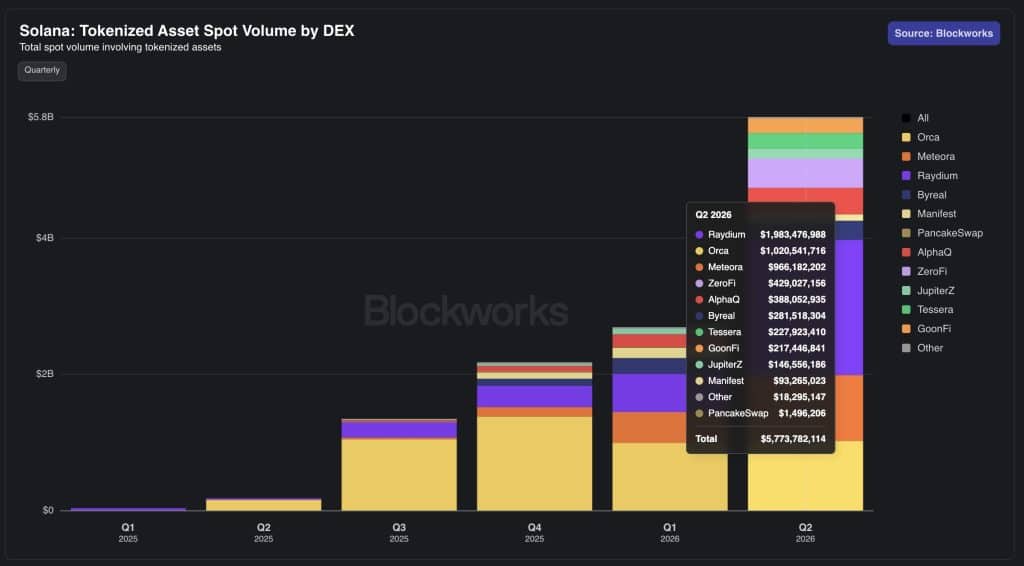
Solana Tokenized Assets has hit an all time high of $5.77 billion in spot trading volume for the second quarter 2026. The figure, reported by data analyst Sam Schubert on July 1, is more than seven times the $775 million generated in the second half of last year.
Developments in the industry like tokenization focused firms moving into public markets and growing talk about regulating digital assets have really given this sector a kick along.
Solana Leads Tokenized Equity Trading
During June 15-21 alone, Solana handled $1.298 billion of the $1.324 billion in global weekly tokenized stock volume, representing a 95% market share.
Trade started to pick up in the final days of the quarter. On June 24th, daily tokenized equities trading surged to $644 million, a set record that meant for the first time ever, tokenized stocks outdid meme coins as a share of Solana’s spot trading volume.
June proved to be a month to remember, with over $2 billion in tokenized stock volume, the highest total ever recorded for the sector. Momentum carried on right through to the final week of Q2 when trading volume hit a new all time high of $1.42 billion just as the quarter was coming to a close.
Raydium Stepping Up as the Main Trading Venue
A lot of that growth went through Raydium, which is now the primary go to market place for Solana tokenized assets.
The decentralized exchange has the majority of xStocks trading pairs, and most of them are on through its concentrated liquidity pools. According to Raydium, the platform racked up its latest $1 billion in cumulative tokenized equity volume in the space of a single month, revealing just how quickly demand took off during Q2.
Instead of relying on conventional market infrastructure, traders can gain exposure through tokenized assets that settle directly on-chain.
As trading volumes continue rising, liquidity has increasingly concentrated on Raydium, strengthening its place within Solana’s tokenization ecosystem.
Why Institutions Are Flocking to Solana
According to ecosystem data released earlier this year, Solana controlled roughly 97% of cumulative on-chain tokenized equity trading volume and maintained that lead for more than 54 consecutive weeks.
Low fees and sub second transaction finality have made it a favorite with big scale financial activity.
The wider RWA ecosystem on Solana is also expanding fast. The network reportedly hosted around $2.8 billion in total on chain RWA value, alongside over $1.2 billion in RWA lending deposits.
Institutional participation has become more visible. Asset managers and tokenization firms have been deploying some significant products on Solana, using the network to help settle and distribute tokenized financial instruments.
The recent public market listing of tokenization company Securitize also showed how confident people are starting to get in blockchain-based asset infrastructure.
Much of the activity is now coming from regulated financial products and assets that generate yield.
Tokenization Momentum Could Grow Further
Market participants are of the opinion that tokenization is one of the strongest long-term growth areas within digital assets.
Cross-chain tokenized equity trading reportedly hit $5.3 billion in May 2026, a 44% increase from April, and Solana is responsible for the lion’s share of that, which is a testament to its competitive advantage.
Looking ahead, the market could see even more growth driven from additional tokenized products like SPYx, QQQx, and NVDAx. Industry observers are also watching how regulatory developments in the United States unfold, particularly discussions around the CLARITY Act, which many think could give tokenized asset markets a bit more clarity.
Even without any new legislation, the latest figures suggest that adoption is already speeding up. The $5.77 billion recorded in Q2 occurred before any potential regulatory catalyst really emerged.

Conclusion
The fast rise of Solana tokenized Assets really is becoming more important for the network’s long term outlook.
Unlike the speculative trading cycles that are seen coming and going, tokenized securities generate recurring activity tied to real financial products. As more institutions start to move their assets on chain, transaction volumes, liquidity and ecosystem participation all continue to expand.
For investors, the latest data is showing that Solana’s growth is no longer merely about decentralized finance or meme coins. Tokenization has really become a driver of network activity, and Q2 2026 was the strongest evidence yet.
Glossary
Tokenization: Turning ownership of real-world assets into blockchain-based tokens
RWA (Real-World Asset): Traditional assets such as stocks, bonds, or funds represented on a blockchain.
Raydium: A decentralized exchange operating on the Solana blockchain.
xStocks: Tokenized stock products that trade on-chain.
Liquidity Pool: A collection of assets locked in a protocol to facilitate trading.
Settlement Layer: The blockchain infrastructure used to process and finalize transactions.
CLARITY Act: Proposed U.S. legislation aimed at establishing clearer rules for digital assets.
Frequently Asked Questions About Solana Tokenized Assets
What are Solana tokenized Assets?
They are blockchain-based representations of traditional financial assets like stocks, funds and other securities that trade on the Solana network.
How much Solana tokenized assets volume was logged in Q2 2026?
Solana tokenized assets recorded $5.77 billion in trading volume in Q2 2026.
Why is Raydium so important to Solana’s tokenization growth?
Raydium is the place where most tokenized equity trading pairs get traded on Solana and it is the leading venue for xStocks trading activity too.
What share of tokenized equity trading does Solana control?
Recent ecosystem data showed that Solana accounts for about 97% of all on-chain tokenized equity trading volume.
Could tokenization boost Solana’s long term growth?
Many analysts think so, because tokenized assets bring recurring institutional activity and real-world financial use cases to the network.
References