







Crypto whales made several interesting moves throughout this week. Large outflows of Bitcoin from exchanges, sizable ETH purchases and transfers, huge stablecoin deposits. These transactions involving whales, as monitored by on-chain analytics services are often used to determine changes in market sentiment and mood.
Bitcoin Whale Transfers
Bitcoin whales were active this week. Whale Alert reported two large BTC withdrawals from Coinbase custody into private wallets on March 10. One transaction during this time was for 743BTC ($52.6M at the time) sent from Coinbase Institutional to an unknown address. Later that day, another transfer sent 723BTC ($51.5M) from Coinbase to a private wallet, totaling 1,466BTC.
Additionally, 1,049 BTC (74,501,545 USD) transferred from unknown wallet to Coinbase Institutional; another 1,052 BTC (74,643,629 USD) transferred from Coinbase to unknown wallet. All round, BTC whales weren’t sleeping this week as the crypto whale activities were in motion.
These withdrawals typically drain BTC from exchanges, and is generally perceived as accumulation (hodling) rather than selling. In other words, big-money investors were removing coins from exchanges; possibly bullish, because that means less supply is available to sell immediately.
Ethereum Whale Activity
Ethereum saw a lot of whale activity this week. In fact, just recently, an on-chain trader (address 0x8A21) played a very typical “buy-low, sell-high” strategy. This whale had sold 499ETH ($2.21M) at a high price in the six months prior; then re-entered by buying 1,004ETH ($2.08M) around $2,070 per ETH; according to data from Lookonchain. The massive buy order by whale 0x8A21 is an obvious bullish accumulation in the $ETH market.
Large on-chain transfer to exchanges from Ethereum also occurred recently. According to Arkham Intelligence data, an anonymous whale withdrew $92.97M USD of ETH from Kraken and divided it into new private wallets. This was an Arkham-flagged transfer, and likely a strategic fund transfer; probably for holding, as the coins did not stay on exchange.
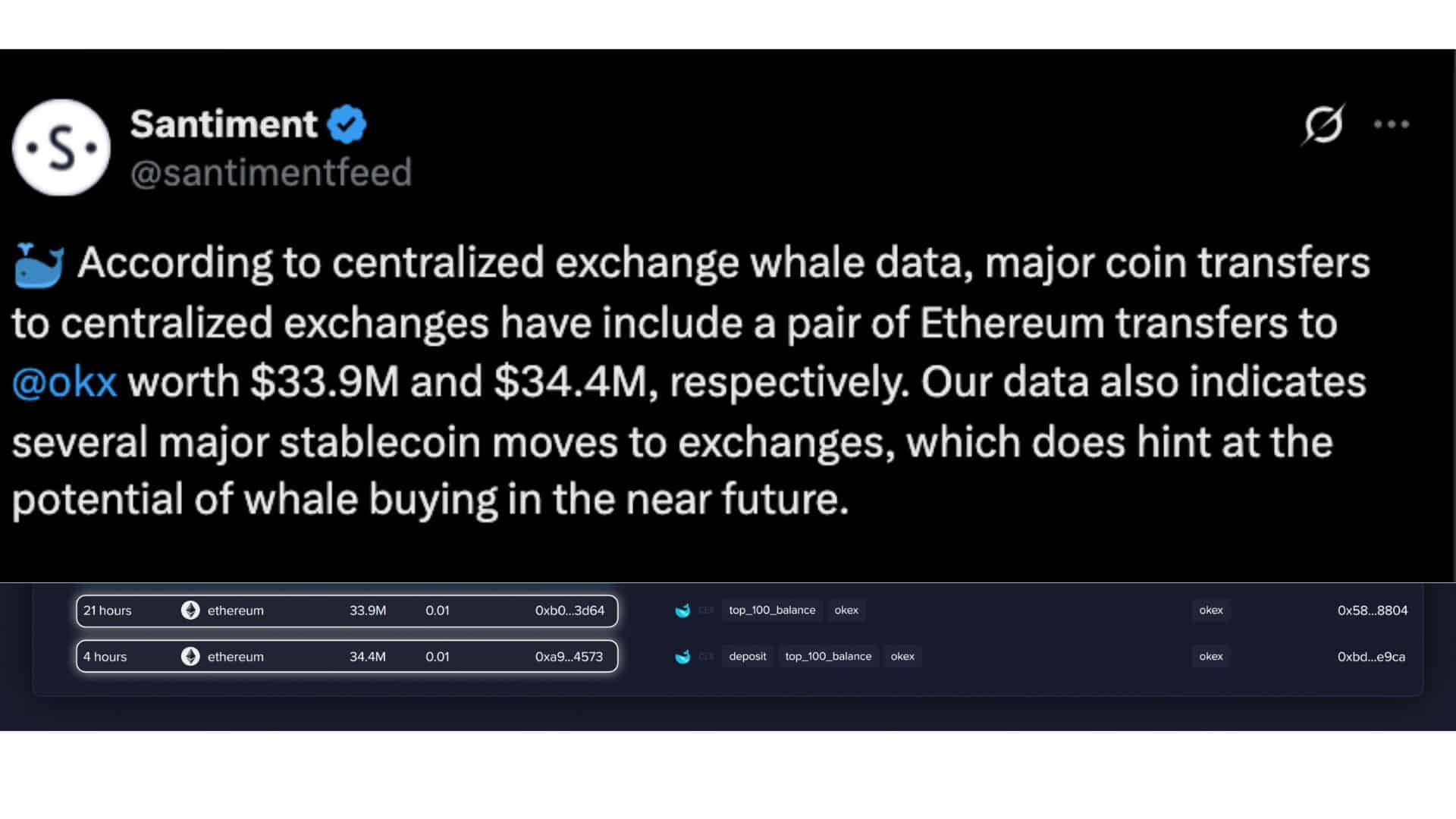
At the same time, Whale Alert tagged two giant deposits of Ethereum to OKX exchange: one worth $33.9M and another $34.4M; a total of $68.3M.
Arkham also spotted a $21M on-chain ETH buy by Longling Capital. Longling reportedly transferred $21M USDT to Binance and purchased nearly 5,000ETH ($21.6M) all at once. This whale-buy through Binance added further buying pressure into Ethereum.
Alongside these flows, Ethereum whales exhibited signs of aggregate accumulation. According to analysis, a founder’s transfer of 79,176ETH ($157M) to Kraken made it appear as if whales were selling for a moment before deeper data showed two large whale cohorts (holding 1M-10M ETH and 100k-1M ETH), accumulating 210,000 ETH from Mar 5-8. This implies that a large number of big holders were soaking up supply, counterbalancing any selling pressure.
The main stance is that crypto whale activity in ETH saw both withdrawal from exchanges and also funds sent in. On Mar 10, a whale purchased 1,004 ETH. Arkham notes that after that, $93M was spotted exiting Kraken and $68M ETH was deposited in OKX. Another whale used $21M USDT to buy 5,000 ETH on Binance. This crypto whale activity shows the large participants stockpiling ETH as crypto market rebounds.
Large Altcoin and Stablecoin Transfers
Other tokens besides BTC and ETH also experienced notable whale activity. Whale Alert recorded a large transfer of Dogecoin; about 314.5 million DOGE (approximately $28.4M) was transferred from Kraken to a private address. Large withdrawals of DOGE or any other alts from exchanges can tighten supply and price support.
Cardano also saw whale flows. It was noted that 230 million ADA ($60M at $0.26) were rotated within the week by whales. These transfers were reportedly into a high-yield token presale.
Even stablecoins saw movements. Whale Alert reported that a wallet with an unknown origin sent 219,421,714 USDT ($219.4M) into OKX. The total Tether mega-transfer (on Tron network) into an exchange suggests an institution is going to trade. Such USDT inflows have usually either signified potential major purchases or just portfolio re-balancing.
In both cases, these stablecoin whale flows mean liquidity is set to enter or change within the market.
Another major thing to note is the institutional moves regarding altcoins. To illustrate, reports covered that Tom Lee’s BitMine bought 60,976 ETH ($131M) for their treasury. While this is not quite a transfer, it gives an idea of the volume of institutional accumulation happening during the week.
Summary of Weekly Whale Transfers
The following table lists the notable whale transactions this week
| Asset & Amount | USD Value (approx.) | From – To |
| 314,500,000 DOGE | $28.4M | Kraken – Private wallet |
| 230,000,000 ADA | $60M | Whale wallets – New presale |
| 743 BTC | $52.6M | Coinbase Inst. – Private |
| 723 BTC | $51.5M | Coinbase – Private |
| 1,049 BTC | $74.5M | Unknown – Coinbase |
| 1,052 BTC | $74.6M | Coinbase – Unknown |
| 1,004 ETH | $2.08M | Whale 0x8A21 bought |
| 5,000 ETH | $21.6M | USDT – Binance (Longling Capital) |
| 219,421,714 USDT (Tron) | $219.4M | Unknown – OKX |
| $68.3M ETH (two transfers) | $68.3M total | Unknown – OKX (2 txns) |
| $92.97M ETH | $92.97M | Kraken – Private wallets |
| 60,976 ETH | $131M | BitMine buys for treasury |

Impact of Crypto Whale Activity on the Crypto Market
These crypto whales activity happened as the general crypto market witnessed a recovery. Bitcoin and Ethereum had recently recovered from earlier lows. During these whale transactions, ETH for example was trading at around $2,060-$2,070; what some analysts called a discount zone. Similarly, altcoins such as DOGE were also building strength at critical levels at $0.09.
Whale flows can move prices in several ways. Withdrawals to private wallets tend to be bullish so they reduce the sell supply, while into exchanges can be bearish indicating selling intentions. In this week’s case, there were mixed signals. It is highly likely that large BTC withdrawals removed selling pressure. Ethereum also saw notable inflows and accumulations. Inflows for stablecoin indicated plenty of liquidity to trade.
On the whole, however, market reaction was one of cautious optimism. The price rose slightly in that time: Bitcoin rose above $70K and Ethereum gained 3% over those days, driven partly by positive whale accumulations. Data from crypto analysts suggested improving sentiment and solid on-chain activity, despite some indications of capital outflows.
To cap it all, crypto whale activity this week was primarily accumulation-based. Big holders withdrew wisely, with no apparent market dumps. The net effect appeared to feed into the crypto rally, adding confidence that big players were buying dips and building positions.
But as experts warn, one-off transactions don’t necessarily point to the direction of a guaranteed trend
Conclusion
The market saw numerous crypto whale activity this week, from individual wallets to institutional treasuries as large holders executed transactions. These included large BTC outflows from Coinbase, ETH accumulation on-chain and exchanges, and massive stablecoin transfers.
ETH whales are believed to be building positions according to Lookonchain and Arkham data, while BTC whales showed net withdrawal based on Glassnode charts. Putting all this together, these moves suggest smart money is buying at current levels, supplying liquidity and some confidence to the space.
Whale behavior can be a tricky signal, so monitoring such on-chain signals is essential. Overall, the above data indicates that major holders were mildly bullish during the week. But like always in crypto, flows can be the result of long-term strategy, rebalancing or market-making.
Glossary
Crypto Whale: A person or organization that holds a significant amount of cry (e.g. thousands of BTC). Whales prove that market liquidity and price reacts on their interactions.
On-Chain Analytics: Data analysis tools for blockchain. EXAMPLES: Whale Alert (big transfers) / Arkham Intelligence (addresses to entities) / Glassnode (on-chain metrics e.g. whale flows)
Exchange Inflow/Outflow: This is the value of crypto flowing to exchanges (inflow) or flowing from exchanges (outflow). Whales transferring assets in either direction can indicate intent.
Stablecoin: A cryptocurrency that is backed by fiat (USDT, USDC, etc). Typically used by whales to park a big value; stablecoins flow can signal the incoming buys/sell.
Frequently Asked Questions About Top Crypto Whale Activity this Week
What is a crypto whale?
A crypto whale is a person or entity that owns a huge quantity of cryptocurrency, so much so that it can sway the market prices.
Why is crypto whale activity significant?
Transactions by whales are publicly visible on blockchains, so they tend to draw market interest.
Are whales currently accumulating or distributing?
Based on data, many whales were either buying or holding. An ETH whale, for instance, bought 1,004 ETH on Mar 10 and Longling Capital bought 5,000 ETH with $21M on Mar 10. At the same time, Bitcoin whales were broadly depositing coins out of exchanges (to private wallets). This suggests accumulation, not selling.
Do crypto prices depend on whale moves?
Whales can impact liquidity and sentiment in the short-term, but market price follow demand, macro news etc. A single whale transfer isn’t a guarantee the price has to move; it’s just one signal in a larger context.
References