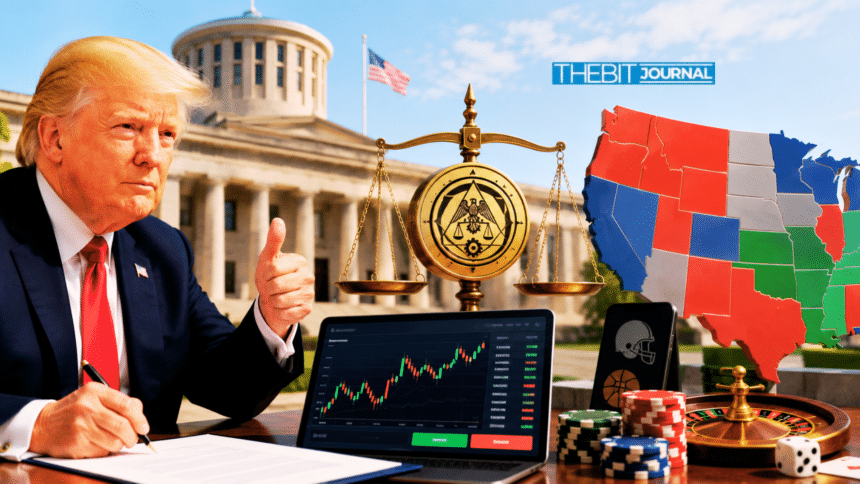

Trump prediction markets have become a central flashpoint in a widening regulatory and political dispute in the United States, as federal and state authorities clash over who controls the rapidly expanding sector. President Donald Trump’s intervention has intensified scrutiny of prediction markets tied to sports, entertainment, elections, and crypto-linked events, placing the Commodity Futures Trading Commission (CFTC) at the heart of the debate.
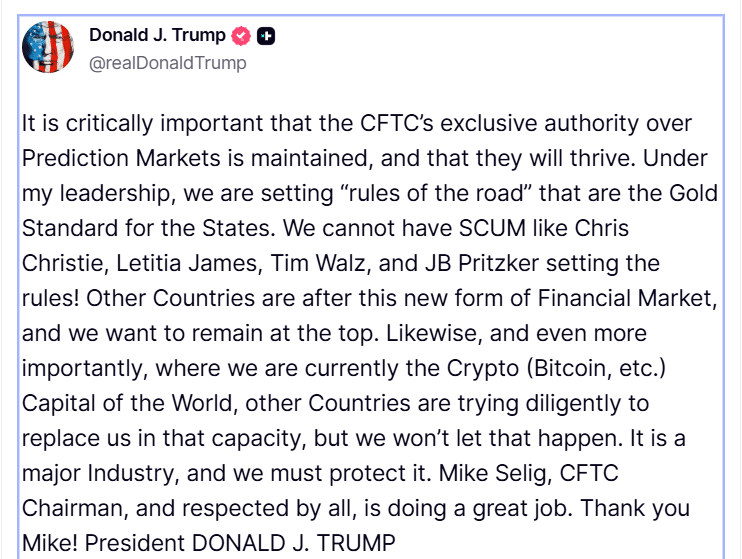
Trump prediction markets gained renewed attention after his Truth Social post on Tuesday, where he stated that it is “critically important” that the CFTC retains “exclusive authority” over prediction markets. He emphasized that a unified federal structure is necessary for the sector to develop consistently and warned that fragmented state rules could weaken innovation and market growth.
What is driving the Trump prediction markets dispute?
The Trump prediction markets dispute centers on a fundamental classification issue in U.S. financial law. Federal regulators argue that prediction contracts linked to sports, elections, entertainment, and crypto events fall under the Commodity Futures Trading Commission’s jurisdiction as regulated financial derivatives. State authorities disagree, arguing that these products resemble gambling and should be governed under state gaming laws.
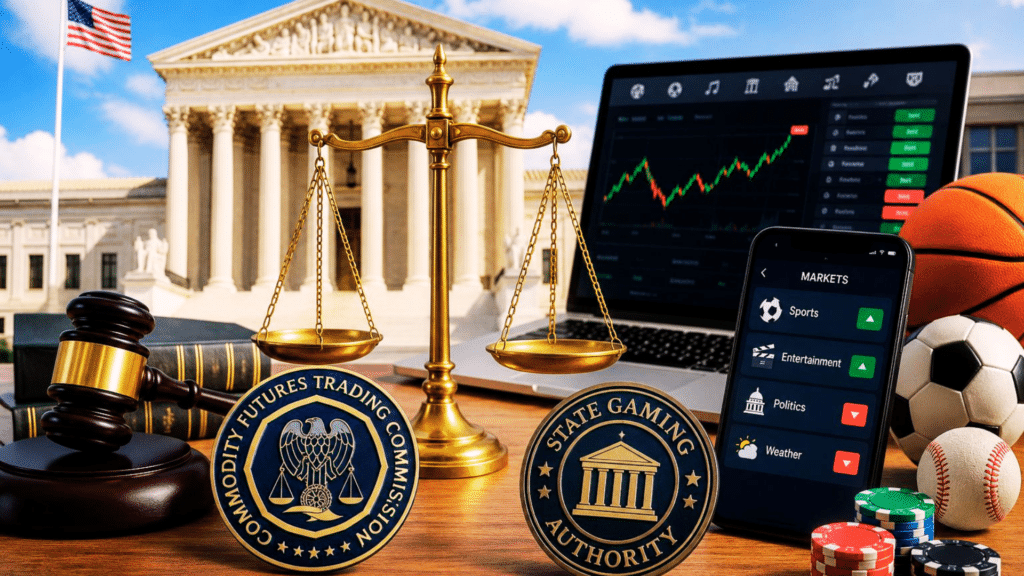
This disagreement has already triggered lawsuits, cease-and-desist orders, and enforcement actions across multiple jurisdictions, affecting major platforms operating in the sector. The scope of these contracts is broad, covering elections, sports outcomes, entertainment events, and crypto-related predictions, making the regulatory outcome especially significant for the industry
Why did Trump support federal authority over prediction markets?
Trump prediction markets received strong backing from the president, who framed federal oversight as essential for stability and global competitiveness. In his post, Trump said it is “critically important” that the CFTC maintains exclusive authority and that prediction markets must be allowed to “thrive.” He also said his administration is establishing “rules of the road” that represent a “Gold Standard for the States,” reinforcing a unified national framework.
Trump directly named several political figures involved in state-level actions, including Chris Christie, Letitia James, Tim Walz, and JB Pritzker, criticizing their involvement in regulatory disputes over prediction platforms. His remarks highlighted opposition to allowing individual states to shape rules for a nationally expanding financial market.
How are regulators responding to Trump prediction markets stance?
Trump prediction markets are now at the center of a sharp regulatory divide between federal and state authorities. The CFTC, led by Chair Michael Selig, supports exclusive federal jurisdiction and argues that prediction markets fall under its authority as federally regulated designated contract markets. The agency has defended this position through legal filings and actions against states attempting to restrict platforms.
State regulators argue the opposite. New York Attorney General Letitia James has filed lawsuits alleging violations of gambling laws, Illinois has issued cease-and-desist orders, and Minnesota has passed legislation introducing criminal penalties for unauthorized prediction market activity.
Former New Jersey Governor Chris Christie has also defended the view that states should retain authority over gambling-style products. The legal conflict is now advancing through federal courts and could eventually reach the U.S. Supreme Court if rulings remain inconsistent.
What political and industry factors influence Trump prediction markets?
Trump prediction markets are also shaped by political connections and increasing scrutiny over industry ties. Donald Trump Jr. serves as an adviser to Kalshi and Polymarket, raising attention around the overlap between political influence and prediction market growth.
The House of Representatives has launched a formal inquiry into the sector, focusing on regulatory approvals and crypto-linked companies tied to Trump allies seeking access to prediction market operations. The investigation has added scrutiny around potential conflicts of interest, particularly as platforms with political connections seek federal approvals in a rapidly evolving regulatory environment.
Gemini the crypto exchange founded by Cameron and Tyler Winklevoss has also entered the prediction market space. Cameron and Tyler Winklevoss have both publicly supported Trump, which has drawn additional attention to how closely parts of the prediction market ecosystem overlap with his political network, while also raising questions about influence and alignment across the industry.
Are Trump prediction markets part of global financial competition?
Trump prediction markets are increasingly cast as part of a global contest over financial innovation and digital asset leadership. Trump has argued that other countries are moving aggressively to limit or reshape similar markets while the United States aims to maintain leadership in financial innovation.

This aligns with his campaign pledge to make the United States the “crypto capital” of the world. He has consistently described prediction markets as a “major industry” that must be protected to preserve U.S. dominance in emerging financial technologies.
At the same time, countries including India, Spain, and Indonesia have moved to restrict or ban prediction market operations, highlighting diverging global regulatory approaches. Industry observers say the direction of U.S. policy will decide whether prediction markets move into mainstream finance or stay limited by ongoing legal uncertainty.
Conclusion
Trump prediction markets have emerged as a central flashpoint in the continuing struggle between federal and state authorities over regulatory control. Trump’s push for CFTC oversight has strengthened demands for a single national framework and intensified debate over how these markets should be regulated.
However, state-level enforcement actions and ongoing lawsuits continue to challenge that position, keeping the regulatory outcome uncertain. Political ties and growing scrutiny over industry connections have added another layer of complexity to the debate. As the legal process unfolds, Trump prediction markets are set to remain a key test case for the future of event-based trading in the U.S. financial system.
Glossary
Trump Prediction Markets: U.S. dispute over control of prediction markets.
CFTC: Federal regulator of derivatives and prediction markets.
State Gambling Laws: State rules classifying prediction markets as gambling.
Prediction Contracts: Agreements based on real-world outcomes.
Market Fragmentation: Different U.S. states enforcing different rules.
Frequently Asked Questions About Trump Prediction Markets
What did Trump say about prediction markets?
Trump said the CFTC should have full control over prediction markets in the U.S.
Why are states involved in this issue?
States are involved because they believe some prediction markets should be treated as gambling.
Why is this issue in court?
This issue is in court because states and federal regulators disagree on who has authority.
How does the CFTC view prediction markets?
The CFTC sees prediction markets as financial products under federal law.
Could this issue reach the Supreme Court?
Yes, this issue could reach the Supreme Court if lower courts disagree.
Sources