

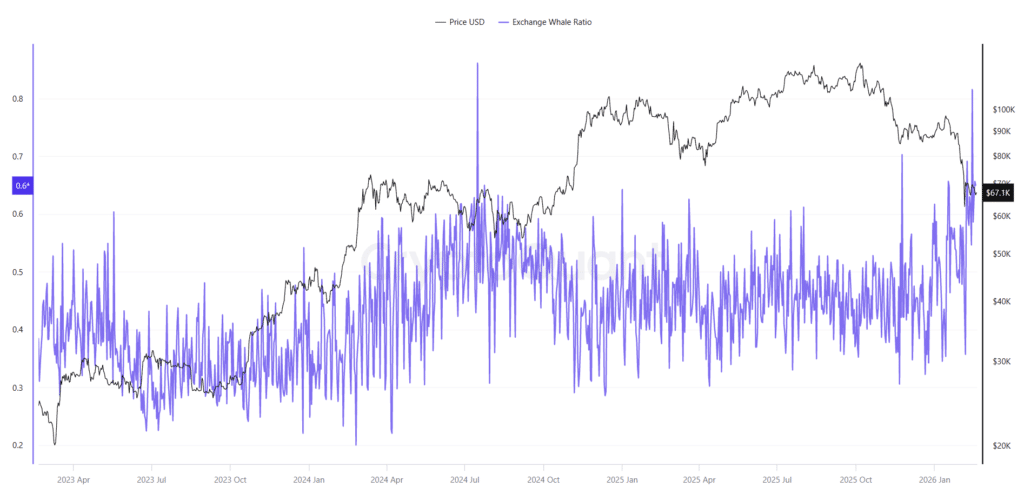
Bitcoin whale accumulation is in the spotlight this month, with on-chain data revealing that big holders have added 200,000 BTC, even as short-term buying is slowing down. The cryptocurrency is currently trading around $67,247.71, which is about 46% below its all-time high near $126,000 in October 2025.
This shows a divided market with large holders continuing to steadily buy and hold while short-term participants are selling quickly to limit losses, as many are currently underwater. This mix of behaviors is influencing Bitcoin’s price movements in the near term, keeping the market cautious and reactive.
What Does Bitcoin Whale Accumulation Signify for Investors?
Bitcoin whale accumulation, referring to purchases by addresses holding large amounts of BTC, shows ongoing confidence from major investors and institutions. Over the past month, whale-held BTC has grown by 200,000 coins, bringing total whale supply to over 3.1 million BTC.

This large-holder buying indicates that even as Bitcoin’s price faces weakness, strategic participants continue to build positions. This steady accumulation is particularly significant while short-term holders remain underwater and are less able to absorb market volatility.
How Are Short-Term Holders Influencing Price Moves?
Bitcoin whale accumulation is unfolding at a time when short-term holders are increasingly underwater, with realized price UTXO age bands showing BTC trading below their average cost. Glassnode outlines a three-stage market unwind since October, beginning with a sharp drop toward the $79,200 True Market Mean, followed by consolidation through late January, and then a clear February breakdown toward the $60,000 area.
As losses mount, many short-term participants react quickly, selling into minor price recoveries to reduce exposure. This behavior turns brief rebounds into supply events. Reflexive flows and leverage further intensify the pressure, with CryptoQuant data showing daily net realized losses averaging about $1.5 billion.
Meanwhile, Alphractal data indicate that the short-term holder 90-day net position change remains positive but is declining rapidly, signaling slowing accumulation. This setup echoes the November 2025 move around $80,000, when prolonged stress led to broad surrender, increasing the risk of capitulation if current conditions persist.
Are Long-Term Holders Experiencing Stress?
Bitcoin whale accumulation is taking place as long-term holders begin to show signs of stress. Data indicate that the long-term holder SOPR has fallen to 0.88, below the key level of 1, which means older coins are now being sold at a loss. Although the yearly average SOPR remains high at 1.87, the recent drop points to growing sell-side pressure within a group usually viewed as the market’s stabilizing force.
At the same time, CryptoQuant data show rising inflows from long-term holders to Binance, one of the largest liquidity venues. These movements suggest that some holders are preparing for possible sales, hedging strategies, or changes in exposure. Together, these signals add caution to the market, even as Bitcoin whale accumulation and large-holder buying continue in the background.
How Are Institutional Purchases Supporting Market Stability?
Institutional activity remains steady despite ongoing market pressure. Strategy added 2,486 BTC between February 9 and February 16, increasing its total holdings to more than 717,000 BTC. Alongside this, Bitcoin whale accumulation continues to provide a steady source of demand that helps offset reactive selling from short-term participants.
A similar setup was seen during the April 2025 correction, when strategic purchases absorbed selling pressure and later supported the rally from $76,000 to $126,000. This shows that large-holder buying can still act as a stabilizing force during periods of elevated volatility.
| Metric | Value |
|---|---|
| Whale Accumulation (Past Month) | 200,000 BTC |
| Total Whale Supply | >3.1M BTC |
| Current BTC Price | $67,247.71 |
| Decline from ATH ($126K Oct 2025) | 46% |
| Glassnode True Market Mean | $79,200 |
| LTH SOPR (Current) | 0.88 |
| LTH SOPR (Annual Avg) | 1.87 |
| Strategy Holdings | 717,000 BTC |
| Strategy Recent Buy | 2,486 BTC (Feb 9-16) |
| Daily Net Realized Losses | ~$1.5B |
| STH 90-Day Net Position Change | Positive but declining |
What Could Determine Bitcoin’s Next Move?
Bitcoin is currently trading between a short-term break-even ceiling and a deeper structural cost floor. A move back above short-term realized price bands would ease pressure on trapped holders and lower the urge to sell into small rallies, pointing toward possible stabilization.

On the other hand, continued stress among long-term holders, together with slowing accumulation from short-term participants, could increase downside risk. This setup reflects past behavior seen during the November 2025 move around $80,000, which Glassnode identified as a surrender phase. In this environment, market direction is being shaped more by liquidity conditions and how different holder groups respond, rather than by individual large purchases.
Conclusion
Bitcoin whale accumulation remains central to overall market resilience. Even as short-term demand weakens and reactive selling persists, the addition of 200,000 BTC to large-holder wallets points to continued confidence among major participants. This trend helps form a potential price floor and clearly shows the gap between long-term, strategic buyers and short-term, loss-driven traders.
Market watchers note that tracking whale behavior alongside short-term holder activity will be key to understanding whether Bitcoin moves into consolidation, faces higher volatility, or sees further downside. In this environment, sustained large-holder buying may ultimately influence whether the market finds stability or continues to decline.
Disclaimer: This article is for informational purposes only and does not constitute financial or investment advice. Cryptocurrency markets are volatile, and readers should conduct their own research before making any financial decisions.
Glossary
Bitcoin Whale Accumulation: Large investors increasing their Bitcoin holdings.
On-Chain Data: Blockchain records showing real transaction activity.
SOPR: Indicator showing if Bitcoin is sold in profit or loss.
Underwater: Holding Bitcoin below the purchase price.
Exchange Inflows: Bitcoin sent to exchanges, possibly for selling.
Frequently Asked Questions About Bitcoin Whale Accumulation
How much Bitcoin do whales currently hold?
Whales now hold more than 3.1 million BTC after adding about 200,000 BTC recently.
What is Bitcoin’s current price compared to its all-time high?
Bitcoin is trading around $67,000, which is about 46% below its all-time high of $126,000.
Why are short-term holders selling?
Many short-term holders are selling because they are at a loss and want to reduce their risk.
How are institutions reacting to the current market?
Some institutions are still buying Bitcoin, which helps provide steady demand.
Why is Bitcoin whale accumulation important?
It is important because large investors buying Bitcoin can support the price during weak markets.
Sources