

Last updated: November 19, 2026
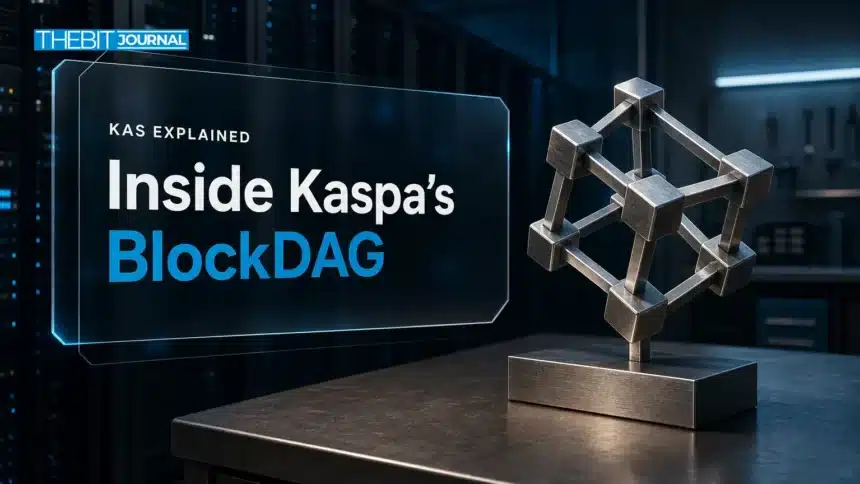
What is Kaspa? Kaspa is a proof-of-work Layer 1 network that uses a BlockDAG protocol to order parallel blocks instead of discarding them. Its native token is KAS, and its design and supply schedule distinguish it from networks that arrange blocks in a single chain.
Kaspa launched its mainnet in November 2021. The project says it had no premine, insider allocation or presale. Here’s how the network works, what KAS represents, and what the latest dated data can and can’t tell you.
Quick answer: What is Kaspa?
Kaspa is a proof-of-work Layer 1 whose GHOSTDAG protocol orders parallel blocks in a directed acyclic graph, or BlockDAG. KAS is its native token, and Kaspa’s mainnet runs at 10 blocks per second.
How Kaspa works, step by step
- Miners produce blocks. Like other proof-of-work networks, Kaspa relies on miners using computational work to produce blocks. This process helps secure the network and record transactions.
- Blocks can be created in parallel. A traditional blockchain generally arranges blocks in one chain. Kaspa’s BlockDAG structure allows multiple blocks to exist at the same time rather than treating every competing block as one to discard.
- GHOSTDAG orders those blocks. Kaspa’s official project description of GHOSTDAG says the protocol orders parallel blocks. That ordering is how the network can keep blocks produced close together within a shared history.
- KAS is the native token. Kaspa’s monetary policy follows a scheduled emission, with step-downs listed in its official emission schedule.
- Applications can use newer tools. Kaspa’s developer documentation says the Toccata hard fork activated on June 30, 2026. It added programmable UTXOs through covenants, transaction introspection, zero-knowledge proof verification and sequencing support for applications.
The project says its mainnet runs at 10 blocks per second. That is a block-production rate, not a promise about how quickly every user’s transaction will confirm or how much activity the network can handle in every condition.

Kaspa overview and KAS data
Kaspa’s core design difference is the way it organizes blocks. The following dated figures provide a snapshot of KAS, not a forecast. CoinGecko reported the market data below at 14:29 UTC on November 19, 2026.
| Item | Kaspa or KAS detail |
|---|---|
| Network type | Proof-of-work Layer 1 |
| Block structure | BlockDAG using GHOSTDAG |
| Native token | KAS |
| Price | $0.02737608 |
| Market capitalization | $761,543,108 |
| Circulating supply | 27,817,831,813 KAS |
| Maximum supply | 28,704,026,601 KAS |
CoinGecko’s price and market capitalization are market snapshots and can change quickly. The supply figures also show why a quoted token price alone says little about a network’s total market value. Kaspa’s official emission schedule gives a maximum supply of about 28.7 billion KAS and lists a scheduled emission step-down on December 7, 2026, from 51,137,609 to 48,267,475 KAS for the listed emission period.
Network development continues beyond the protocol’s original design. Kaspa’s official developer resources describe Toccata’s additions, while the project’s published lore describes DAGKnight as a next major consensus development with a 2027 hard-fork target for 10-millisecond blocks. That is a target, not confirmation of an activation date. Crypto.news reported that the Kaspa Covenant Coordination Forum finalized KCC-1, KCC-2 and the KCC-20 fungible-token convention on October 21, 2026. Those are ecosystem standards, not consensus-rule changes.
What is Kaspa useful for, and what are its limits?
Kaspa’s base layer is designed to record transactions through proof of work, while newer programmable features are intended to support application logic. The project’s developer documentation outlines the tools added with Toccata. A feature being available at protocol level does not, by itself, prove that an application is widely used, reliable or safe.
For readers comparing networks, Kaspa’s central design feature is its handling of parallel blocks, and KAS is its native token. Any assessment of the network should also consider market volatility, technical risks and custody risks.
Common mistakes and risks
- Confusing blocks per second with transaction certainty. Kaspa’s stated 10 blocks per second describes block production. It does not guarantee a particular confirmation time or transaction outcome.
- Treating a roadmap target as a completed upgrade. The 2027 DAGKnight timing described by Kaspa is a target. Future development can change, and a target is not the same as a mainnet release.
- Assuming a maximum supply fixes the token’s value. A supply cap does not determine demand, market price or future performance. KAS has price volatility, and holders can lose some or all of the value they put at risk.
- Overlooking technical and custody risks. Proof-of-work networks can face security and operational challenges. Wallet mistakes, exchange failures, smart contract flaws and scams can also result in losses. Never share a wallet seed phrase.
Kaspatrol’s explorer displayed a hashrate of 305.57 PH/s, 69,328 transactions in the prior 24 hours and 27,817,887,802 KAS circulating when checked on November 19, 2026. These are time-sensitive explorer readings, not permanent network characteristics. Rules for crypto products and taxes differ by country.

Kaspa FAQ
What is Kaspa and how does it work?
Kaspa is a proof-of-work Layer 1. Its GHOSTDAG BlockDAG protocol orders parallel blocks, and KAS is the network’s native token.
Is Kaspa a blockchain?
Kaspa is a Layer 1 network, but its block structure is a BlockDAG rather than a single linear chain. The project says GHOSTDAG orders parallel blocks instead of discarding them.
What is KAS used for?
KAS is Kaspa’s native token. Its market price can move sharply, and holding it carries volatility, custody and total-loss risks.
Sources
- LORE | Kaspa (www.kaspa.org)
- Kaspa Developer Docs, SDKs, APIs, and Node Access | Kaspa (kaspa.org)
- Kaspa price and market data (CoinGecko)
This article is for informational purposes only and does not constitute financial or investment advice. Cryptocurrencies are highly volatile; always do your own research before investing.