
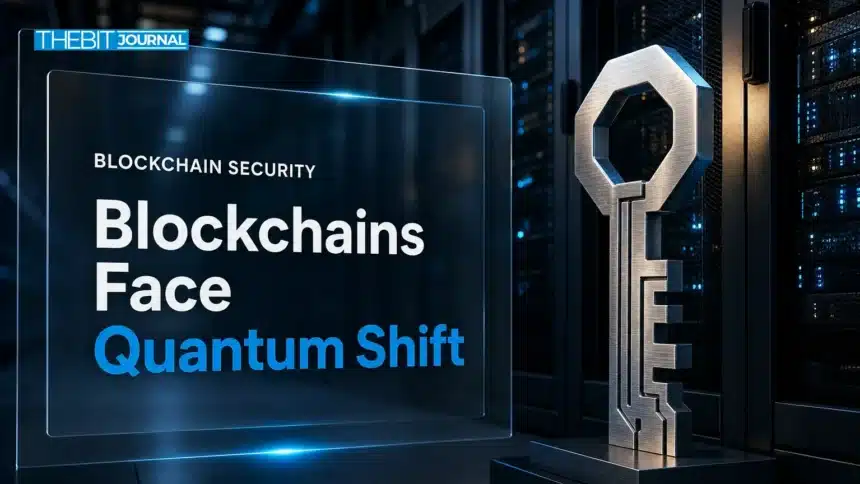

The quantum blockchain upgrade could be harder than a routine software change, the International Organization of Securities Commissions (IOSCO) warned on November 19. The global forum of securities regulators said quantum computers capable of breaking current cryptography don’t yet exist, but financial firms and blockchain networks need to prepare for a lengthy transition.
IOSCO’s final report examines how public-key cryptography supports financial services, including blockchain transactions. Its warning concerns readiness, not an active attack on networks.
Key Takeaways
- IOSCO says migration may be especially difficult for blockchains because cryptography is built into their core design.
- Future signatures could be 35 to 40 times larger than common elliptic-curve signatures.
- A quantum-resistant Solana testnet reportedly saw throughput fall by about 90% after conventional signatures were replaced.
- Practical quantum computers able to compromise widely used cryptography do not yet exist.
What happened with the quantum blockchain upgrade warning
IOSCO published its 63-page report, Implications of Quantum Computing on Financial Markets, on November 19. It calls the move to post-quantum cryptography a significant cybersecurity challenge. For blockchains, the upgrade could be especially complex because cryptography is built into transaction formats and consensus rules.
Public networks including Bitcoin, Ethereum, Solana and Tron use elliptic-curve cryptography to verify users and transactions. A sufficiently powerful quantum computer could potentially derive a private key from an exposed public key, putting assets controlled by that key at risk. IOSCO says no such practical machine exists today.
The timeline remains uncertain. IOSCO cited conservative estimates that a machine capable of compromising widely used cryptography could emerge between 2030 and 2035. Some industry participants consulted for the report said firms should prepare for a possible five-year timeline, potentially accelerated by AI. These are estimates and concerns, not a confirmed arrival date.
IOSCO Board Chair Jean-Paul Servais said the financial sector should prepare now because the transition will take time. The IOSCO report describes cyber-readiness as an immediate challenge, even though the quantum capability behind the concern is not yet available.
Why a quantum blockchain upgrade is difficult
IOSCO says blockchain migration is difficult because cryptography is embedded in core architecture and requires coordinated action across decentralized networks. Replacing that cryptography requires hard forks, and decentralized networks have no way to force quick adoption.
New signatures also create a performance and data-size trade-off. The report cites ML-DSA-44, a post-quantum standard from the U.S. National Institute of Standards and Technology, with signatures around 2,420 bytes. That is roughly 35 to 40 times the size of a typical 64-byte elliptic-curve signature.
On a quantum-resistant Solana testnet, replacing conventional signatures reportedly cut throughput by about 90%. This is a testnet result, not a measurement of a completed upgrade on a live network.
The transition could leave vulnerable accounts or smart contracts behind if they continue using old keys. IOSCO distinguishes attacks on keys exposed for a long time from attempts to exploit a public key after a transaction reveals it. Dormant or abandoned coins are a harder case if their owners can’t move them.
Wallets and device software face additional migration questions. Decrypt reported that Trezor CTO Tomáš Sušánka discussed candidate Bitcoin signature trade-offs, including the risk that some stateful signatures could expose funds if keys are reused beyond their signing budget. Hardware wallets must also consider cryptography for firmware and device authentication.

Market reaction to the quantum blockchain upgrade news
Prices showed no broad one-way move in the market snapshot at 14:13 UTC on November 19. Bitcoin was near unchanged over 24 hours, while Ethereum and Solana were modestly higher. All three were down over seven days, so the daily moves alone don’t establish a reaction to IOSCO’s report.
| Asset | Price, USD | 24-hour change | 7-day change |
|---|---|---|---|
| Bitcoin (BTC) | $63,950 | +0.12% | -12.15% |
| Ethereum (ETH) | $1,811.95 | +1.25% | -10.36% |
| Solana (SOL) | $75.11 | +1.26% | -8.54% |
CoinGecko market data, recorded at 14:13 UTC on November 19, 2026, provides the figures. It doesn’t isolate the report’s effect from broader market conditions. Crypto prices remain volatile, and network security risks are separate from short-term price moves.
The warning came amid wider policy attention. On the same day, the UK’s Prudential Regulation Authority, Financial Conduct Authority and Bank of England published practices for managing quantum-related cyber risk, including migration testing and checks on third-party readiness. IOSCO also warned against “quantum washing,” or overstating the maturity of quantum technology, and said it would keep the issue on its agenda for 2027.
What to watch next
Watch for detailed migration plans from major networks, including which keys need changing, how users can move assets and how old signatures will be handled. IOSCO says firms should plan migrations, test quantum-resistant technologies and engage suppliers. UK regulators also highlighted the need to assess technology providers’ readiness.
A working upgrade would require coordination among wallet developers, exchanges and network participants. IOSCO urged firms to test quantum-resistant technologies and engage suppliers.
IOSCO’s warning doesn’t establish that a breakthrough is imminent. It frames preparation as a multi-year redesign rather than a last-minute patch. The central challenge is whether decentralized networks can agree on a safe migration before quantum computers pose a practical threat, while limiting disruption and avoiding false claims about readiness.
FAQ
What does a quantum blockchain upgrade mean?
It means replacing or supplementing cryptographic methods used to secure transactions and keys with methods designed to resist attacks from sufficiently capable quantum computers. The transition may require network-wide software and wallet changes.
Does a quantum computer currently threaten Bitcoin or Ethereum?
IOSCO says practical quantum computers capable of compromising widely used cryptography don’t yet exist. The report discusses a future risk and urges early preparation, not an active attack on Bitcoin or Ethereum.
Why could the quantum blockchain upgrade take years?
Blockchains rely on shared transaction rules and decentralized participants, so changes require coordination across networks and service providers. Larger post-quantum signatures may affect performance, while old or inactive keys could remain vulnerable after an upgrade.
Sources
- FR/07/2026 Implications of Quantum Computing on Financial Markets (www.iosco.org)
- Quantum Upgrade Could Be 'Particularly Challenging' for Blockchains: IOSCO (Decrypt)
- IOSCO warns quantum upgrades could slow blockchains, leave security gaps (Cointelegraph)
This article is for informational purposes only and does not constitute financial or investment advice. Cryptocurrencies are highly volatile; always do your own research before investing.