


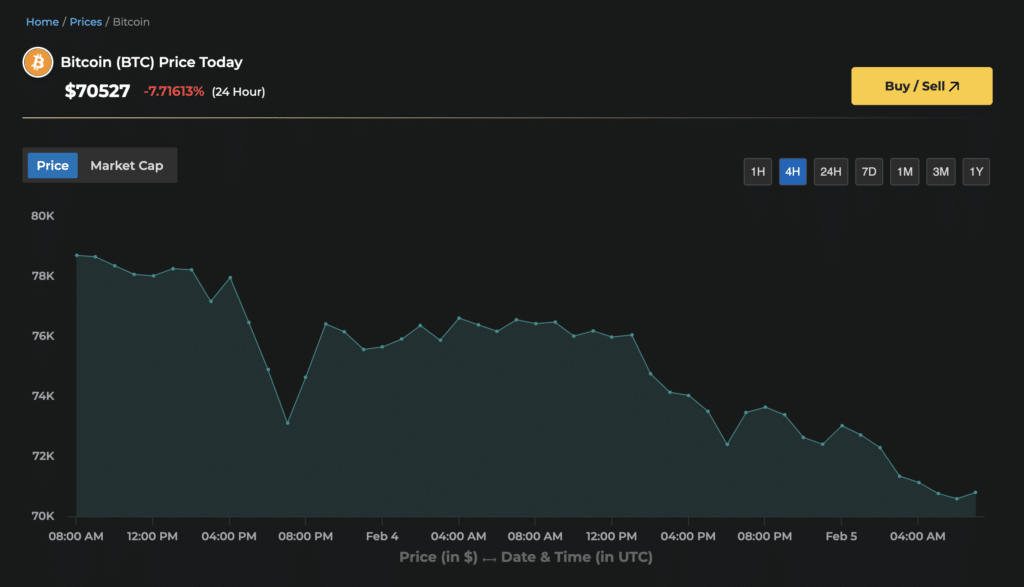
The war of words between Schiff and Saylor continues to heat up with Strategy’s Bitcoin investment now being put under the microscope. BTC is trading near $72,000 USD with a 24-hour volume of about $82 billion USD, but market volatility is putting pressure on companies carrying large crypto portfolios. ”Strategy’s stock is on the board near $133, off roughly 6.4%, reflecting added risk tied to Michael Saylor’s Bitcoin acquisition strategy.
Investors are now asking whether the corporate Bitcoin holdings of strategy can really survive such swings, and the feud between Schiff vs Saylor over Bitcoin has been ramped up a notch in both mainstream and crypto-focused media.
Looking Into Strategy’s Bitcoin Holdings
That is because Strategy holds tens of thousands of Bitcoin, meaning there’s a direct correlation between the company share price and BTC volatility. With Bitcoin trading in the $72,000 range, unrealised losses for the firm are poised to tick close to $900 million. Michael Saylor’s corporate Bitcoin play will lead to long-term insolvency: critics Peter Schiff, amongst others, including me, have not wavered in their criticisms of Michael Saylor’s corporate Bitcoin strategy.
The Schiff vs Saylor crypto clash is crystallizing the fight between proponents of bullish corporate adoption and detractors warning about excessive leverage. Market observers are now wondering whether Strategy’s BTC holdings betting against 2026 risk assumptions is even realistic in the context of larger crypto volatility.
MSTR Stock The Mirror of Bitcoin’s Volatility
The relationship between MSTR stock and Bitcoin is real. Shares are trading up $133, or about 6.4%, while Bitcoin is off by around 2.56% over the last 24 hours. Analysts believe that an extended BTC downtrend will likely weigh heavily on the market cap of Strategy.
The Schiff vs Saylor MSTR stock debate just became more than theoretical; It is now palpable for investors to witness corporate balance sheets teeter. “Risk management” Many are questioning if MSTR stock is now directly correlated with Bitcoin as the company’s corporate crypto treasury becomes less sustainable in a turbulent market.
Peter Schiff Hits Corporates on Bitcoin Tactics
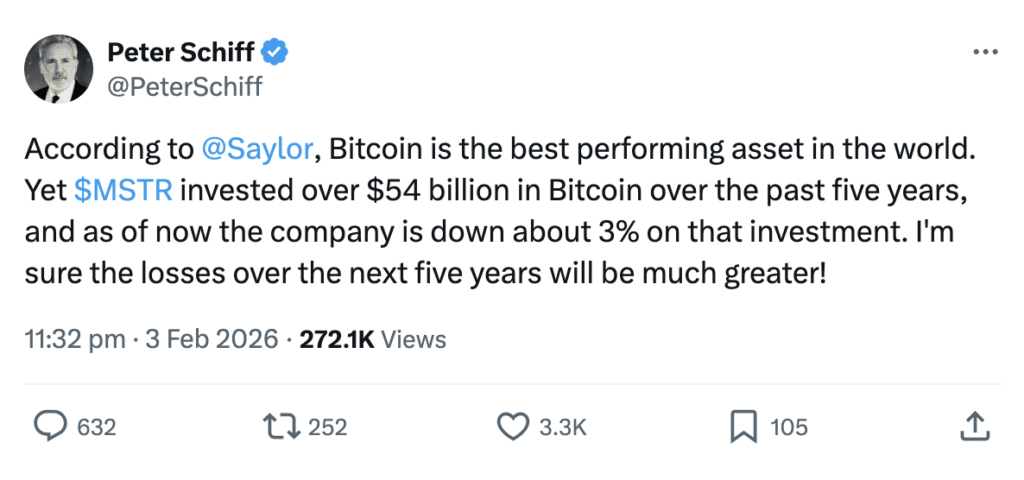
Peter Schiff has been vocal in his opposition to corporate Bitcoin adoption, particularly targeting Strategy’s exposure. He warns that if Bitcoin’s price falls below approximately $70,000, the company may face existential challenges, highlighting broader concerns captured in the ongoing Schiff vs Saylor 2026 debate. Schiff emphasises liquidity and balance-sheet security over aggressive growth, framing his critique as a cautionary message for other public companies considering high levels of crypto in their treasuries. These perspectives are reflected in his commentary on X.
Michael Saylor Responds to Criticism
Michael Saylor: “We Will Never Sell One Single Satoshi of BTC” Michael Saylor has come out in defense of the same stating this is to do with long-term Bitcoin adoption trends by institutional players. Strategy’s assets are safe and there is a method behind the madness, he says. But the market reality here does not support the story line.
The Schiff-Saylor debate has by now crossed public statements, investor threads and social media while participants weigh the advantages of corporate Bitcoin accumulation at scale. The probability of success versus risk has made Saylor’s Bitcoin strategy a bone of contention, which pits optimists and pessimists in an open-ended argument about whether it is failing or bound to bounce back.
Market Implications of Strategy’s Exposure
Strategy’s BTC exposure impacts overall market sentiment. A sudden fall in Bitcoin could spark not just more losses for MSTR but contagion across similar names. Analysts now wonder whether corporate Bitcoin adoption might cause traditional equity markets to wobble.
The Schiff vs Saylor #Bitcoin feud serves as a perimeter for this topos, emphasizing systemic risk exposed from concentrated BTC holdings. Investors and analysts are trying to determine if the firm Strategy’s strategy is copyable for other companies, or if public company exposure to Bitcoin introduces unnecessary market risks in 2026 and further.
Analyst Opinions and Price Targets
Analysts forecasts are changed with the market chaos. At the beginning of the month, Canaccord reduced MSTR’s target by almost 60%, justifying it with price volatility for Bitcoin and Strategy’s leverage. These changes feed into the Schiff vs Saylor Strategy BTC debate where some are urging to mitigate risk and others stand by their company’s visionary strategy.
These divergent views reflect a larger uncertainty: Will Strategy withstand the whims of Bitcoin, or will big paper losses finally demand a course correction? Investors are listening for any evidence that Saylor is pivoting or struggling.
Lessons for Corporate Bitcoin Adoption
The Schiff vs Saylor Bitcoin debate echoes the nuances of corporate crypto strategy. It asks questions about risk management, treasury diversification, and whether companies can maintain exposure in the long-term without endangering operational stability.
While Strategy is steering its way through these waters, not only are analysts acknowledging that exposure of public companies to Bitcoin has become a mainstream risk conversation. The lessons are applicable to far more than just MSTR, and should make any company paying attention consider not only whether or not it’s worth buying some crypto in a bid to put its corporate cash to work achieving more return on investment, but the inherent tug-of-war between the opportunity presented by public markets and prudent corporate policy in volatile times.
Risk Assessment: Saylor’s Strategy Is It Suddenly Failing?
And although Saylor has mounted a defensive defense, market metrics indicate that Strategy is feeling pressure. Unrealized BTC losses are nearly $900M as MSTR stock drops. This is where the Schiff vs Saylor debate turns into a real live case study for corporate Bitcoin risk.
Observers wonder if Michael Saylor’s Bitcoin strategy is flopping, or if so-called short-term market gyrations will play out in the long run in favor of the plan. It’s key for investors when considering “Strategy BTC Holdings Risk 2026 to do this analysis due to the strong relationship between movements in the price of BTC and asset performance on a company balance sheet.
Here’s What is Next for MSTR and Bitcoin Both?
Looking to the future, Strategy’s path forward will rely on Bitcoin’s short-term price action. If, however, BTC manages to trade back above $75k then unrealized losses may decline and confidence will return. On the other hand, additional falls below $70,000 could trigger risk worries.
The Schiff v Saylor Bitcoin feud is putting these cases within the context of a broader discussion about corporate exposure to crypto. Analysts and investors will have to weigh questions like “Can MSTR survive another BTC crash?” and “Is corporate Bitcoin adoption dangerous?” as they look ahead to the next crucial actions for Strategy and the market.
Conclusion
The Schiff vs Saylor showdown is bullish for corporate Bitcoin adoption; Michael Saylor’s oversight of risk management in the face of Peter Schiff’s erroneous characterization of BTC. Strategys exposure, reportedly unrealised losses of nearly $900 million and MSTRs market performance underscore the risks public companies face when dabbling in crypto.
Common investors, analysts and market enthusiasts need to keep their eyes both on the Bitcoin charts and company financials. For those playing in this arena, the message is clear: understanding and managing risk are key. Keep up to date and watch for fluctuations in BTC, examine the crypto strategies of companies with a grain of salt before investing.
Appendix: Glossary of Key Terms
Bitcoin (BTC): A digital cryptocurrency and the largest by total market cap.
MSTR (Strategy stock): a Nasdaq company with loads of holding in BTC.
Unrealised Loss: A negative difference between the market price of a security and its current cost.
Corporate Bitcoin Treasury: Firm’s designated reserves in BTC to hedge or invest.
Leverage: The use of borrowed funds to increase investment exposure.
Volatility: How variable prices are within a market.
Frequently Asked Questions About Schiff Vs Saylor
What is the argument between Schiff and Saylor?
It pitted Peter Schiff’s criticism of corporate Bitcoin exposure against Michael Saylor’s bullish BTC strategy.
How many Bitcoins does Strategy own?
Strategy holds tens of thousands of BTC, with a value around $72k a coin.
Will MSTR continue to live through additional drops of Bitcoin?
In the end, survival comes down to hits risk management, liquidity on the treasury and markets rebounding. But analysts caution that there is still potential for exposure to large fluctuations.
What does Peter Schiff have against Bitcoin adoption?
Schiff claims Bitcoin is speculative and corporate exposure creates financial risk.
Is Michael Saylor’s Bitcoin play failing?
While near-term losses are getting attention, the million-dollar question persists: Is long-term viability real or a mirage that will leave analysts and investors scratching their heads?
Sources: