
XRP price analysis points to a familiar yet often-ignored market setup as trading activity around the token becomes noticeably quiet. Recent price movement shows XRP weakening in the short term, even though broader market indicators suggest a possible change in momentum.
This phase is not influenced by news headlines or market excitement. Instead, it is defined by low trader participation, tight price movement, and signals that have historically appeared before strong price moves in XRP’s market cycles.
Although the token has declined in recent sessions, traders and analysts are now focusing on what reduced trading interest has signaled for XRP in past market conditions. This situation is important because similar periods of silence have previously been followed by sharp upward price movements, rather than extended downturns.
What does the recent XRP price movement indicate?
The recent price movement reflects a short-term cooling rather than a structural breakdown. XRP has declined by 8% over the past week and is currently trading around $1.91, showing a 1.89% drop over the last 24 hours. The token moved below the $2 level after starting the year with a strong rally. Despite this pullback, XRP remains up 5% since the beginning of 2026.
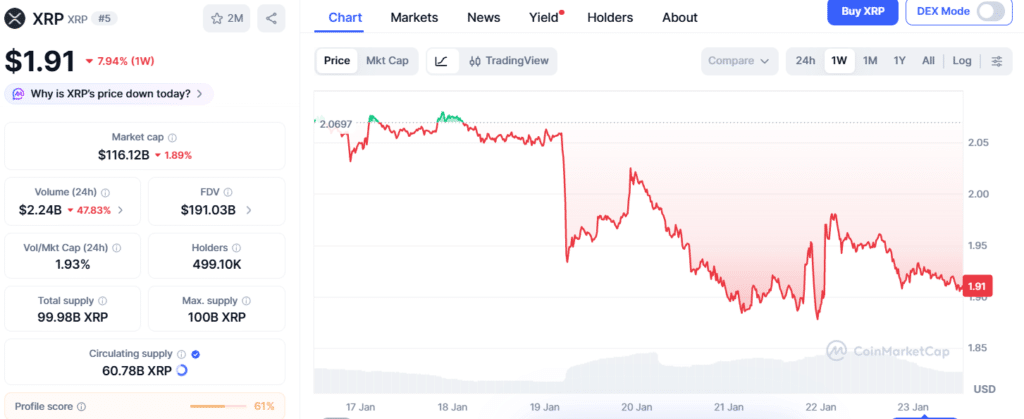
This combination of a weekly decline and a positive year-to-date performance points to a phase of consolidation rather than a broader trend reversal, a pattern often noted in XRP price analysis during transitional market phases. Market analysts note that similar pullbacks have historically helped reset momentum, especially when they occur near established technical levels rather than after extended rallies.
Why has trading activity dropped, and why does it matter?
Lower market participation has historically worked as a contrarian signal for XRP. On-chain data shows that trading interest around the token has declined, with fewer traders actively taking positions. Analysts who monitor behavioral market trends note that periods of reduced attention have often come before sharp price movements in XRP.
This behavior has supported a more constructive XRP price analysis when overall sentiment remains quiet instead of overheated. The reasoning is simple. When many traders step back, the market can react more strongly once demand returns. In past cycles, similar slowdowns in activity around XRP have been followed by sudden increases in volatility, catching much of the market off guard.
What role does trading volume play in the current setup?
Rising trading volume near support levels adds important context to XRP’s ongoing consolidation. XRP trading volume recently increased nearly 20% to $4 billion as the price found support along a key trend line. Current data shows trading volume at $2.24 billion, reflecting a 47.86% decline over the past 24 hours, indicating that activity has eased after the initial surge.
This pattern suggests that buyers were active near support before broader participation cooled again. From a market structure perspective, volume returning at support is often seen as part of a base-building phase rather than distribution. Analysts reviewing this data note that the behavior remains consistent with a neutral-to-bullish XRP price analysis, provided the token continues to hold above key technical levels.
| Metric | Value |
|---|---|
| Current Price | $1.91 |
| Trading Volume (24h) | $2.24B |
| Futures Open Interest | $3.5B–$4.5B |
| RSI (1D) | 41.36 |
| Key Support | $1.85–$1.90 (double bottom) |
| Key Resistance/Neckline | $2.10–$2.20 |
| Year-to-Date Gain | +5% |
What does futures market data reveal about trader positioning?
Open interest stability has stood out as a key feature of XRP’s derivatives market. Data from XRP futures shows open interest holding between $3.5 billion and $4.5 billion for several months, indicating a prolonged period of balance. This extended range is notable because the last time open interest remained within similar limits, it was followed by a strong price advance that brought XRP closer to its all-time high than it had been in seven years.
Derivatives analysts often refer to this type of structure as a coiled market. With leverage neither rising sharply nor unwinding aggressively, positioning appears restrained. This setup suggests the market may be preparing for a directional move once a clear catalyst emerges. As a result, this behavior has contributed to a more constructive XRP price analysis among traders who prioritize historical patterns over short-term market noise.
How does technical compression affect near-term expectations?
Tight trading ranges often come before decisive market moves. XRP is currently consolidating near the $2 level, reflecting strong price compression that has limited short-term volatility. Technical analysis also shows XRP forming a double bottom pattern around the $1.90–$2.00 support zone, a structure that has emerged following sell-offs seen in late 2025.
This pattern suggests selling pressure may be weakening as price action stabilizes near a well-defined support area. For the double bottom structure to confirm a bullish reversal, XRP would need a sustained move above the $2.15–$2.20 neckline resistance, supported by rising volume. A move above $2.10 would indicate improving bullish momentum and could potentially push XRP toward $3 in the near term. Until that occurs, the signal remains neutral to cautiously constructive rather than confirmed.
From a risk management perspective, the setup provides clear downside levels. A sustained break below $1.85 could trigger a deeper pullback toward $1.75 or lower. Until such a move takes place, the ongoing compression continues to act as a neutral foundation within broader XRP price analysis frameworks, allowing traders to monitor structure without assuming direction.
What signals are momentum indicators sending?
Short-term momentum indicators remain mixed rather than decisively positive. On the 1-day timeframe, the Relative Strength Index (14) is reading 41.36, indicating neutral to slightly bearish momentum for XRP. This level shows that selling pressure is currently outweighing buying interest, though the indicator has not reached oversold conditions.

Momentum analysts note that RSI readings in this range often reflect a market in transition rather than one under strong directional control. While the signal does not confirm a reversal, it aligns with broader XRP price analysis that highlights consolidation and compressed volatility, suggesting the market may be stabilizing as traders wait for clearer direction.
Conclusion
XRP price analysis now centers on whether historical patterns may once again influence market behavior as the token trades within a tight range and market participation remains subdued. With XRP consolidating near a key psychological level, futures open interest holding steady, and momentum indicators beginning to shift, the structure suggests a market in pause rather than one losing conviction.
While downside risks remain clearly defined below important support levels, the combination of muted sentiment and technical compression has drawn attention from traders familiar with similar past setups. How this period of calm resolves will depend on whether participation and momentum return or consolidation continues.
Glossary
Open Interest: Number of active futures or derivatives contracts.
Contrarian Signal: Low activity that could mean price may rise.
Coiled Market: Stable prices and positions before a big move.
Resistance: Price level where upward movement may slow.
Trend Line: Chart line showing support or resistance direction.
Frequently Asked Questions About XRP Price Analysis 2026
Has XRP gained or lost value this year?
XRP is up about 5% since the beginning of 2026, despite a recent weekly drop of 8%.
What does low trading interest mean for XRP?
Low trading interest often acts as a contrarian signal, meaning XRP could rise after quiet periods.
What is open interest in XRP futures showing?
Open interest has been steady between $3.5 and $4.5 billion, indicating traders are holding positions and waiting for a big move.
Could XRP reach $3 soon?
If XRP breaks above key resistance at $2.10, it could move quickly toward $3.
Why did XRP trading activity drop recently?
Trading activity dropped because fewer traders are taking positions, which can signal a potential future price move.
Sources