






This article was first published by The Bit Journal.
Claims about Bitcoin’s environmental impact have consistently dominated public discourse, from debates that mining destabilizes power grids to the presumption that it worsens electricity cost degradation for the average consumer.
However, ESG researcher Daniel Batten has charged that many popular claims can’t be substantiated, and have been rebutted by studies published in peer-reviewed journals and real grid-level data.
His critique is aimed at stubbornly persistent myths regarding Bitcoin’s proof-of-work mining and the energy it consumes, which present a data-driven stance that rebuts common simplistic or alarmist narratives around Bitcoin’s electricity appetite.
Myth 1: Bitcoin Mining Causes Power Grids to Go Down
The largest Bitcoin mining energy myth is that the rapid growth of mining operations destabilizes local and regional power grids. Critics argue that the immense mining operations strain electricity systems and cause blackouts.
Batten disagrees though, pointing out that grid operators are beginning to bring mining online as a flexible load; in other words, miners can increase or decrease consumption based on what is happening with the grid and supply of renewables.
While comprehensive grid-wide empirical integration studies remain limited, analysis of how flexible loads can reduce real-time emissions show that data centers including crypto miners possess the technical capability of responding to signals from a grid, matching demand with supply renewable production and taking stress away from systems.
This suggests that miners may actually be able to stabilize grids, rather than destabilize them, in some cases.
Myth 2: Bitcoin Mining Pollutes the Environment and Raises Electricity Prices
It is also commonly argued that Bitcoin mining leads to higher prices of electricity for private or business users. On a scale that matters, Batten contends there’s no empirical basis for this claim.
In many areas where mining occurs, energy price structures are primarily determined by considerations such as fuel expenses, transmission investments and heavy industrial demand.
Even as mining activity grows, there’s been no report that found any direct correlation between growing mining activity and higher retail electricity rates.
Miners themselves are cost-sensitive as they need to keep energy costs low if they want to maintain a competitive edge. While isolated local cases of high consumption have raised concerns (for example small clusters of miners in areas with constrained grids), these incidents do not represent systemic price inflation across the electricity markets.
Myth 3: The Energy Consumed by Bitcoin Should Be Measured on a Per-Transaction Basis
The high energy per transaction for Bitcoin is often cited by critics as a sign of waste. Batten and others argue that total energy use is not proportional to transaction count, as the energy footprint of Bitcoin mining is tied to securing the whole network rather than authenticating particular transactions.
The Cambridge Digital Mining Industry Report, one of the most definitive energy studies to date, makes this point plain by demonstrating that Bitcoin’s annual energy usage (clocked at an estimated 138 Twh) does not grow relative to transactions or fees but only in accordance to network hash rate and consensus difficulty.
This reframes the discussion from transactions per unit of energy towards Bitcoin’s overall security architecture.
Myth 4: Bitcoin Mining Produces a Lot of Carbon
Batten counters the argument that Bitcoin mining must inevitably have a huge carbon footprint. It is true that mining uses electricity, and it can be associated with emissions when generated by fossil fuels; a significant part of the carbon footprint depends on the electricity mix.
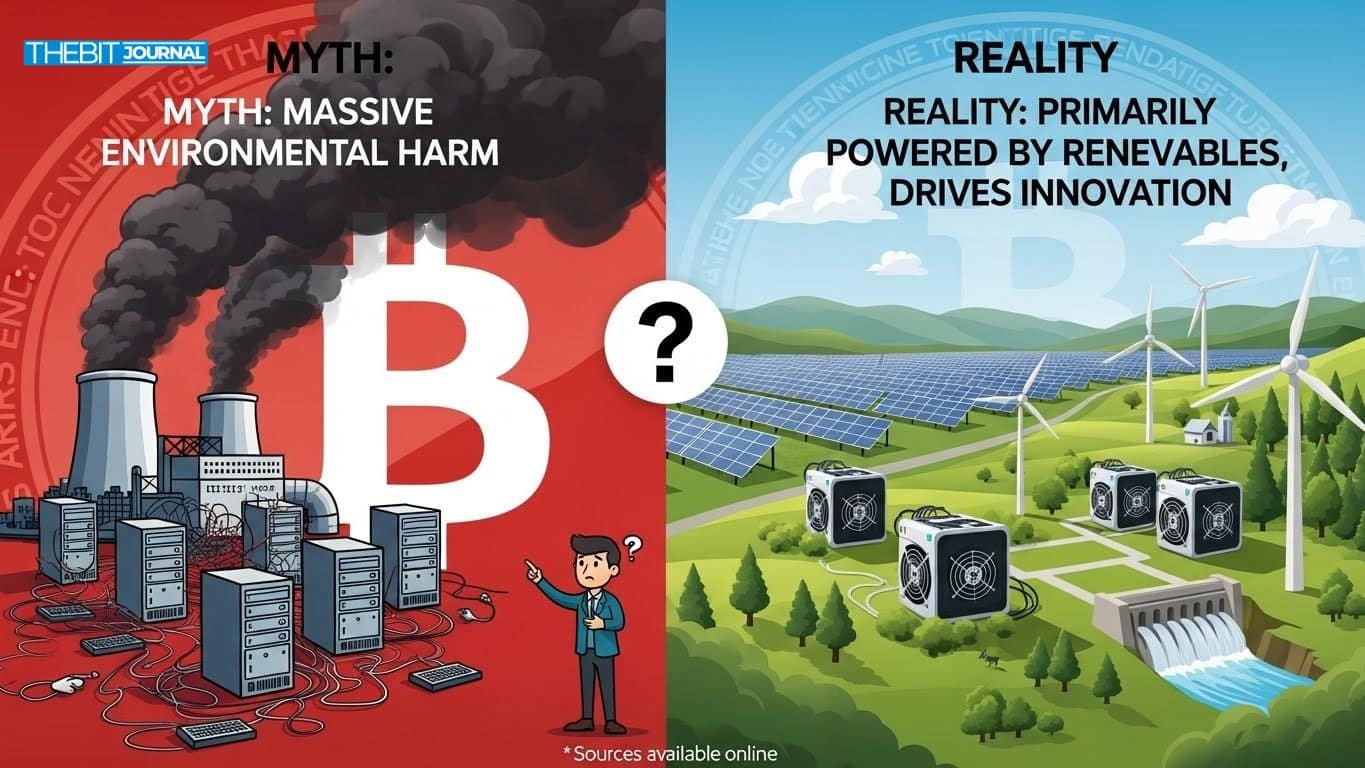
Recent empirical evidence reveals that more than 50 percent of the energy utilized in Bitcoin mining is presently derived from sustainable or low-carbon sources, like renewables such as hydropower and wind, and nuclear.
Sustainable power sources made up an estimated 52.4 percent of the energy consumed by Bitcoin miners in 2025, up from around 37.6 percent in 2022, according to the Cambridge report, which signaled a movement toward cleaner power.
Natural gas, a more carbon-friendly fossil fuel than coal, replaced coal as a top energy source, once again reducing the carbon intensity of mining operations.
Myth 5: Proof-of-Stake Is Universally Greener Than Proof-of-Work
Another Bitcoin mining energy myth is that alternative consensus mechanisms like Ethereum’s proof-of-stake (PoS) are necessarily more environmentally friendly.
Batten writes that this view confuses energy use with damage to the environment. It is true that PoS networks generally use much less energy as they don’t demand constant computing in order to secure the chain. Nevertheless, measuring energy use is not the same thing as capturing widespread system impacts of today’s mining practices like how miners can fit into electricity markets, tame methane emissions or take advantage of surplus renewable generation that would otherwise be lost.
The environmental profile of a network also relies on the energy mix and validation work context. PoS systems can be less energy-intensive, but net environmental contributions of PoW should be considered more comprehensively.
Beyond the Scope: Sustainable Energy Adoption and Grid Integration
According to reports, about 42.6 percent of mining energy is renewable, including hydropower and wind sources, complemented by some nuclear offerings at around 9.8%, to make 2025’s total sustainable fraction of all energy used equal to 52.4%.
Natural gas made up about 38.2 percent of the mix, while the role of coal tanked to less than 9 percent.
These moves indicate that Bitcoin mining’s environmental mix is changing, becoming more aligned with cleaner sources of power.
Part of this transition is motivated by economics. Miners frequently locate near low- cost or surplus renewable generation, so that they can operate with flexibility and avoid wasting away some renewable generation.
This process in which mining absorbs energy that might otherwise be wasted, counters the assumption that mining only competes for scarce grid resources.
Conclusion
The analysis of Bitcoin mining energy myths revealed that most objections are old and based on misconceptions, obsolete data, or unaccounted developments.
Peer-reviewed research and recent reporting suggest that Bitcoin’s energy use is not a proxy for environmental harm, that sustainable energy use is increasing, and that mining can interact constructively with electrical grids
As reports now make clear, more than half of Bitcoin mining energy already thrives from low-carbon or renewable sources, a detail that counters false depictions of mining as an “energy disaster.”
Although environmental arguments will no doubt continue, data suggests that assertions of grid instability, automatic price inflation and massive carbon footprints across the board are simply not rooted in rigorous evidence.
Glossary
Proof-of-work (PoW): The consensus algorithm which Bitcoin uses to secure and validate its transactions.
Renewable energy: Power sources that can naturally recharge over a reasonable period, like wind and solar or hydroelectric power.
Sustainable energy: Composed of renewable sources and low-carbon inputs, such as nuclear.
Cambridge Digital Mining Industry Report: An extensive, peer-reviewed report on the energy consumed by Bitcoin mining and its mix.
Frequently Asked Questions About Bitcoin Mining Energy Myths
Why does it take so much power to mine a Bitcoin?
Bitcoin’s proof-of-work consensus requires miners to perform computational work continuously, which consumes electricity. But this energy usage is what makes the network secure and it doesn’t scale with transaction volume. According to reports, mining currently consumes an average of 138 TWh per year, making up only about 0.5 percent of the world’s electricity consumption.
Is Bitcoin mining worse for the environment than other businesses?
While mining consumes significant electricity, the transition toward sustainable and low-carbon energy sources means its environmental impact is more complex than simple comparisons. More than 50% of mining energy now comes from sustainable inputs, reducing its relative carbon footprint compared to past years.
Is proof-of-work better for the environment than proof-of-stake?
Proof-of-stake networks take up less energy overall, but simply comparing energy use is not enough to gauge environmental consequences, such as where the power is sourced or how it is incorporated into grids.
Can Bitcoin mining be used to accelerate the adoption of renewable energy?
Sure, miners are included in some renewable generation installations and can occasionally prevent wasted power by consuming surplus output that might otherwise have to be curtailed, aiding integration of renewables.
References
Cambridge Judge Business School
CCN
CoinNews
arXiv