






Divergence Between Bitcoin and Mining Stocks
The financial world is buzzing about Bitcoin vs Bitcoin mining, a debate that has gained urgency as September brought unexpected results. Bitcoin, the original digital asset, fell by roughly 3 percent, while mining companies saw their share prices skyrocket. Cipher Mining gained more than 120 percent, Terawulf jumped 95 percent, and Iris Energy surged 86 percent.
This divergence is not just a fluke; it highlights the distinct dynamics that drive each asset class. Bitcoin’s price reflects global liquidity and macroeconomic trends, while mining equities respond to investor sentiment, operational performance, and new narratives like artificial intelligence.
For financial students and analysts alike, the Bitcoin vs Bitcoin mining conversation provides a textbook case in risk, leverage, and market psychology.
Market commentator Matthew Kimmell explained on X, “Mining stocks act like leveraged Bitcoin bets. When sentiment turns bullish, equities overreact to the upside.” His remarks underline why mining firms often outperform during short rallies but also collapse harder when conditions reverse.
The Hidden Struggles Behind the Rally
Despite eye-catching gains, the fundamentals of mining remain strained. Hashprice, a measure of miner earnings per unit of computing power, lingers below $55 per petahash per second. Transaction fees, which once played a major role in miner revenue, now account for less than one percent of block rewards. Expensive hardware has payback periods stretching longer than two years, forcing miners to rely on external financing.
Yet equities rallied hard in September. Investors appear willing to overlook these stress points in exchange for exposure to companies positioned at the intersection of crypto and advanced computing. The Bitcoin vs Bitcoin mining debate therefore hinges on whether equity valuations reflect sustainable prospects or just speculative excess.
Mining Stocks and the AI Infrastructure Boom
One reason miners are outperforming is their rapid pivot toward artificial intelligence and high-performance computing infrastructure. Several firms now market themselves as energy providers for data centers, not just Bitcoin producers. This narrative has resonated with institutions eager to capture growth in AI while diversifying beyond traditional tech stocks.
Prominent investor Anthony Pompliano noted, “Public miners are transitioning into energy-first businesses, with Bitcoin as a by-product. That shift is attracting capital from entirely new sectors.” His observation illustrates how mining companies are reshaping their image to secure higher valuations.
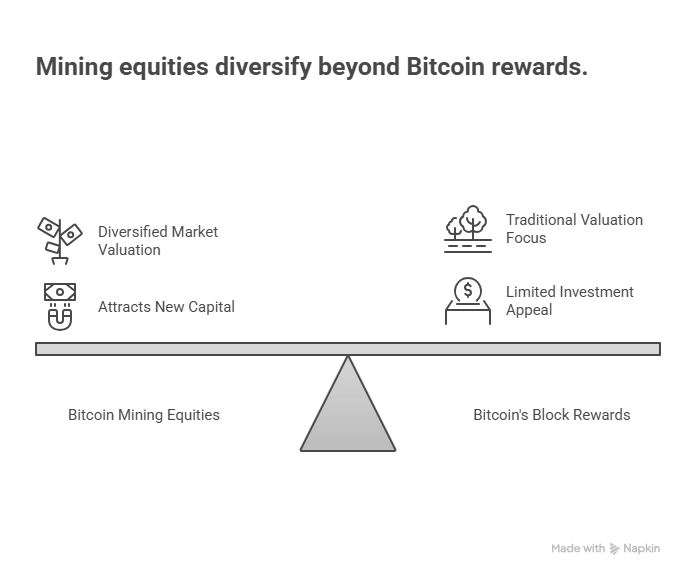
This strategic repositioning complicates the Bitcoin vs Bitcoin mining debate. Mining equities are no longer tethered exclusively to Bitcoin’s block rewards; their success may also depend on how effectively they integrate into broader digital infrastructure markets.
Bitcoin’s Long-Term Value Proposition
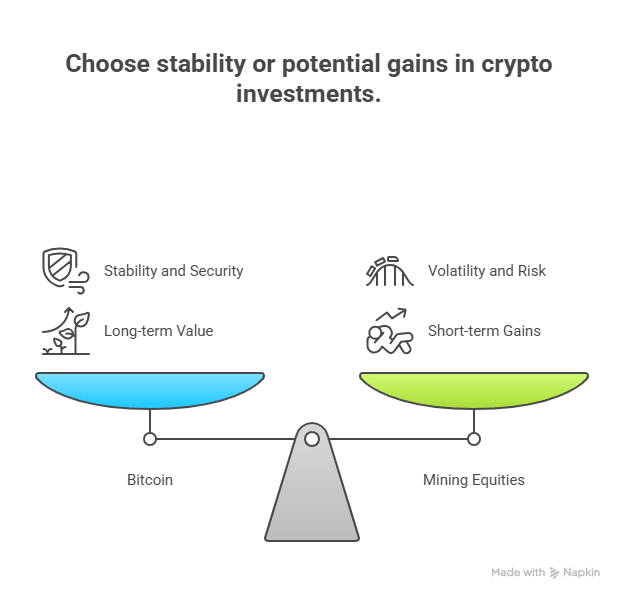
While miners chase new narratives, Bitcoin continues to play the role of digital gold. Its capped supply of 21 million coins, robust security, and global adoption give it a unique position as a long-term store of value. For blockchain developers, Bitcoin represents the most secure decentralized network ever built. For financial analysts, it is a hedge against inflation, currency devaluation, and systemic risks.
Scott Melker, a widely followed trader, commented, “If you want exposure to Bitcoin without the baggage of balance sheets and electricity bills, then Bitcoin itself is the safer play.” His words emphasize that despite temporary outperformance by mining stocks, the core asset remains unmatched in stability and resilience.
The Bitcoin vs Bitcoin mining decision thus boils down to time horizon and risk appetite. Mining equities may deliver amplified returns in bullish phases, but they remain vulnerable to energy prices, regulation, and competition. Bitcoin, on the other hand, remains the benchmark asset in the digital economy.
Conclusion: Balancing Exposure
The current divergence between Bitcoin and mining stocks underscores the complexity of crypto investing. The sharp gains in equities reflect investor appetite for leverage and speculative growth, while Bitcoin’s steadier path highlights its role as the bedrock of digital finance.
For financial students, the Bitcoin vs Bitcoin mining debate is a live case study in how markets reward different narratives. For crypto enthusiasts, it’s a reminder that not all exposure to Bitcoin is created equal. For blockchain developers, it shows how infrastructure companies can reinvent themselves to stay relevant. And for financial analysts, it illustrates the constant tension between short-term speculation and long-term fundamentals.
Ultimately, a balanced approach may serve investors best. Mining stocks offer volatility and upside tied to evolving business models, while Bitcoin offers security, liquidity, and endurance. Together, they form two sides of the same coin in the ever-expanding digital asset ecosystem.
Frequently Asked Questions about Bitcoin vs Bitcoin mining
Why are mining stocks rising while Bitcoin lags?
Mining stocks surged due to investor enthusiasm around AI infrastructure pivots and leveraged exposure, even as Bitcoin held steady or declined slightly.
Is Bitcoin less risky than mining stocks?
Yes. Bitcoin is free from operational risks like energy costs, regulation, and hardware financing, making it more stable long term.
How does AI impact the Bitcoin vs Bitcoin mining debate?
Mining companies leveraging their infrastructure for AI workloads are attracting new capital, boosting equity valuations beyond pure Bitcoin exposure.
Should I diversify between Bitcoin and mining stocks?
Many analysts recommend diversification. Mining stocks provide leveraged upside, while Bitcoin offers long-term resilience and a hedge against systemic risk.
Glossary
Hashprice: A metric measuring miner revenue per unit of computing power.
Mining Difficulty: A measure of how much computing power is required to validate transactions and create new blocks.
Public Mining Equities: Shares of mining firms listed on stock exchanges, providing indirect exposure to Bitcoin.
Transaction Fees: Fees users pay to miners for processing transactions, part of total block rewards.
Store of Value: An asset that preserves wealth over time, resistant to inflation or devaluation.
Leverage: Investment approach that amplifies gains or losses through borrowed capital or derivative exposure.