



AI agent payments face a basic accountability problem: software can stay within a spending limit and still buy the wrong thing. In an October 31 report, BeInCrypto uses a hypothetical flight booked to the wrong Korea to examine who bears the cost when an automated assistant misunderstands instructions or falls for an attack.
Key Takeaways
- The flight example is hypothetical, not a reported booking incident.
- BeInCrypto classified 14 of 19 reviewed products and workflows as capable of acting within advance permissions.
- Two selected incidents examined by its researchers sent $281,200 to attackers before recoveries.
- Payment permissions and reimbursement obligations are different questions, as reported Stripe terms illustrate.
Why AI agent payments raise questions about responsibility
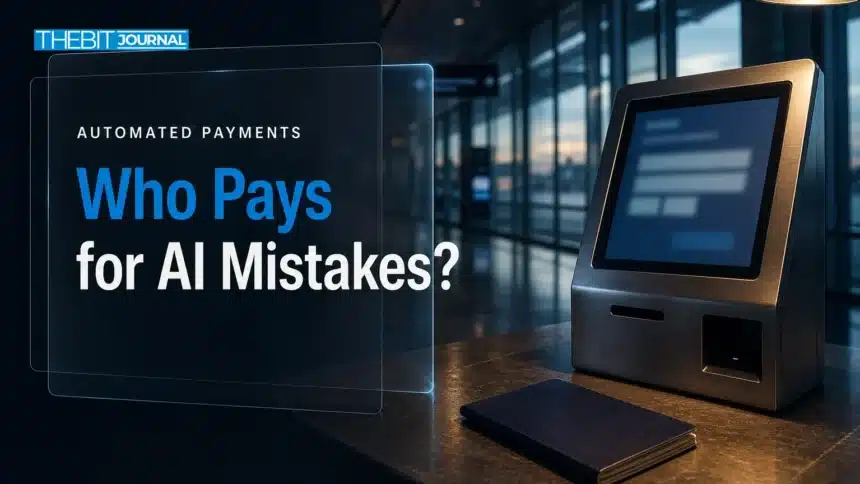
Bakkt chief commercial officer Daniel Ishag recounted a version of the scenario from a panel discussion, according to BeInCrypto’s October 31 report. An assistant finds an affordable business-class ticket to Korea, but selects North Korea rather than South Korea.
The point isn’t that this booking happened. It’s that a successful budget check wouldn’t necessarily catch a failure to understand the destination. Payment authorization answers whether software may spend, not whether it has correctly interpreted the task.
BeInCrypto separates several routes to an unwanted transaction: misunderstood instructions, malicious content presented as useful information, and stolen account access. The financial outcome may look similar, but responsibility could depend on which failure occurred.
That distinction makes automated spending more than a checkout engineering problem. It raises questions about whose instruction a system followed and what remedy exists afterward.

Background and context
BeInCrypto’s State of AI Agent Payments 2026 research classified 14 of 19 reviewed products and workflows as able to operate within permissions approved beforehand. The outlet cautioned that this documents capabilities, not proof that safeguards cannot fail. It also said broad demand and autonomous financial activity remain insufficiently demonstrated.
The same research examined two selected incidents in which attackers received $281,200 before recoveries. According to BeInCrypto, malicious instructions reached funded wallets without breaking the blockchain. Its article also referenced a mistaken $175,000 transfer to the wrong address in May 2026.
These examples illustrate a distinction: a transfer can proceed without a blockchain breach while the instruction prompting it is wrong. Protecting wallet access doesn’t by itself establish that an agent understood the owner’s intent. Malicious instructions and compromised credentials pose different risks.
BeInCrypto reported that Stripe’s current Link agent terms assign users responsibility, as between themselves and Stripe, for connected-agent transactions, including unintended payments caused by bugs, hallucinations or misunderstood instructions. The reported exception concerns Stripe’s own technical failure or error.
Those terms aren’t a universal legal ruling. Applicable rights and obligations may differ by country. As BeInCrypto’s discussion of Link’s terms notes, that contractual position does not settle every consumer’s legal rights. Permission to use a service should not be confused with a promise that its provider will cover an agent’s errors.
Market context
CoinGecko’s October 31 snapshot showed declines across the cryptocurrencies listed below, but the evidence does not establish a reaction to BeInCrypto’s report. These were USD prices and rolling 24-hour changes at 06:13 UTC on October 31, 2026:
| Asset | USD price | 24-hour change |
|---|---|---|
| Bitcoin | $77,215 | -1.66% |
| Ethereum | $2,240.64 | -0.10% |
| Solana | $95.89 | -2.10% |
The CoinGecko Bitcoin data and other prices provide market context only. They do not show that concerns about AI agent payments moved prices, nor do they establish demand for automated payment services.

What to watch next
Reimbursement claims need to be distinguished from demonstrated coverage. BeInCrypto quoted Sailo Technologies co-founder and CEO Ehud Tal saying, “So we provide our customers for the first time ever a money-back guarantee.” The report does not establish eligibility conditions, exclusions or a claims process, so his statement should not be read as blanket protection.
Ishag also warned that competition for computing resources and AI development could push security aside, according to BeInCrypto. Bitcoin Japan Corporation CEO Phillip Lord expects agents to introduce additional risk, while noting that human users already make mistakes.
A useful test for AI agent payments would be evidence of safeguards working under pressure: whether they detect misleading instructions and stop unintended transfers. Separate questions are what caused an unwanted transaction and whether any money was recovered.
The reported incidents show why blockchain integrity alone is not enough to assess these risks. In BeInCrypto’s account, attackers’ instructions reached funded wallets without breaking the underlying blockchain.
FAQ
Who pays when AI agent payments go wrong?
The reported Link example illustrates why service terms and the cause of an error matter. BeInCrypto says those terms place connected-agent transaction responsibility on users, as between users and Stripe, with an exception for Stripe’s own technical failure or error. Legal rights may differ by country.
Did an AI actually book a flight to North Korea?
Not according to BeInCrypto’s report. Ishag used the wrong-Korea scenario as a hypothetical illustration of misunderstood instructions.
Do spending limits prevent AI payment mistakes?
Not necessarily. A limit controls the permitted amount, but an agent could still choose the wrong recipient or purchase. BeInCrypto’s research distinguishes documented permissions from demonstrated protection against failure.
Sources
- What If AI Agents Book You The Wrong Flight? (BeInCrypto)
This article is for informational purposes only and does not constitute financial or investment advice. Cryptocurrencies are highly volatile; always do your own research before investing.