





A new long-range projection from ARK Invest is putting a huge number on the table: a $28 trillion crypto market by 2030. It is the kind of forecast that grabs attention fast, but the real value is not the headline figure. It is the reasoning underneath it, and the market signals that would need to stay strong for years, not weeks, for this scenario to play out.
This crypto market forecast frames the next phase as more than a price cycle. It treats digital assets like a financial system that is slowly gaining serious infrastructure: regulated access, deeper liquidity, and products that institutions can actually use without improvising their way through every step.
ARK’s model suggests the growth could come from three big forces moving at the same time: Bitcoin adoption, the expansion of DeFi and stablecoins, and the steady rise of tokenized real-world assets. The firm also points to smart contract networks as the backbone that could carry that activity, but it still places Bitcoin at the center of the story.
The crypto market forecast hinges on Bitcoin becoming the “institutional anchor”
In ARK’s projection, Bitcoin could represent about 70% of the total crypto market value by 2030. That matters because it tells readers what ARK believes crypto becomes in its mature form: not a scattered collection of tokens competing for attention, but a market with a clear core asset that institutions treat as a long-term allocation.
ARK ties this view to the idea that Bitcoin is increasingly behaving like a “new asset class” rather than a niche trade. Institutional access has grown through familiar wrappers such as exchange-traded products, alongside the steady rise of corporate holdings. ARK’s report notes that these categories increased their share of Bitcoin supply during 2025, a detail the firm reads as a sign that the buyer base is widening.
In this crypto market forecast, Bitcoin’s price implication sits around $950,000 to $1,000,000 by 2030. The supply logic behind that is simple on paper: by then, roughly 20.5 million BTC could be mined, leaving a limited float relative to the size of potential demand. That does not guarantee anything, but it explains why long-term models keep circling back to scarcity as the “math lever” in Bitcoin valuations.
A $28 trillion target sounds wild, but CAGR explains how analysts get there
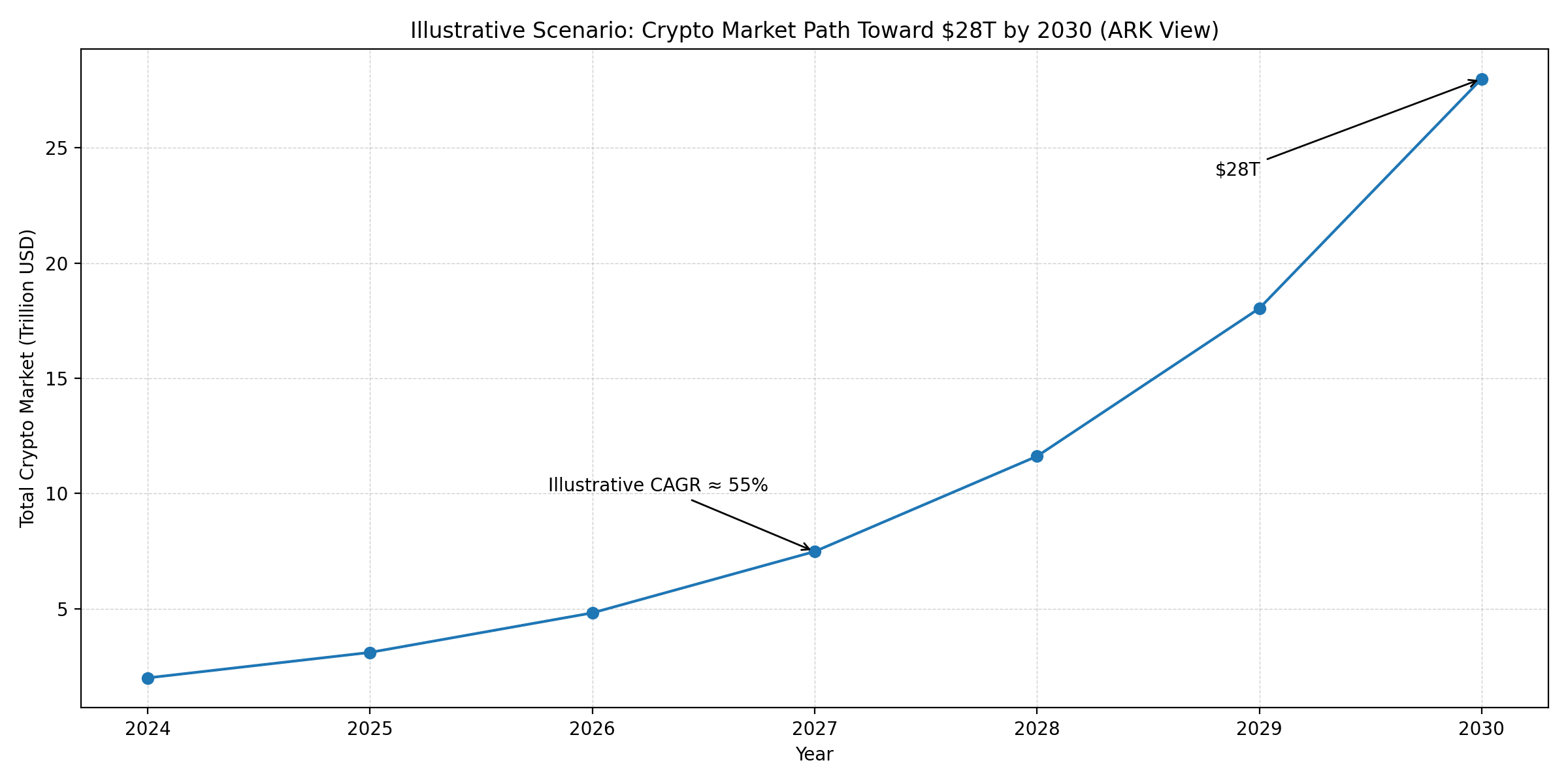
One reason these numbers feel unrealistic is that the mind compares them to today’s market size and stops there. Analysts prefer to frame the path as a growth rate, and ARK does the same by estimating a 61% compound annual growth rate to reach $28 trillion by 2030.
CAGR can feel like finance jargon, but the concept is not complicated. It is simply the “smooth” yearly growth rate that would take a market from point A to point B over a set number of years. It is not a promise. It is a map that helps quantify how big the leap really is.
That is why the crypto market forecast should be read less like a prophecy and more like a stress test. If the market does not show consistent progress in adoption, regulation, and real utility, the math breaks. If those fundamentals strengthen year after year, the growth curve becomes easier to imagine.
Why DeFi and stablecoins matter more than hype cycles
ARK also places meaningful weight on decentralized finance and stablecoins as growth engines. That is a notable shift from older narratives where crypto growth was explained mostly through speculation and liquidity waves.
Stablecoins matter because they are practical. They are used for settlement, trading, payroll, remittances, and cross-border transfers, and they fit into workflows that people already understand. When stablecoin supply expands, it usually signals that more value is moving on-chain and more users are using crypto rails, even if they are not taking directional risk on volatile tokens.
DeFi is the broader ecosystem built around lending, trading, yield strategies, and liquidity management without relying on centralized intermediaries. The strongest indicator for DeFi growth is not social media noise. It is whether the market sees deeper liquidity, higher total value locked, more active users, and sustained fee generation that does not collapse the moment volatility disappears.
This crypto market forecast essentially assumes those indicators keep rising over the next several years, with DeFi becoming less of a “casino narrative” and more of a serious financial layer that can coexist with traditional markets.
Smart contract platforms: the rails behind everything
ARK estimates that major smart contract networks could grow into a $6 trillion market by 2030, using a model that implies around a 54% CAGR. The firm’s analysis also discusses revenue generated across smart contract platforms and an average take rate tied to network activity.
There is an important nuance here. Many people evaluate smart contract chains like software companies and focus on cash flows alone. ARK takes a different angle, suggesting these assets may ultimately be valued more like reserve assets as well, especially if they become the base layer for settlement, tokenization, and on-chain applications.
That does not mean every smart contract token wins. It means the networks that are reliable, scalable, and developer-friendly could absorb more economic activity over time, and that activity can show up in the data through fees, transaction volume, application revenue, and user growth.
For readers watching this closely, the health check looks familiar: consistent uptime, predictable costs, steady developer activity, growing adoption by applications, and expanding liquidity. If those indicators strengthen together, the rails become harder to ignore.

Tokenized real-world assets could be the quiet giant of the next cycle
Perhaps the most ambitious part of ARK’s view is tokenization. ARK suggests that tokenized real-world assets could reach $11 trillion by 2030. That would include tokenized versions of assets such as treasuries, funds, credit products, and other financial instruments that already exist in traditional markets.
Current tokenized RWA volume sits far below that level today, which is why the growth requirement is extreme. ARK’s report points to a growth rate in the triple digits to reach the target, and that only happens if two conditions improve meaningfully: regulatory clarity and institutional-grade infrastructure.
Tokenization often sounds abstract until it is put into a real-world comparison. A tokenized treasury product is like turning a slow, office-hours financial instrument into something that can settle faster and integrate directly into on-chain lending and trading systems. It is not about replacing banks overnight. It is about making certain market functions more efficient, the same way online banking did not “kill cash” but changed habits permanently.
This part of the thesis is also the most dependent on policy. Without clear rules, large institutions move carefully. With clearer frameworks, tokenization becomes less experimental and more operational.
The indicators that will decide whether this projection stays credible
The market does not need to guess blindly, there are measurable signs that either support or weaken any long-range projection.
Institutional participation is one of the first. It shows up through regulated products, corporate balance sheet decisions, custody solutions, and consistent allocation behavior that does not vanish after a correction.
Liquidity is another as healthy markets have deep spot liquidity, tighter spreads, and derivatives markets that support hedging without excessive distortions. When liquidity improves, volatility often becomes more manageable, which in turn attracts more conservative capital.
Network usage matters too as a rising number of active wallets, sustained transaction counts, and resilient fee generation indicate real demand, not just a temporary frenzy. Stablecoin adoption adds another layer, because it is often used as “working capital” on-chain rather than a speculative bet.
This crypto market forecast is really a claim that all of these indicators keep improving at the same time, and that they do so across multiple market cycles, not just one good year.
What this means for investors watching 2030 narratives
There is a human tendency to treat long-term forecasts like a scoreboard. Either it comes true or it fails. In reality, a projection like this is more useful as a framework for what to track.
If Bitcoin continues to absorb institutional demand, the “store of value” narrative strengthens. If DeFi becomes easier to use and safer through better design and clearer standards, activity can grow in a way that feels less fragile. If tokenization expands through credible issuers and compliant structures, the market starts to look less like an experiment and more like a new settlement layer for finance.
The key is that nothing here depends on one trend. It is a multi-engine outlook. If one engine stalls, the overall number becomes harder to justify. If several engines accelerate together, the path becomes clearer.
That is why this crypto market forecast deserves attention even from skeptics. It forces the conversation away from short-term price calls and toward structural progress, which is where the real long-term signal usually lives.
Conclusion: A big forecast, built on real adoption signals
ARK’s $28 trillion projection is ambitious, and it should not be treated as a guaranteed destination. Still, the logic behind it is grounded in measurable trends: Bitcoin becoming more institutionally accessible, stablecoins growing as a settlement tool, DeFi maturing, and tokenization moving from concept to practice.
Whether this exact number is reached by 2030 matters less than whether the underlying indicators keep improving. If they do, the market’s long-term trajectory remains upward, even if the journey is messy and uneven along the way. In that sense, the forecast functions like a compass. It points to where the industry could go if adoption, trust, and infrastructure continue to rise together.
And for anyone tracking the next decade, this crypto market forecast offers a clear checklist of what to watch, rather than a headline to chase.
Frequently Asked Questions
What does a $28 trillion crypto market mean in practical terms?
It implies crypto grows beyond being mostly a trading market and becomes a larger financial ecosystem, with deeper institutional participation, stronger liquidity, and more real-world integrations.
Why does Bitcoin take such a large share in ARK’s projection?
ARK treats Bitcoin as the most established asset in the space, with the strongest “store of value” positioning and the clearest path to institutional adoption through regulated access.
Is a $1,000,000 Bitcoin price realistic by 2030?
It is possible under a high-adoption scenario, but it is not guaranteed. Models like this depend on long-term demand growth and continued confidence in Bitcoin’s role as a scarce asset.
How do stablecoins contribute to market growth?
Stablecoins expand on-chain liquidity and enable everyday settlement and transfers. Their growth often signals broader usage of blockchain systems beyond speculation.
What makes tokenized real-world assets a major narrative for 2030?
Tokenization can bring traditional financial products on-chain, enabling faster settlement and easier integration into DeFi. Its growth depends heavily on regulation and institutional infrastructure.
Glossary of Key Terms
Bitcoin (BTC): The largest digital asset by market value, often described as a scarce, decentralized store of value with a fixed supply schedule.
Compound Annual Growth Rate (CAGR): A way to express the average yearly growth rate of an investment or market over time, smoothing out volatility.
Decentralized Finance (DeFi): A set of on-chain financial services like lending, trading, and borrowing that operate through smart contracts rather than centralized intermediaries.
Stablecoin: A crypto asset designed to maintain a stable value, often pegged to fiat currencies like the U.S. dollar, and widely used for settlement and trading.
Smart Contract Platform: A blockchain network that supports programmable applications, enabling developers to build decentralized apps and financial protocols.
Tokenized Real-World Assets (RWAs): Traditional assets such as treasuries, funds, or credit products represented on-chain as tokens, enabling new settlement and integration options.
Take Rate: The effective fee rate earned by a platform or network from activity occurring within its system, often measured as a share of transaction value.
Institutional Adoption: The participation of large regulated entities such as asset managers, banks, corporates, and funds, typically through compliant products and custody solutions.
Market Capitalization: The total value of an asset or market segment, usually calculated as price multiplied by circulating supply.
Reference