
This article was first published on The Bit Journal.
The global crypto market took a hit in late January, losing roughly $100 billion in value over a short period as political uncertainty in the United States weighed on traders’ minds.
Worries about the crypto market drop stemmed from increasing anxiety over a partial U.S. government shutdown. Market data indicated that total crypto market cap fell sharply from roughly $2.97 trillion to around $2.87trillion in the span of about six and half hours..
Political Standoff Sparks Market Sell-Off
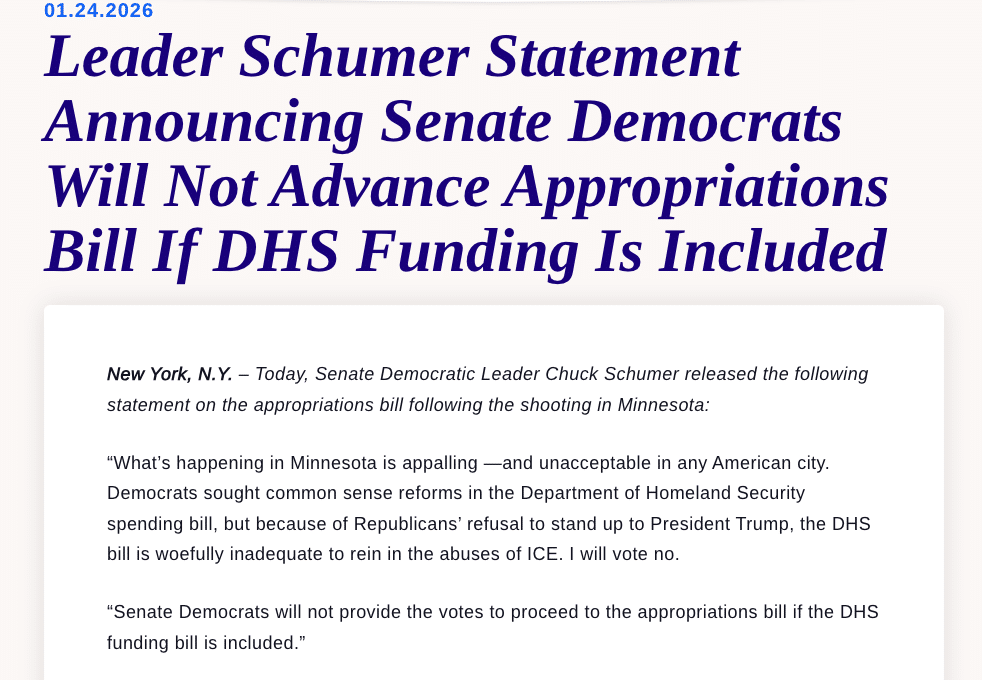
The main cause for this quick crypto market drop was a standoff in Washington, D.C., where Senate Democrats threatened to block a federal funding bill unless it included reforms to the Department of Homeland Security (DHS).
The fight intensified after federal agents were involved in a deadly shooting of a man in Minneapolis, pushing the Senate majority leader, Chuck Schumer, to decry the proposed DHS funding bill as insufficient and to say that Democrats would oppose it outright.
“Democrats sought common sense reforms in the Department of Homeland Security spending bill, but because of Republicans’ refusal to stand up to President Trump, the DHS bill is woefully inadequate to rein in the abuses of ICE. I will vote no,” said Senate Democrat Leader Chuck Schumer.
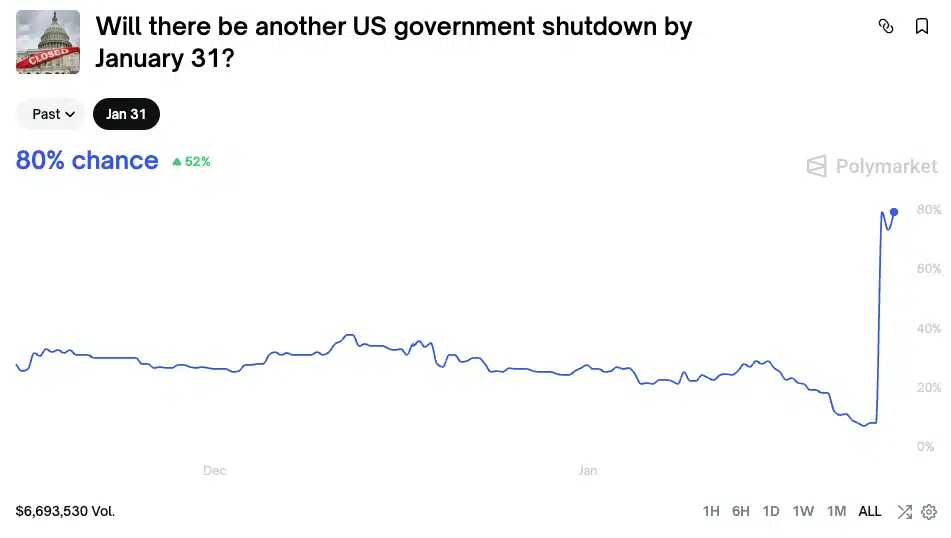
Those political pressures increased the odds of a partial government shutdown at the end of January, as prediction markets such as Kalshi and Polymarket were pricing the possibility of a government shutdown in late January at closer to 80%, according to market signals.
This sudden surge in perceived political risk pushed some investors into safer harbors, prompting the overall crypto market crash.
Price Impact in Leading Crypto Assets
Big cryptocurrencies felt the brunt of market reactions to the political uncertainty. Bitcoin (BTC) had retreated by around 3.4%, sliding below important psychological levels near $88,000 and Ethereum (ETH) was down by -5.3% over the same time.
Each of these losses weighed heavily on the overall market. The sell-off was further intensified by leveraged trading dynamics, with over $360 million in leveraged positions liquidated, including approximately $324 million of long positions, according to market trackers.
Crypto’s heightened sensitivity to macro headlines, be they domestic or international, was apparent as traders sought to take off risk on a fear of larger collapse.

Geopolitical Pressures Intensify Risk Sentiment
It wasn’t just the political uncertainty that caused the crypto market drop. Other geopolitical issues added to the risk-averse sentiment. One notable example was the U.S. President Donald Trump’s threat to slap 100% tariffs on Canada if it pursued a bilateral trade deal with China.
These announcements added more turbulence and sent investors into a “risk-off” trading mood. Tensions with Iran and military deployments to the Middle East, in fact, also rattled the global markets.
These developments raised fears that the typical calm surrounding the crypto market would be shattered by these larger geopolitical issues
Context and Market Sensitivity
The January 2026 response by the crypto market reminds us of previous events in which political and macroeconomic shocks impacted pricing.
During the record 43-day U.S. government shutdown from October to November 2025; Bitcoin dropped from its all-time high of around $126,080 to below $100,000.
Meanwhile, traditional safe-havens like gold strengthened over the same period compared to crypto.
Investors turning to traditional assets rather than crypto during these periods of extreme uncertainty point to the changing relationship between digital currencies and global markets.
Conclusion
The late January 2026 crypto market drop is a perfect example of how political and geopolitical risks can instantly impact global digital asset prices.
With around $100 billion wiped from the total market’s value as investors sought refuge amid the uncertainty, the episode shows crypto’s sensitivity to macro headlines and particularly those connected to U.S. policy and political stability.
Bitcoin and Ethereum were among the most impacted, as both experienced pullbacks in a short time period as leveraged long positions were liquidated and sentiment moved aggressively towards risk-off.
While Congress hashes out budget disputes and traders monitor the odds set by prediction markets pricing in a high likelihood of shutdown, it appears crypto markets are on pins and needles, proving that political developments can move this market rapidly.
Glossary
Market capitalization: The market value of all coins in circulation times the current price, used to indicate a market’s size.
Leveraged positions: Trades in which investors use borrowed funds to increase their potential profits, but they can also lead to bigger losses when markets go down.
Long position: A trading stance that takes profit from an increase in an asset’s price; liquidations of long positions happen when prices fall aggressively.
Prediction markets: Platforms where participants bet on the likelihood of future events, such as a government shutdown.
FrequentlyAsked Questions About Recent Crypto Market Drop
What is behind the $100 billion crypto market drop of 2026?
This was prompted by mounting concerns about a U.S. government shutdown following political clashes in the U.S. Congress over funding of the Department of Homeland Security, among other matters. The uncertainty prompted traders to sell out of positions, leading to broad-based losses.
How did leading cryptocurrencies like Bitcoin respond?
Bitcoin dropped around 3.4% and Ethereum about 5.3% over the course of a day during the sell-off.
How much did leveraged trading contribute to the decline?
More than $360 million in leveraged crypto positions were liquidated, and $324 million of that amount was long positions, which helped push the market lower.
How much did politics matter in this sell-off?
The market pullback was fueled in large part by heightened uncertainty from a number of sources, such as Senate Democrats’ vow to block a government spending bill, as well geopolitical concerns about tariff threats and deployments to the Middle East.
What is the likelihood of a government shutdown affecting crypto markets?
Prediction markets such as Kalshi and Polymarket priced in a 78-80% chance of a U.S. shutdown by January 31, 2026 at the time, pointing to political risk.
References
Cointelegraph
whale alert
CoinCentral
Investopedia