






ASTER (ASTER) has emerged as a breakout DeFi token, surging with whales and exchange support. $ASTER price prediction for 2025 and 2026 seems to be the hottest topic in crypto right now as the token keeps climbing. Since its explosive launch, $ASTER has defied expectations with a 2,500%+ surge and is now one of the most watched assets in the market.
With whale engineering supply squeezes, rising HODLer numbers, and unprecedented derivatives activity, the question has changed from “what is ASTER?” to “how high can it go?”
ASTER and Its Ecosystem
$ASTER is the native token of the Aster DEX ecosystem, built on a high-performance, privacy-focused Layer-1 blockchain. It bridges CEX features with DeFi transparency. The platform has Spot and Perpetual markets, so beginners can trade in Simple Mode and advanced users can access Pro Mode with hidden orders and 24/7 stock perpetuals.
Aster accepts yield-bearing assets (e.g. asBNB, USDF) as collateral, improving capital efficiency. The $ASTER token governs the network, incentivizes growth and allocates ecosystem rewards. In short, it’s CEX-level trading with DeFi benefits.
Also read: Aster Whale Activity Surges With $2.5B Spot Volume and $32B Perp Flow
Factors Affecting $ASTER’s Price
$ASTER’s price could be influenced by multiple factors. Leading forecasts highlight User Adoption because more traders and liquidity on Aster DEX is essential. More users and TVL means more demand for $ASTER.
Another is Cross-Chain Liquidity. Aster’s multi-chain strategy (BNB Chain, Ethereum, Solana, Arbitrum, etc.) can pull capital from other ecosystems, expanding its market reach.
Next is Tokenomics or Governance. $ASTER’s role in governance and as a reward token may encourage holding, reducing sell pressure. Token unlock schedules and supply inflation also matter.
Broader DeFi health could also affect $ASTER. Bullish crypto markets and increasing interest in decentralized trading means higher prices, bear cycles mean lower.
Aster competes with other perpetual DEXs (dYdX, GMX, Hyperliquid) and other DeFi innovations. How it stands out with better features (stock perpetuals) will impact trading volume.
Other factors like regulatory news, institutional involvement and macroeconomic conditions can also impact $ASTER’s price.
Recent Developments and Whale Influence
$ASTER’s token Generative Event in September 2025 has stirred wild volatility and institutional interest. Within days of trading, $ASTER went up +2,587% since launch and briefly doubled in price. Much of this surge is due to whales (big holders) buying on dips, creating tight supply.
Sources reports that 96% of ASTER’s supply is held in just 6 wallets. When this info dropped, the price pulled back 16% from the $2 high and liquidated many leveraged positions. But then, those same whales bought the dip: one whale bought 6.72 million ASTER at $2.08 each and had $1.09M in unrealized gains.

4 out of 11 large transactions in that period were whale buys . Hence $ASTER’s price action showed a manufactured supply squeeze.
Data from DefiLlama shows $ASTER is dominating perpetual trading volume. This on-chain activity is how fast $ASTER has attracted liquidity and trader attention. The result of this hype and whale support is that $2 became a support level overnight.
The HODLer count (addresses holding ASTER long term) went up 7.3% to 61,450 wallets, meaning holders seem to be very convinced despite the volatility. Derivatives traders also piled in with total open interest across exchanges being $1.25B.
However, the whale hype could also mean long-term risk. Expert analysis says that because supply is so locked up, a big sell order could trigger liquidations and big drops.
In summary, $ASTER’s recent move is due to whale accumulation and exchange hype.
Technical Analysis
From a technical standpoint, $ASTER shows bullish patterns as well as some bearish signals. Experts highlight an upward trend on ASTER’s chart, noting price bounced off support and could be heading higher. The Relative Strength Index (RSI) is positive at 51. However; the Moving Average Convergence Divergence (MACD) could be at the verge of having a bearish crossover (“death cross”).
This means momentum might pause or correct before any new breakout. In practical terms, if $ASTER breaks out of the upward trend, sources predict the next resistance could be around $5 .
In summary, any long-term bullish case relies on $ASTER maintaining user activity and liquidity beyond the initial hype.
ASTER Price Predictions for 2025
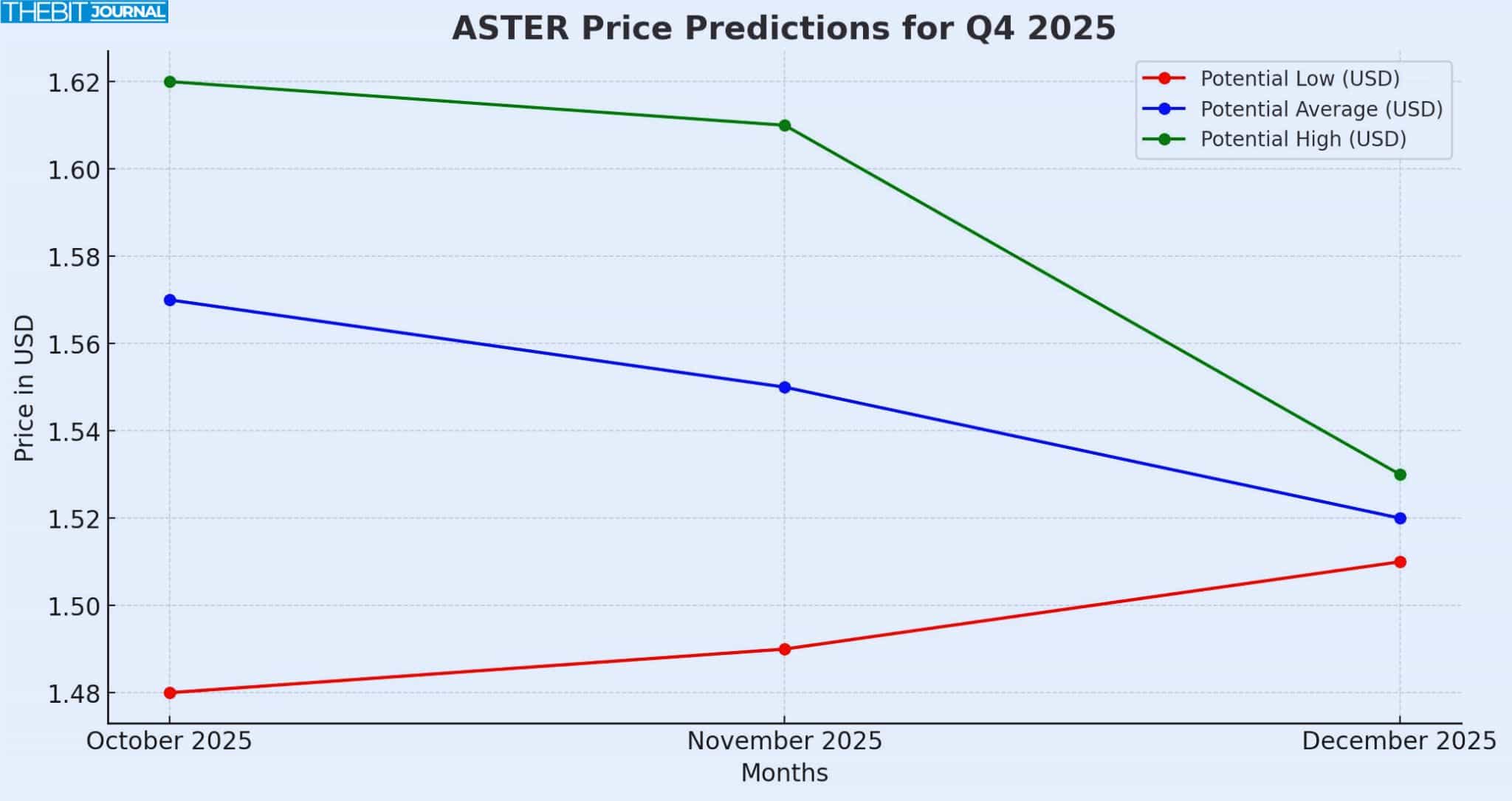
Below is $ASTER price prediction table for Oct-Dec 2025. Note these are estimates, not guarantees:
| Month 2025 | Potential Low (USD) | Potential Average (USD) | Potential High (USD) |
| October 2025 | $1.48 | $1.57 | $1.62 |
| November 2025 | $1.49 | $1.55 | $1.61 |
| December 2025 | $1.51 | $1.52 | $1.53 |
Analysis: These monthly figures show a pullback at the end of 2025. The average price is expected to go down from around $1.57 in October to around $1.52 by December. But if new catalysts emerge (e.g. major exchange listings or wider adoption), prices could go above these ranges. If big whale sell-offs or broader market downturns happen, prices could go to the lower end of these ranges.
ASTER Price Predictions for 2026
Here are annual forecasts for 2026.
| Year | Potential Low (USD) | Potential Average (USD) | Potential High (USD) |
| 2026 | 1.037 | 2.074 | 3.111 |
Analysis: The above ranges has $ASTER price prediction averaging $2.07 in 2026, with a range of $1.04 to $3.11. This is a somewhat bullish scenario assuming continued growth of the ecosystem.
Also read: Can Aster Token Price Bullish Rally Last? Analysts Warn of Volatility Ahead
Experts’ ASTER Price Predictions
Assuming waning initial hype after September’s parabolic rally, models see $ASTER trading in a more moderate range around $1.5-$1.6. The rapid gains may not be sustained, so stabilization by late 2025 could be expected.
CoinPedia has $ASTER at $1.383 for 2025 with a high of $2.074. Bitrue is even more bullish with $3.20-$4.70 by end-2025 (average $3.90) if adoption accelerates.
Other models are more aggressive. DigitalCoinPrice has $ASTER breaking $4.99 by late 2026 with a ‘most likely’ year-end price of $4.77. Bitrue’s analysis agrees with $4.00-$6.10 (average $5.20) by 2026.
In any case, all models agree 2026 will be higher than 2025. On the conservative baseline, an ASTER Price prediction at $2-$3 for 2026 with upside to $5+ could be possible if conditions hold.
Conclusion
Based on the latest research, $ASTER price prediction for 2025-2026 is bullish but with high risk. Though recently; $ASTER’s supply squeeze and whale FOMO have driven big rallies. Technicals suggest more upside (to $5) but whale concentration means even small sell-offs can trigger big drops.
For 2025, most models have $ASTER stabilizing in the $1.5-$2.0 range for Q4. For 2026, forecasts are wide: conservative is $2-$3, aggressive is $4-$6.
Stay up to date with expert analysis and price predictions by visiting our crypto news platform.
Summary
$ASTER has been explosive in its early days, driven by whale buying and high liquidity. Momentum is strong with technicals pointing to a move to $5. Analysts have $ASTER moderating in 2025, $1.5-$2.0 by year-end. For 2026, forecasts vary: conservative is $2, aggressive is $4-$6.
Glossary
DEX (Decentralized Exchange): A trading platform that operates without a central intermediary. Users trade directly from wallets using smart contracts.
Perpetual (Perp): A type of derivative contract with no expiry; allowing traders to gain leveraged exposure to an asset.
HODLer: Slang for an investor who holds a cryptocurrency for the long term.
Whale: A very large cryptocurrency holder.
Open Interest (OI): Total value of outstanding futures or perpetual contracts.
FOMO/FUD: Market speak. FOMO = “fear of missing out;” when buyers buy on the way up, FUD = “fear, uncertainty, doubt”; when bad news causes selling.
Frequently Asked Questions About ASTER Price Predictions
What is $ASTER?
$ASTER is the native token of the Aster decentralized exchange (DEX) ecosystem. It powers governance and rewards on a privacy-focused Layer-1 blockchain; bridging CEX-like trading features with DeFi flexibility.
What drives $ASTER’s price?
Key drivers include user adoption of the Aster DEX; cross-chain liquidity integration; tokenomics (such as rewards and vesting), general DeFi market trends; and competition from other platforms. On-chain factors like whale buying and derivative open interest have also moved the price.
How might whale activity affect $ASTER going forward?
With a few wallets holding most $ASTER, large trades by those whales could create sharp swings. So far, whales have so far supported the price by buying dips. However, any major sell-off by whales could trigger rapid declines. Traders should be aware of this concentration risk.