






The Binance MiCA license has become one of the biggest regulatory stories in the crypto industry as Europe prepares to enter a new era of digital asset oversight. With the July 1 deadline approaching, Binance is racing to secure approval after unexpectedly withdrawing its licensing application in Greece. The development has raised fresh questions about the exchange’s future in Europe and the growing impact of EU crypto regulation on global crypto businesses.
According to the source, Binance voluntarily withdrew its application from Greece’s Hellenic Capital Market Commission (HCMC) after reviewing the licensing timeline. The company concluded that pursuing authorization through another European Union member state would provide greater certainty before the MiCA transition period ends.
The current MiCA transition period expires on July 1, after which crypto firms without authorization may no longer provide regulated services across the European Union. Despite the setback, Binance stressed that customer assets remain secure and accessible while it continues working toward a new Binance MiCA license.
Why the Binance MiCA License Is Now Critical for European Operations
The Binance MiCA license has become the gateway for crypto exchanges seeking legal access to the European market. Under the new EU crypto regulation, one authorization issued by a national regulator allows a Crypto Asset Service Provider to legally offer services across all 27 EU countries without applying for separate licenses in each nation.
The Markets in Crypto Assets Regulation, better known as MiCA, replaces fragmented national crypto laws with one harmonized framework. It introduces common standards for licensing, governance, investor protection, operational resilience, record keeping, complaint handling, and market supervision. ESMA coordinates and oversees the MiCA framework, while national regulators such as Greece’s HCMC issue the actual licenses.
Binance said it worked constructively with the Hellenic Capital Market Commission (HCMC) for several months before deciding another licensing route would better serve users as the deadline approached.
The exchange stated, “While we withdrew our application in Greece, Binance remains committed to Europe,” according to its official announcement.
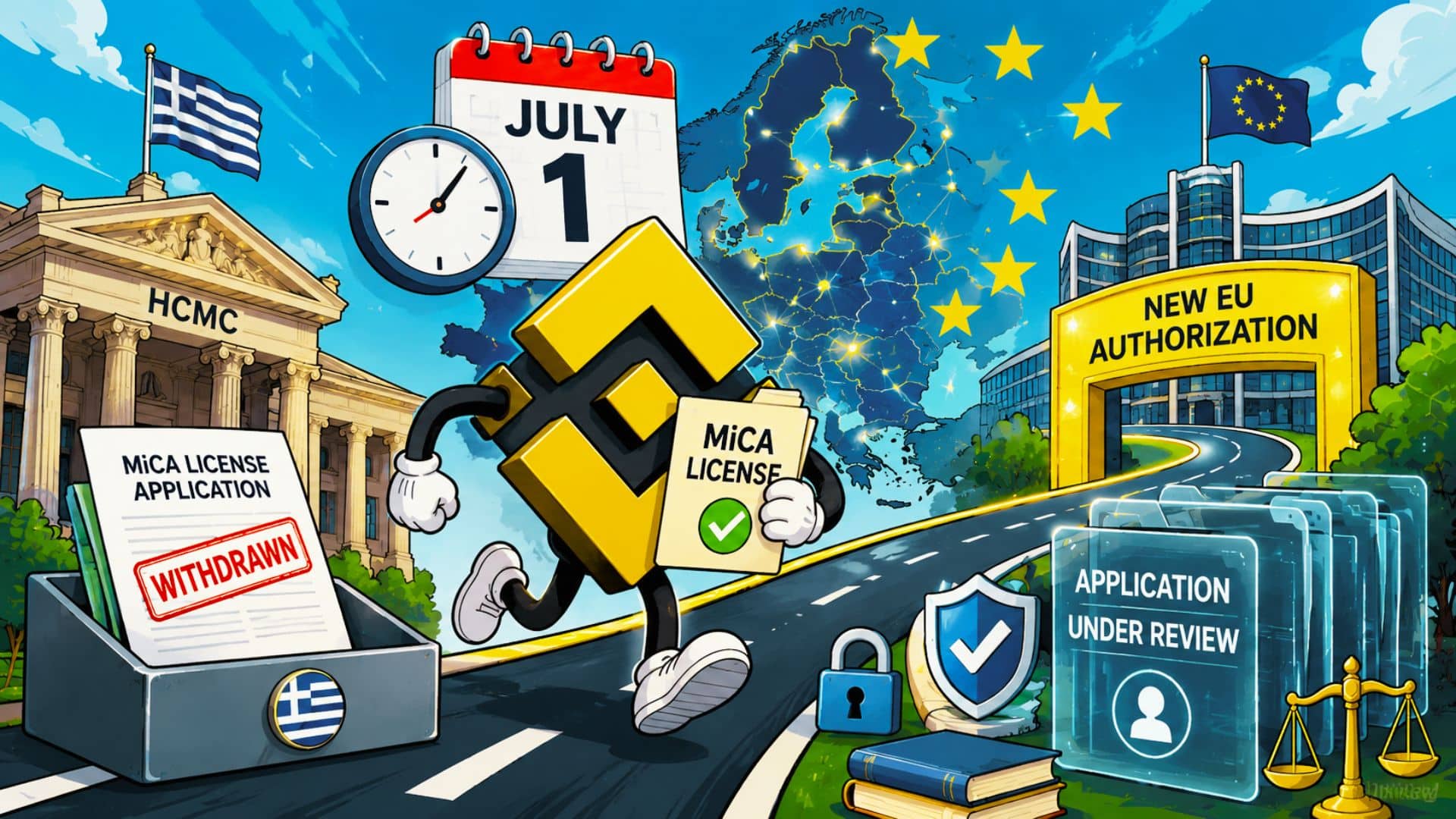
Binance MiCA License Strategy Shifts After Greece Withdrawal
The withdrawal surprised many industry observers because Greece had been viewed as Binance’s preferred regulatory base in Europe. However, the exchange determined that continuing the process there no longer offered enough certainty before the July deadline. Binance also said it is reviewing several licensing options within the European Union before announcing its next regulatory destination. Binance has not disclosed which EU member state will receive its next Binance MiCA license application, saying the decision will be announced at a later stage.
The company also confirmed that customer funds remain safe and fully accessible. However, some European users could experience service changes depending on their country of residence and account status. EU users are receiving direct emails and account specific guidance from Binance as the company prepares for the regulatory transition.
Meanwhile, regulators continue to tighten EU crypto regulation before the transition period expires. ESMA has instructed crypto firms without authorization to prepare orderly wind down plans, suspend new customer onboarding where required, and maintain clear communication with users. If authorization is not secured before the transition period ends, exchanges may need to limit regulated services until approval is granted. These measures demonstrate that EU crypto regulation is entering a stricter enforcement phase.

Compliance Investment Reflects Binance’s Long Term European Strategy
Rather than stepping back from Europe, Binance continues expanding its compliance capabilities. The company says it now employs around 1,500 compliance professionals responsible for anti money laundering controls, governance, internal monitoring, and regulatory oversight. These investments are designed to strengthen its next Binance MiCA license application while supporting the objectives of EU crypto regulation.
Binance reaffirmed its commitment by stating, “Europe is an important region for Binance, and our ambition to operate under a clear, fair, and harmonized MiCA framework remains unchanged,”
. The company also added, “We continue to support MiCA’s goal of creating a consistent regulatory framework for crypto assets across the EU, and we are confident we will secure authorization in another EU Member State in the coming months.”
Binance urged customers to rely only on official communication channels and remain alert for scams during the regulatory transition. Under MiCA, Crypto Asset Service Provider (CASP) rules establish licensing standards, complaint handling procedures, disclosure obligations, and ongoing supervisory requirements for regulated exchanges. These rules will also guide Binance’s next Binance MiCA license application under the evolving EU crypto regulation framework.
Conclusion
The race for the Binance MiCA license has become much more than a licensing process. It reflects Europe’s determination to create a safer, more transparent, and more accountable crypto market through stronger EU crypto regulation. As the July 1 deadline arrives, regulators are making it clear that every exchange must meet the same standards regardless of its size.
Whether Binance secures its next Binance MiCA license in another member state remains to be seen, but the outcome will likely shape how global crypto companies approach EU crypto regulation for years to come. For investors, developers, and market analysts, this milestone signals that regulatory readiness is rapidly becoming as valuable as technological innovation in the digital asset industry.
Glossary of Key Terms
Binance MiCA License: A regulatory authorization that allows Binance to legally provide crypto asset services across the European Union under MiCA rules.
MiCA (Markets in Crypto Assets Regulation): The European Union’s unified legal framework that governs crypto asset service providers and strengthens investor protection.
EU Crypto Regulation: The collection of laws and regulatory standards introduced by the European Union to oversee cryptocurrency markets and crypto businesses.
ESMA: The European Securities and Markets Authority, which helps coordinate and supervise the implementation of MiCA across EU member states.
Crypto Asset Service Provider (CASP): A licensed company that offers crypto-related services such as trading, custody, transfers, or exchange under the MiCA framework.
FAQs About Binance MiCA License
Why did Binance withdraw its MiCA application in Greece?
Binance said it reviewed the licensing timeline and decided another EU member state could provide a clearer and faster path to authorization before the MiCA deadline.
What is the Binance MiCA license?
The Binance MiCA license is the authorization required for Binance to legally offer regulated crypto services across all European Union member states under MiCA.
Will EU users lose access to their crypto assets?
No. Binance has confirmed that customer assets remain safe and accessible. However, some services may change depending on users’ country of residence and regulatory requirements.
Why is EU crypto regulation important?
EU crypto regulation creates one consistent legal framework for crypto companies across the European Union. It aims to improve investor protection, market transparency, and regulatory oversight.
Sources/References