

This article was first published on The Bit Journal.
Bitcoin ETF inflows finally turned positive after 10 straight trading days of investors pulling funds out. This came as a much needed glimmer of hope for a market that has struggled for months with institutional selling.
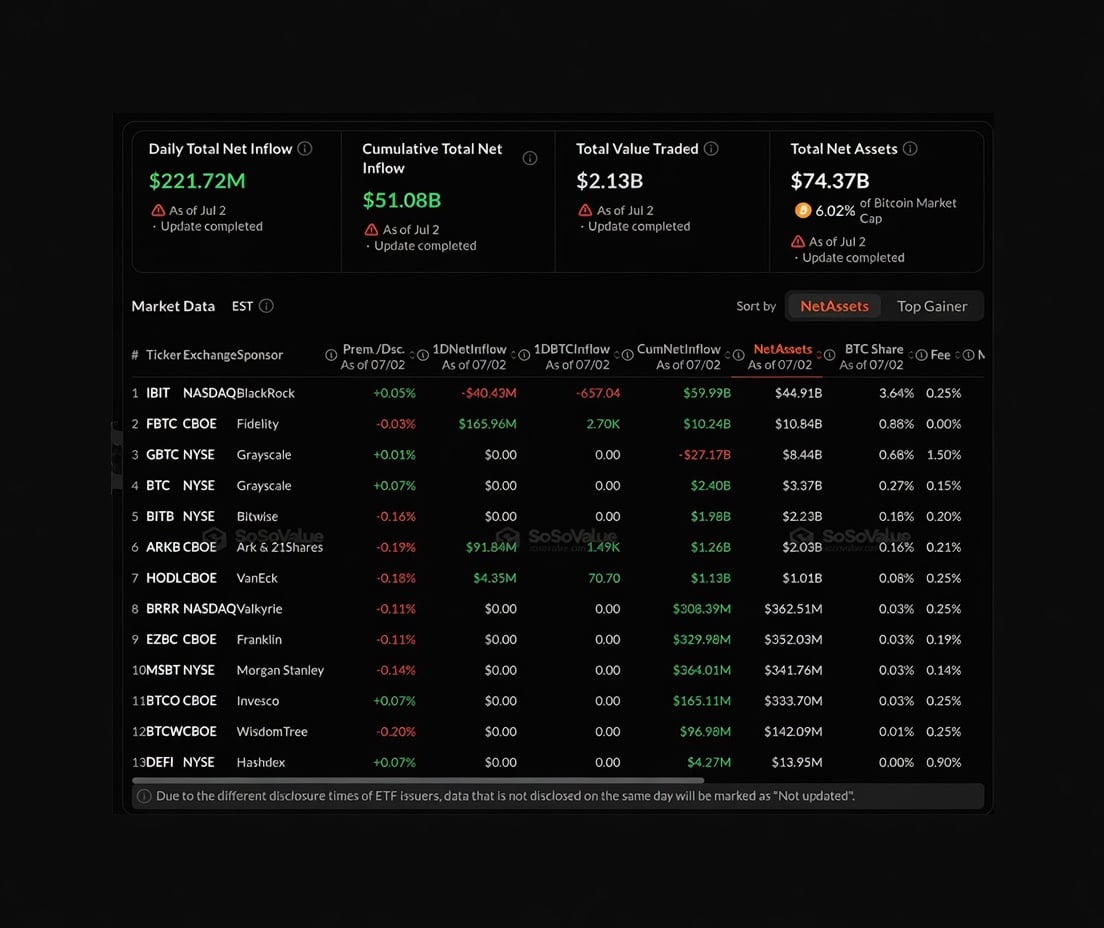
According to data from SoSoValue, U.S. Bitcoin ETFs recently pulled in a $221.7 million new capital, the biggest single-day gain in about two months. This ended a painful streak where investors had just pulled out over $2.7 billion and it helped push Bitcoin’s price up towards $61,700 after briefly dipping below $58,000 earlier in the week.
While the return of Bitcoin ETF inflows has helped improve the mood of investors, the rest of the data still points to caution. Year-to-date, U.S. Bitcoin ETFs have got around $5.4 billion are still carrying approximately $5.4 billion in net outflows, showing that one strong day does not erase months of investor caution.
Fidelity Stepping Up The Recovery Efforts
The latest push in Bitcoin ETF inflows came courtesy of Fidelity’s FBTC fund.
FBTC pulled in $165.96 million, while ARK 21Shares’ ARKB attracted $91.84 million. VanEck’s HODL chipped in with another $4.35 million.
Interestingly though, the biggest Bitcoin ETF BlackRock’s IBIT, was the only major product to see a net loss on that particular day, with $40.43 million going out the door.
What this says is that investors are being very selective with allocating capital and not broadly returning to every Bitcoin ETF product.
Bitcoin Price Responds Positively
The sudden improvement in Bitcoin ETF inflows just happens to coincide with Bitcoin’s price starting to recover.
After touching a 21-month low point below $58,000, Bitcoin managed to get back above $61,000, bringing relief to investors who had been watching it stumble through one of its weakest periods since 2022.
As a rule of thumb, when there are sustained Bitcoin ETF inflows, it typically means the price tends to go up because ETF issuers must acquire Bitcoin to back new shares. Conversely, extended outflows can create selling pressure and weigh on market sentiment.
So the latest injection of new capital into the market is still a good sign even if they remain small compared to the billions that left the market throughout June.
Why Has the Market Been Shunned by Institutions ?
The reason institutions have been pulling out their funds from Bitcoin ETFs in the first place is largely due to economic worries.
High inflation, rising Treasury yields, and uncertainty over Federal Reserve policy have made it so that many institutional investors don’t want to play around with their cash in untested markets like crypto.
June proved to be a really challenging month for Bitcoin ETFs with about $4.5 billion being pulled out. This was one of the toughest months since the whole Bitcoin ETF market launched.
Capital has continued flowing into technology and artificial intelligence stocks, creating additional competition for investment dollars.

Is This the Start of a Larger Reversal?
At this point, traders are curious to know if these Bitcoin ETF inflows would be the beginning of a sustained recovery or simply a temporary pause in a downtrend.
Market watchers have pointed out that when there’s a big period of selling in Bitcoin ETFs, it is not uncommon for it to be a sign of a local market bottom.
The fact that Bitcoin managed to hold on above key support levels even in the face of months of heavy selling does suggest there’s still a bit of demand coming from retail investors and long-term holders.
However, one day of positive flows isn’t going to be enough to convince investors that a trend change is really happening.
For Bitcoin ETF inflows to become a real bullish catalyst, there is need to see several weeks of net positive flows stacking up, not just a single strong day.
Conclusion
As Bitcoin enters July, the momentum is looking up, but uncertainty lingers.
The return of Bitcoin ETF inflows is encouraging for bulls, especially after ten straight days of investors pulling their money out of ETFs. But the market is still a long way from recovering all the capital that left the exchanges this year.
If Bitcoin can keep above $60,000 and the ETF demand continues to pick up, attention might shift to higher resistance zones in the coming weeks. On the other hand, if there is renewed outflows, it could quickly revive concerns about institutional participation.
For now, the latest data offers something the market has lacked for weeks which is evidence that at least some investors are willing to step back into Bitcoin exposure after a prolonged period of selling.
Glossary
Bitcoin ETF: An exchange-traded fund that provides exposure to Bitcoin through traditional financial markets.
Net Inflow: The amount of money going into a fund after subtracting all the money that’s being pulled out.
FBTC: Fidelity’s spot Bitcoin ETF
IBIT: BlackRock’s iShares BitcoinTrust ETF
Institutional Investors: Professional investors such as asset managers, hedge funds, pension funds, and investment firms.
Frequently Asked Questions About Bitcoin ETF Inflows
What are Bitcoin ETF inflows?
Bitcoin ETF inflows measure the amount of money entering Bitcoin exchange-traded funds during a specific period.
How much money came into Bitcoin ETFs on July 2
The US spot Bitcoin ETFs recorded roughly $221.7 million in net inflows.
Which ETF saw the biggest inflow?
Fidelity’s FBTC was the leader with $165.96 million in net inflows coming in.
Did BlackRock’s IBIT move any money in?
No, IBIT actually saw investors pull about $40.43 million out on that day.
Why are Bitcoin ETF flows important?
ETF flows give a good read on institutional demand, and can also influence Bitcoin’s price through all the buying and selling going on.
References