













XRP’s DeFi narrative has been lagging behind others for a while, but recent developments are closing the gap. Just recently, infrastructure provider Axelar announced that the mXRP liquid staking vault filled 6.5 million tokens in 2 days and was raised to 10 million, with almost $20 million in assets locked.
This shows a huge demand from investors who want to turn idle XRP into yield. Built on the XRPL EVM sidechain and managed by Midas and risk curators, mXRP is a great way for XRP holders to get into DeFi.
How mXRP Works
mXRP is a yield-bearing derivative token built on the XRPL EVM sidechain, issued by Axelar and Midas. When users deposit XRP into mXRP, that XRP is bridged into the XRPL EVM and tokenized into mXRP. The deposited XRP is then deployed into yield strategies managed by independent “risk curators” with Hyperithm handling the initial capital allocation.
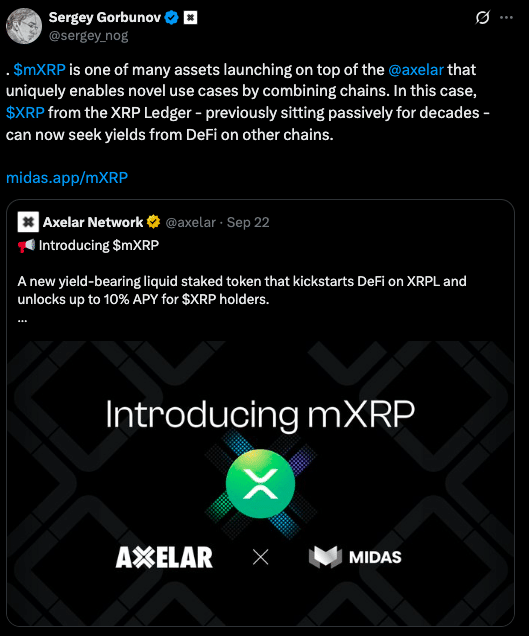
The yield from these strategies accrues to mXRP holders, not as additional tokens but as an increase in the token’s value. At launch, mXRP targets 6-8% APY, but optimistic projections suggest 10% under favorable conditions.
mXRP is liquid so holders can use it in DeFi protocols (lending, pools etc.) while still earning yield from the strategies. This is different from traditional locked staking mechanisms.
Axelar’s role is important as it bridges XRPL to over 80 blockchains so mXRP can be composible across DeFi ecosystems.
Also read: XRP Ledger’s EVM Sidechain Enters DeFi as EramXRP Debuts With 8% Yields
Adoption and Demand Signals
The early numbers for mXRP are impressive. 6.5 million tokens were deposited in 48 hours, triggering the mXRP Liquid Staking Vault cap to be raised to 10 million. TVL is almost $20 million. This revealed pent-up demand from holders who had no yield options for $XRP until now.
Also, integration into XRPL EVM protocols and liquidity pools is already underway; mXRP is expected to bridge XRP into lending, DEXs, and other composable layers.
Midas CEO Dennis Dinkelmeyer said most of the $XRP supply is idle and mXRP unlocks “on-chain strategies” for holders. Axelar co-founder Georgios Vlachos also said mXRP is a proof of XRPL moving into DeFi enabled by cross-chain infrastructure.
XRP’s DeFi Utility
The launch of mXRP is necessary for XRP’s DeFi relevance. $XRP has always been a settlement and value transfer token with no yield options. mXRP changes that by giving holders something to do with their XRP.
By being composable, mXRP can be used across DeFi protocols, and XRP’s economic footprint may grow. This may attract liquidity, developers and new use cases to the XRPL ecosystem.
Additionally, mXRP locks $XRP into mXRP vaults, which reduces the circulating supply, which, if demand continues, will put upward pressure on the price. The alignment of yield and capital efficiency changes how holders see and use their XRP.
The concept of XRPFi is also emerging. An ecosystem around yield, tokenization and interoperable DeFi on XRPL EVM and cross-chain layers. Other projects like Flare Network’s FXRP; complement this vision by bringing lending, liquidity and borrowing for XRP to other networks.
Together, they strengthen the tapestry of XRP’s DeFi future.
Also read: Why XRP DeFi Adoption Is the Biggest Shift in 2025
Conclusion
Based on the latest research, mXRP is a change in how $XRP is seen by holders. The rapid mXRP Liquid Staking Vault fill and $20 million TVL show investor appetite. With cross-chain infrastructure via Axelar and strategy design via Midas, mXRP bridges XRPL into the DeFi era.
However, smart contract risks, performance uncertainty and adoption hurdles remain. If these are managed well, XRP’s DeFi utility could re-emerge in a new powerful form.
For in-depth analysis and the latest trends in the crypto space, our platform offers expert content regularly.
Summary
mXRP is XRP’s first liquid staking token, launched via Axelar and Midas, allowing holders to stake $XRP and receive yield in the form of a composable token. The vault filled fast, almost $20 million in assets locked. With 6-8% APY returns, mXRP may change how XRP interacts with DeFi.
Glossary
Liquid staking – A model where staked assets are still usable in DeFi by issuing a derivative token.
Vault / TVL – Depository pool of assets locked in staking or yield strategies, measured as total value locked.
Risk curator – A manager who directs capital into yield strategies under agreed parameters.
XRPL EVM – The Ethereum Virtual Machine-compatible sidechain environment built for the XRP Ledger.
Composable token – A token usable across multiple protocols (lending, DEX, etc.).
Bridging – The act of transferring assets across chains, often via cross-chain infrastructure.
Frequently Asked Questions About mXRP Liquid Staking Token
What yield can mXRP give?
6-8% APY, up to 10% under optimal execution.
How does mXRP work?
Users deposit $XRP into vaults and get mXRP which reflects yield via token value growth.
Can mXRP be used across DeFi?
Yes, mXRP is composable: lending, swapping, liquidity provision, etc. on XRPL EVM and cross-chain.
How does mXRP impact XRP supply?
Locking XRP into mXRP vaults reduces the circulating supply, which, if demand for mXRP grows, will put upward pressure.