






This article was first published on The Bit Journal.
Bitcoin price forecast for 2026 is turning heads following Grayscale’s publication of its 2026 investment themes report.
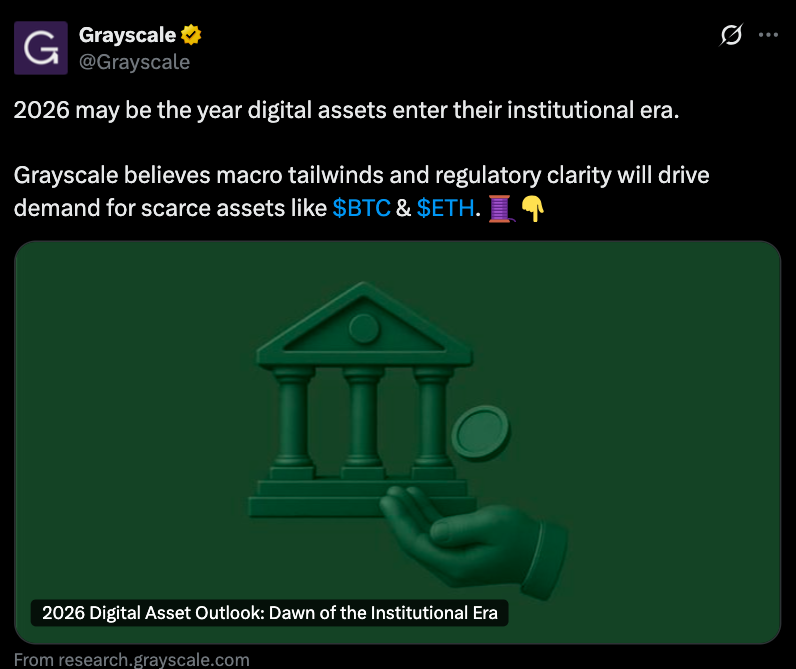
According to the firm’s research, Bitcoin could reach a new all-time high within the first half of the year, supported by increasing institutional demand, clearer U.S. regulatory frameworks, and macroeconomic forces that encourage diversification into digital assets.
Grayscale 2026 Bitcoin Price Outlook
The 2026 report from Grayscale offers ten investment themes, with the Bitcoin comeback taking the lead.
In its published outlook, Grayscale writes:
“We expect rising valuations in 2026 and the end of the so-called ‘four-year cycle,’ or the theory that crypto market direction follows a recurring four-year pattern. Bitcoin’s price will likely reach a new all-time high in the first half of the year, in our view.”
This statement is a divergence from previous halving cycles narratives in the crypto market.
Rather, Grayscale treats the impending price spike in terms of institutional capital flows, regulatory maturation, and macro cross-asset demand, especially as concerns over fiat currency debasement escalate with sophisticated investors and portfolio managers.
Grayscale’s framing implies that the price of Bitcoin is not just a continuation of history based momentum but a change in how global capital markets incorporate digital assets into diversified portfolios.
Institution Demand: A Force Behind The Bitcoin Price Outlook
Institutional demand is at the core of Grayscale’s Bitcoin price prediction. Spot U.S. Bitcoin ETFs had cumulatively gathered more than $118 billion in AUM by the end of 2025, spread between BlackRock’s iShares Bitcoin Trust (IBIT) with about $86.3 billion, and others, according to recent reports.
Some analysts argue that these flows have played a role in Bitcoin’s price stability and depth, with ETFs serving as persistent buyers of BTC on behalf of investors who might otherwise stay away.
Regulatory Milestone as a Catalyst
Another major point supporting Grayscale’s Bitcoin price outlook is regulatory certainty, especially in the US.
National direction on stablecoins/digital asset frameworks got a change following passage of the GENIUS Act in July 2025.
Grayscale’s report also speaks to a larger regulatory evolution, where enforcement tactics have turned toward guidance and legislative participation in creating the framework necessary for innovation while protecting consumers.
This change includes recent approvals of a variety of spot ETP products, greater dialogue with industry participants and proposed market structure legislation that will likely bring blockchain-based finance further into U.S. capital markets.
According to Grayscale, the more defined regulation makes it easier for institutional investors to mitigate risk by reducing the unknowns and potential pitfalls faced while operating in such a new market, which could be critical in attracting even more widespread participation as well as buy-and-hold strategies.
Thus, the Bitcoin price outlook is less tied to niche crypto sentiment and more aligned with mainstream asset management initiatives.
Macro Tailwinds Reinforce Market Structure
Outside of institution-anchored flows and regulation, Grayscale’s Bitcoin price outlook also factors macro forces that could contribute to digital asset demand.
The firm points to mounting government debt around the world and a growing preoccupation with “fiat currency debasement” as forces that may redirect capital flows toward scarce digital assets, such as Bitcoin.
As Grayscale puts it:
“As long as the risk of fiat currency debasement keeps rising, portfolio demand for Bitcoin and Ether will likely continue rising as well, in our view.”

While Bitcoin price outlook dominates Grayscale’s 2026 report headline, the firm also pinpoints a host of other themes driving the development of blockchain tech and digital markets.
These are: Stablecoins, Tokenization, Privacy, AI-crypto, DeFi growth, Next-gen chains and Staking clarity impact.
The firm also adds that work on post-quantum cryptography will persist, but does not anticipate it will have a significant impact on market valuations in the immediate future.
Conclusion
Bitcoin’s 2026 price forecast, as explained by Grayscale, hinges not on speculative cycles but on fundamental forces at play in global financial markets.
Institutional interest via spot ETFs has completely reformatted the way capital enters into Bitcoin and U.S. regulatory clarity through regulatory acts such as the GENIUS Act, reduces operational ambiguity everywhere.
Macroeconomic pressures like currency debasement, panic, and portfolio diversification further support the story that Bitcoin may hit a new ATH by the first half of 2026.
Glossary
Spot Bitcoin ETF: an investment vehicle that directly holds and trades actual BTC on regulated markets.
GENIUS Act: US law enacted by Congress in 2025 on payment stablecoins and a framework for oversight of digital assets.
Asset tokenization: It means that assets are being turned into tokens on a blockchain.
Stablecoin: a digital asset that tracks the value of a fiat currency or another stable asset, and it’s frequently used for transactions and liquidity.
Frequently Asked Questions About Grayscale Bitcoin Price Forecast
What does Grayscale’s forecasting say about Bitcoin?
Based on institutional demand and more legislated clarity, Grayscale estimates that Bitcoin could be at a new all-time high by the first half of 2026.
What is the relevance of spot ETFs for Bitcoin demand?
The spot Bitcoin ETFs facilitate compliance, institutional capital and more liquid markets, which can make BTC investible for big allocators.
What effect does the GENIUS Act have on Bitcoin?
The GENIUS Act brings legal certainty to stablecoins and other similar digital assets, decreasing confusion in the marketplace and promoting institutional adoption.
Do stablecoins feature as part of Grayscale’s themes for 2026?
They do, along with the exponential growth of stablecoins, asset tokenization and DeFi expansion as trends that shape digital markets.
References
Coinpaper
TradingView
Yellow
Bitbo
AInvest