

Bitcoin price predictions are heating up again after Fundstrat’s Tom Lee reiterated his view that Bitcoin could reach $250,000 by the end of 2026, even as the market digests recent volatility and debates whether the old four-year cycle still drives crypto prices.
Bitcoin is trading below its latest record after a volatile stretch as at the time of writing, BTC is around $89,433, while its recent all-time high stands at $126,198.07 (Oct. 6, 2025), putting it roughly 29% below its peak. This gap is central to the 2026 debate because bulls want to see Bitcoin reclaim record territory before projecting a sustained multi-quarter run.
In recent coverage of Lee’s outlook, he has argued that Bitcoin may be shifting away from the classic halving-led rhythm, as broader institutional participation and regulated access channels reshape demand. Supporters say this creates a more durable buyer base than in prior cycles, while skeptics argue liquidity still dominates and volatility remains the defining feature.
This article examines Bitcoin’s current market position, 2026 price expectations, expert outlooks, and the key factors that could influence whether Bitcoin can realistically reach the $250,000 level.
About Bitcoin
Bitcoin is the world’s first decentralized cryptocurrency, launched in 2009 by the pseudonymous creator Satoshi Nakamoto. It operates on a proof-of-work blockchain and has a fixed maximum supply of 21 million coins, a rule that underpins its scarcity narrative.
Bitcoin’s value proposition is centered on scarcity, decentralization, and resistance to censorship. Over time, it has evolved from a niche peer-to-peer payment system into a globally traded digital asset, increasingly viewed as a hedge against currency debasement and macroeconomic uncertainty. At the same time, its market behavior often reflects risk sentiment, with periods of sharp rallies followed by deep pullbacks.
Today, Bitcoin remains the largest cryptocurrency by market capitalization and serves as the benchmark for the broader digital asset market.
Bitcoin Market Overview
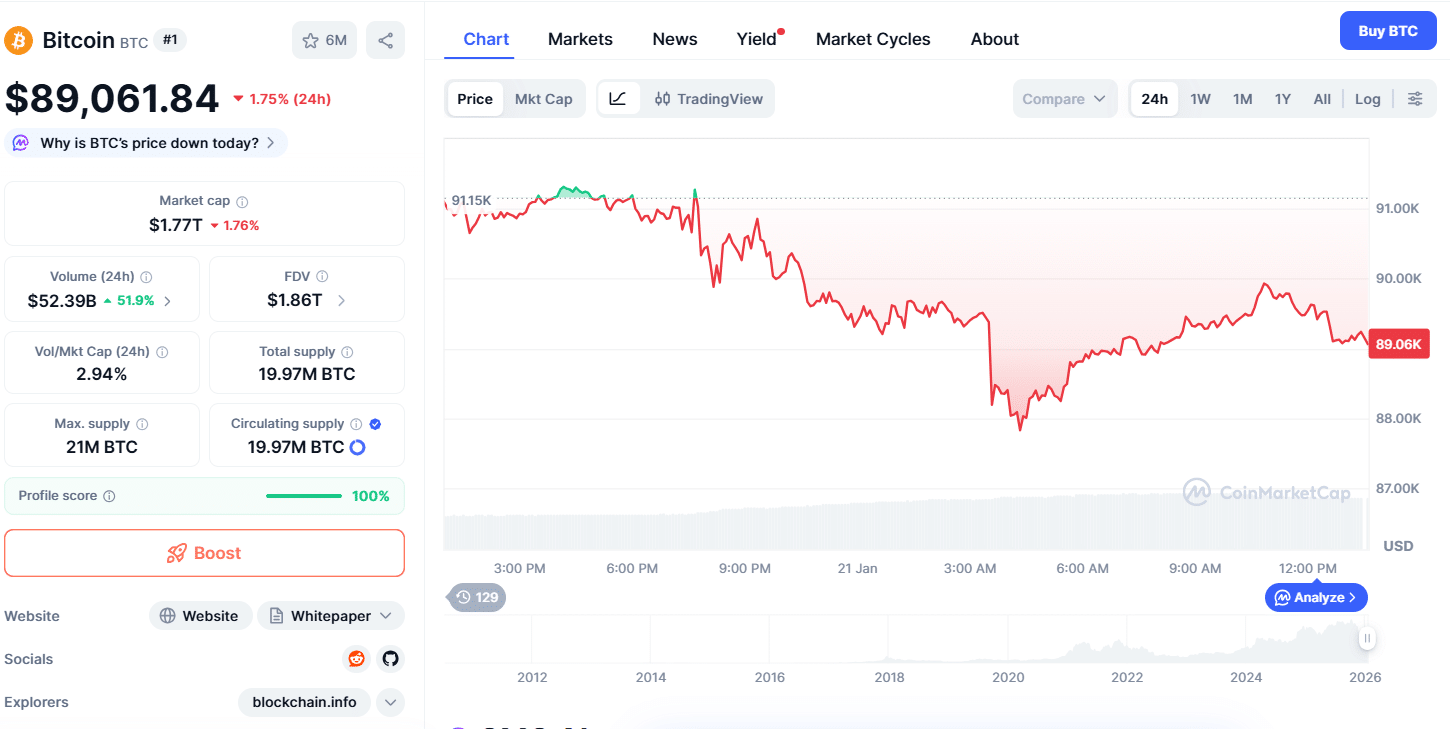
CoinMarketCap’s live BTC page provides a standard snapshot used across crypto newsrooms for price, market cap, supply, and the most recent record high. These figures help frame the scale of the move implied by Tom Lee’s $250,000 target and how much ground BTC must recover before the market can even test that thesis.
| Metric | Data |
|---|---|
| Current Price (BTC/USD) | 88,061.84 |
| Market Capitalization | $1.77T |
| 24-Hour Trading Volume | $52.39B |
| Circulating Supply | 19.97M BTC |
| Maximum Supply | 21M BTC |
| 24h Low | $87,814.93 |
| 24h High | $91,343.84 |
All-Time High (ATH) | $126,198.07 (Oct 06, 2025) |
Bitcoin Price Prediction 2026
Bitcoin price prediction is uncertain and heavily debated as one widely cited range of public forecasts stretches from $250,000 on the high end to $10,000 on the low end, reflecting a sharp disagreement over whether Bitcoin is moving into a more institution-driven era or remaining a liquidity-sensitive, cyclical asset.
Tom Lee’s $250,000 target sits at the top of the bullish bracket. In recent reporting, Lee has argued that if Bitcoin breaks from the traditional four-year pattern, it could be because stronger structural demand and easier access are changing the market’s behavior.
Quarterly Outlook
The market does not have one universally accepted quarter-by-quarter path for 2026. The table below expresses a range-based outlook that mirrors the commonly referenced forecast bands for 2026, including an upper ceiling near $250K and bear-side scenarios below $80K.
| Quarter | Average Price | Low Price | High Price |
|---|---|---|---|
| Q1 2026 | $115,000 | $75,000 | $150,000 |
| Q2 2026 | $135,000 | $70,000 | $170,000 |
| Q3 2026 | $155,000 | $65,000 | $189,000 |
| Q4 2026 | $185,000 | $78,500 | $250,000 |
Expert Bitcoin Price Predictions for 2026
Beyond Tom Lee, many other experts and big institutions have also shared their guesses for Bitcoin’s price in 2026. Their predictions vary a lot because they assume different things about the economy, how many people will use Bitcoin, and how much the price will swing.
It is also worth noting that in late 2025, Lee’s comments were seen as more cautious for the short term. He pointed to a lower range early in 2026, but didn’t change his bigger bullish view for the end of 2026.
| Source | Bitcoin Price Prediction 2026 |
|---|---|
| Tom Lee (Fundstrat) | Up to $250,000 by end-2026 |
| Charles Hoskinson | Around $250,000 |
| Citi (scenario-based) | $143,000 base, ~$189,000 bull, ~$78,500 bear |
| JPMorgan | Roughly $170,000 |
| Standard Chartered (revised) | Around $150,000 for 2026 |
| Fidelity (Jurrien Timmer commentary) | Support zone $65,000–$75,000 in consolidation |
| Peter Brandt | Around $25,000 (bear case) |
| Mike McGlone | Toward $10,000 (extreme downside) |
Factors Affecting Bitcoin Price
Several major variables are likely to shape Bitcoin’s price trajectory through 2026 and beyond.

Institutional Adoption
The biggest bullish argument is that broader access channels have brought new buyers into the market and could make demand more persistent during pullbacks.
Supply Dynamics
Bitcoin’s fixed supply cap remains central to long-term valuation narratives. With most supply already mined, new issuance continues to decline over time.
Macroeconomic Conditions
Interest rates, inflation expectations, and liquidity conditions have repeatedly influenced crypto appetite. A risk-on environment supports upside moves, while tightening conditions can pressure high-volatility assets.
Regulation
Clear regulatory frameworks can expand participation, while restrictive policies remain a downside risk that can reduce liquidity and confidence quickly.
Can Bitcoin reach $250,000 by 2026?
For Bitcoin to hit $250,000, it would need to almost triple from where it is now. That is a very big jump, but Bitcoin has made large gains before over a few years. Still, the move is usually not smooth. The price often rises fast, then drops hard, and those sudden drops can shake people’s confidence and push some investors to sell.
Tom Lee’s view is that Bitcoin is entering a new phase where demand is stronger and steadier than in earlier cycles. He believes more long-term buyers, easier ways to invest, and broader interest could help support higher prices over time. Critics disagree and say Bitcoin is still known for extreme price swings and big cycle-based drops. They also point out that even a strong bull market can include sharp pullbacks and long periods where the price goes sideways. In the end, reaching $250,000 depends on more buyers entering than sellers exiting, plus an economic and regulatory setup that does not block a long rally.
Conclusion
Tom Lee’s renewed $250,000 Bitcoin price prediction for 2026 places him among the most bullish voices in the market, and it continues to draw attention amid an unusually wide forecast landscape. Even among major institutions and veteran commentators, the 2026 range spans from aggressive upside to deep downside.