






As per recent data, Bitcoin M2 correlation has become one of the most closely followed signals in the crypto market. U.S. M2 money supply is at record highs, and Bitcoin trades just above USD 111,000. Analysts are asking: will liquidity expansion push Bitcoin higher, or will strong resistance cap the rally?
What is M2 and Why It Matters
M2 measures cash, checking, savings, and other near-money instruments. Rising M2 reflects more liquidity in the financial system. More liquidity often means more capital available for risk assets like Bitcoin.
According to the source, U.S. M2 recently hit USD 21.94 trillion, with annual growth of about 4.5%. This expansion has strengthened demand for crypto, with the Bitcoin M2 correlation becoming a vital reference point for traders.
How Strong is the Bitcoin M2 Correlation?
| Evidence | Observation |
|---|---|
| Record U.S. M2 | An official source noted that Bitcoin tends to rally about 90 days after liquidity peaks. |
| Global M2 growth | Coinglass shows that global M2 expansion often precedes broad crypto demand. |
| Correlation strength | NewHedge charts show that Bitcoin prices and M2 move in lockstep over multi-year cycles. |
These findings highlight that Bitcoin M2 correlation works as a forecast tool. Yet market shocks, regulation, or sudden inflation can break the pattern.
Also read: Ethereum Nears ATH While Bitcoin Taps M2 Surge: Altcoin Season Next?
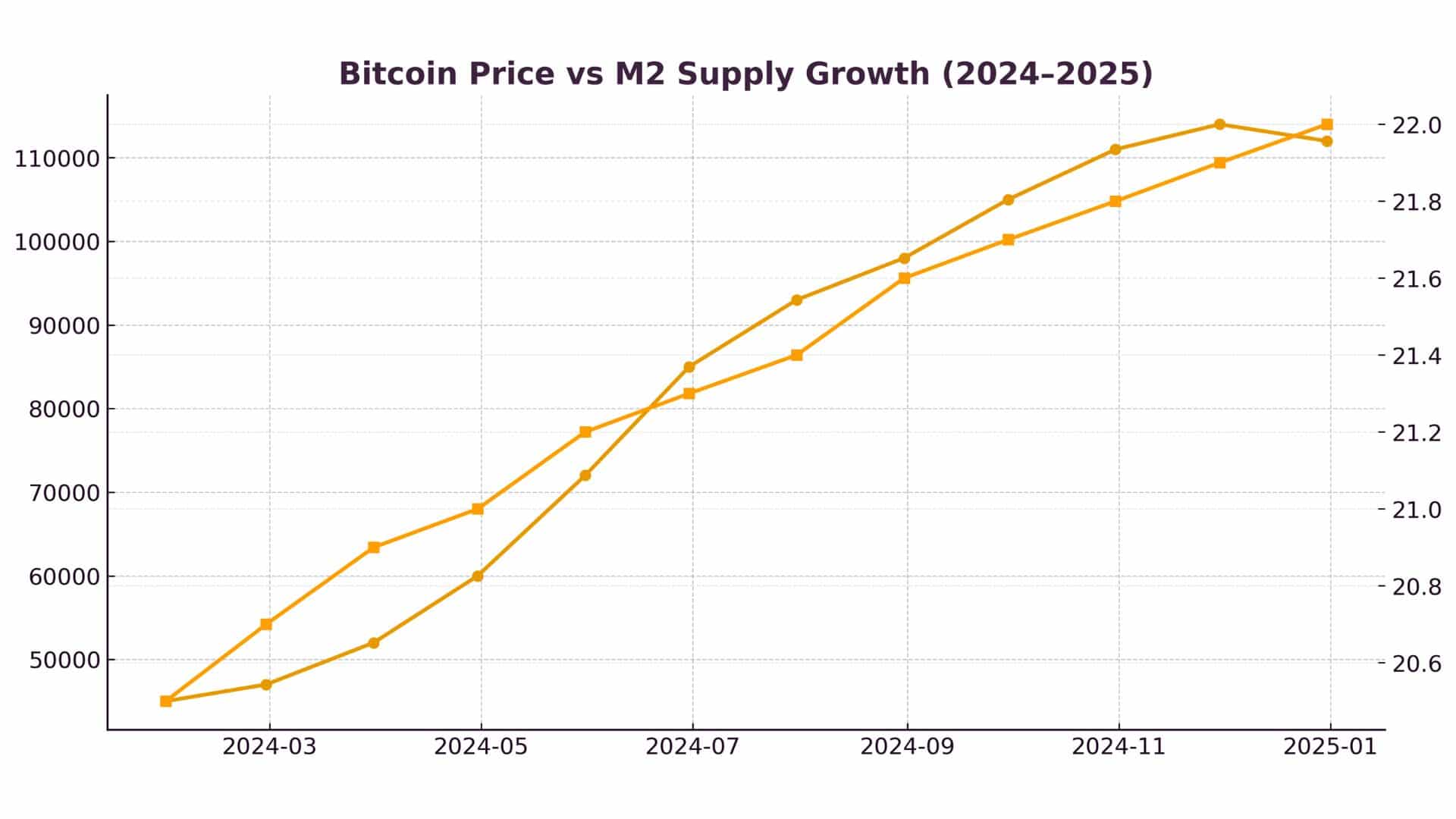
Price Charts and Expert Insights
- CoinTelegraph reported that analysts see targets of USD 130,000–170,000 if M2 growth continues.
- DZilla observed that rising debt and inflation boost M2, making Bitcoin more attractive as a hedge.
- Another official source confirmed Bitcoin trades near USD 111,000–112,500, showing steady but cautious investor sentiment.
Risks That Could Break the Link
- Inflation spikes could push the Federal Reserve to raise rates, slowing M2.
- Regulatory moves may disrupt investor confidence even if liquidity expands.
- Economic Times noted that Bitcoin remains volatile near $111K, showing that liquidity alone cannot guarantee a rally.
Thus, while Bitcoin M2 correlation is powerful, it should not be the sole guide.
Investor Sentiment and Market Psychology
Market psychology plays a crucial role when it comes to the interpretation of the correlation between Bitcoin and M2. Traders, however, consider increasing M2 a criterion for viewing their risk-taking as green light and build bullish sentiment around Bitcoin.
Barron’s recently reported that Bitcoin held above $112,000 due to remaining investor confidence that transcended the general market fluctuations. This shows that liquidity data not only fuels the obsession with technical analysis but also reinvigorates people’s faith in Bitcoin as a hedge against inflation and monetary expansion.

Conclusion
Based on the latest research, Bitcoin M2 correlation remains a key signal for crypto investors. Expanding money supply gives Bitcoin momentum to test higher levels, with experts pointing toward six-figure targets. However, inflation risks, policy tightening, and market shocks must be watched closely.
For now, tracking M2 data offers one of the clearest guides to where Bitcoin and related assets could head next.
Also read: Bitcoin Price Prediction: Triangle Breakout Looms After $123K Rejection
Summary
U.S. M2 money supply has reached USD 21.94 trillion, fueling the Bitcoin M2 correlation. Analysts say Bitcoin often rallies weeks after liquidity peaks, with forecasts pointing toward USD 130,000–170,000 if growth continues. Bitcoin now trades near USD 111,000–112,500, reflecting cautious optimism.
Risks remain; policy tightening and inflation could disrupt the trend. Still, tracking M2 data offers one of the sharpest tools for understanding where Bitcoin might head next.
Glossary of Key Terms
M2 money supply: Cash, savings, checking, and near-money combined.
Correlation: A Measure of how two factors move together.
Liquidity: Ease of money flow into assets.
Inflation hedge: Asset that helps preserve value when prices rise.
Federal Reserve: U.S. central bank controlling interest rates and monetary policy.
FAQs for Bitcoin M2 Correlation
Q: What is Bitcoin M2 correlation?
A: It describes how Bitcoin’s price often follows changes in the M2 money supply.
Q: Does Bitcoin always rise when M2 expands?
A: No. External shocks and regulation can interrupt the pattern, even when liquidity rises.
Q: How long after M2 growth does Bitcoin react?
A: CryptoSlate found Bitcoin often reacts 8–12 weeks later, sometimes up to 90 days.
Q: What is the current level of M2 supply?
A: CoinSpeaker reported that U.S. M2 stands at record highs above USD 21.9 trillion.