





This article was first published on The Bit Journal.
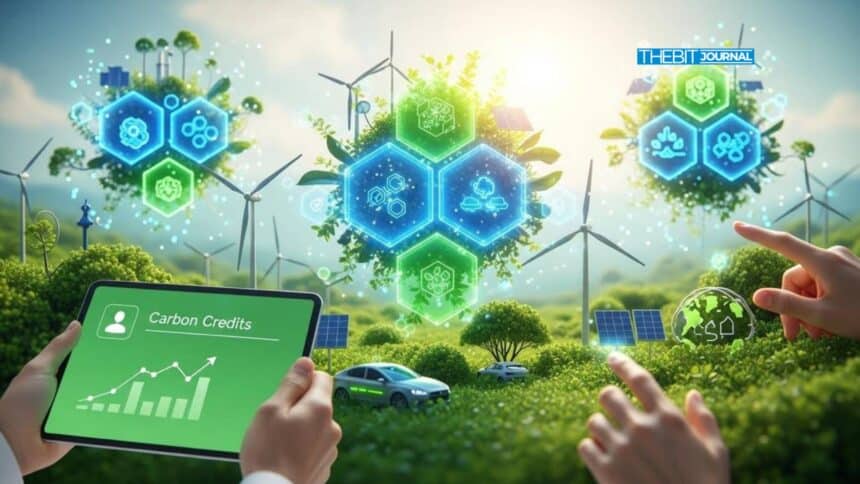
Blockchain carbon credits are one of the most exciting new tools for sustainability. In 2026, advances in blockchain technology are transforming how carbon credits (certificates representing one tonne of CO₂ emissions reductions) are tracked and traded.
Experts point to the fact that whole classes of assets, such as carbon credits, could eventually move on-chain. By converting credits into digital tokens, companies aim to increase transparency, reduce fraud and make markets more efficient.
What Are Blockchain Carbon Credits?
A carbon credit is equivalent to one ton of greenhouse gas emissions either reduced or erased from the atmosphere. Corporations and individuals purchase credits to offset their emissions.
Traditionally, these credits are recorded in centralized registries, which can be fragmented and opaque.
Blockchain-based carbon credits use blockchain’s secure, distributed ledger to record ownership and transactions. A carbon credit is tokenized; its ownership is transformed into a digital token on a blockchain. On blockchain platforms, this token can then be purchased, sold or retired without any intermediaries.
Asset tokenization is simply converting ownership of a real-world asset into the form of digital tokens, which are to be stored on a blockchain.
For carbon credits, this would entail taking steps such as depositing a verified credit in a locked custodial account and issuing a token that corresponds to it. It is then permanently and irreversibly written to the blockchain, where every transfer (or retirement) of that token is recorded thereon.
Notably, the tokenization of a credit does not alter its value as it’s still that same emission reduction but instead accelerates and clarifies trading and verification.
Benefits of Blockchain Carbon Credits
Blockchain carbon credits have several benefits over traditional systems. First, they vastly increase the transparency and auditability of systems. Because every token trade is logged on a public or permissioned ledger, buyers can trace the complete history of a credit.
A blockchain, an “immutable, auditable, and decentralized record of carbon market data allows detection of double counting. In fact, by tracking projects across multiple registries, blockchain helps prevent the credit from being counted twice. This will cut down fraud and help stabilize the market.
Secondly, on-chain tokens enhance the integrity, quality of records and standardization of data. Metadata about each credit (e.g. project specifics, vintage and quality ratings) can be embedded into credits via smart contracts.
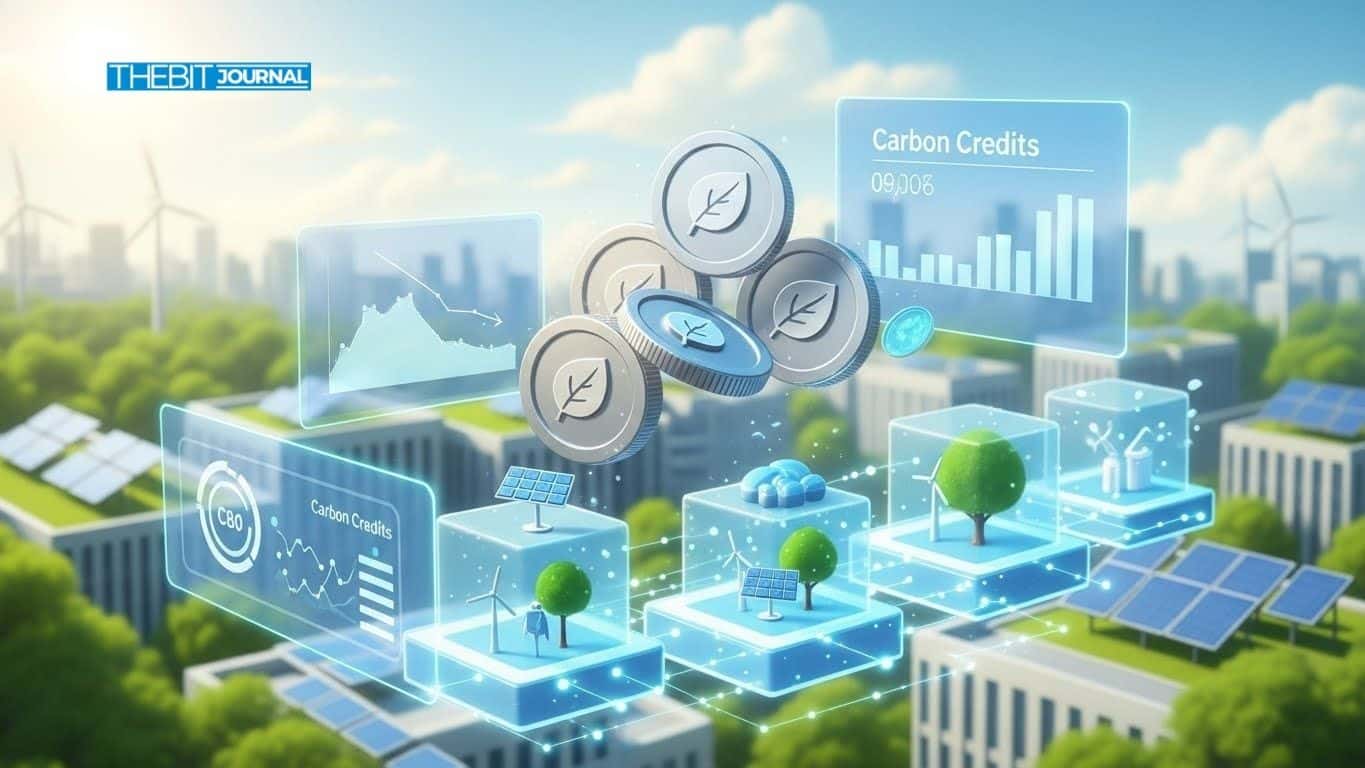
This is because credits are uniformly characterized, facilitating comparison between projects. JPMorgan, an early tester of a blockchain carbon registry, says that tokenization can foster a single, tokenized carbon ecosystem and allow for fluid trading.
It might support greater information and price transparency that lead to greater liquidity. In plain words, by making credits on-chain, buyers and sellers have real-time access to trusted data, and trades can settle faster.
Third, blockchain serves to democratize access and innovation. Because tokens can be fractionalized and traded globally 24/7, smaller buyers and new markets can participate.
Some platforms incorporate carbon tokens into apps and financial products. Organizations, such as Carbonmark, automate buying, retiring and fractionating credits into payment systems. Nasdaq’s climate system is applying blockchain to digitize carbon registries and automate pre-issuance processes, turning carbon assets into a standardized, trusted ecosystem where institutional capital can flow more easily.
In short, blockchain carbon credits can bring more capital into climate projects by making offsets easier to buy, sell and verify.
Major Initiatives and Platforms
Many of the top players and initiatives are already testing blockchain carbon credits. In mid-2025, JPMorgan’s Kinexys team revealed a partnership with S&P Global; EcoRegistry and the International Carbon Registry to issue carbon credit tokens at the level of individual registries.
These tokens will represent ownership of the credits, allowing direct transfers and retirement on JPMorgan’s internal blockchain system. The aim is to harmonize the data of registries and make them more transparent.
A second major initiative is the Climate Action Data Trust (CAD Trust), supported by World Bank, and IETA among others. Launched in 2023, CAD Trust provides a blockchain ledger for projects supported across multiple carbon registries to ensure that they are not double counted.
Bby aggregating registry data across a shared ledger, CAD Trust ensures each credit has a unique identity and brings the process closer to real time and global compliance reporting. This sort of meta-registry could serve as the foundation for future on-chain carbon trading.
On the corporate front, Nasdaq is working on its own blockchain tools for carbon markets. Nasdaq officials have indicated they are bringing institutional-grade digital asset technology to carbon markets with an emphasis on automation, transparency and efficiency.
Their objective is to digitize the current registries and combine with authenticated data oracles so that carbon-backed financial products can enter into mainstream trading.
In the private sector, startups and exchanges are tokenizing credits. Singapore’s AirCarbon Exchange (ACX), for instance, operates a digital exchange where credits are tokenized in order to increase transparency.
Climate-focused blockchain projects such as Toucan Protocol, and Regen Network (specifically the Jaguares project) allow credits from nature-based ecosystems to be bridged onto public blockchains.
Even small companies are doing something: Nature’s Miracle Holding purchased a $20 million carbon portfolio in 2025 and plans tokenize it on the XRP Ledger so that trading is transparent, while energy efficient.
Hence, an increasing ecosystem of banks, regulators and tech platforms is pushing blockchain carbon credits from pilot stage into real-world use.
How Blockchain Carbon Credits Improve Climate Action in 2026
| Traditional Carbon Credits | Blockchain Carbon Credits | What This Means |
| Stored in private databases | Stored on public blockchain | Anyone can verify them |
| Can be sold more than once | Can only be used once | Stops fraud and double-counting |
| Hard to track | Fully traceable | Builds trust |
| Slow manual trading | Instant digital trading | Faster climate funding |
| Limited access | Global online access | More buyers support green projects |
| High middle-man fees | Lower platform fees | More money goes to the environment |

Moving Through Obstacles and Requirements
Blockchain carbon credits are promising, but they face challenges.
Credibility is still dependent on a rigorous project verification process. Transferring credits on-chain does not guarantee that a credit actually represents a real emission reduction.
As JPMorgan notes, its blockchain app is not an authority on [credit] quality, it only enforces standardized data structures. So, rigorous auditing and certification from well-respected entities (whether Verra, Gold Standard, etc.) will still be crucial.
Blockchain can record data immutably, but it can’t verify the accuracy of that data on its own.
The regulatory and legal clarity is still taking shape. A number of jurisdictions are attempting to reconcile the place of blockchain assets within current securities and commodity laws.
Standards like the EU’s CSRD (Corporate Sustainability Reporting) and forthcoming US frameworks could impact how blockchain credits are acknowledged. Firms have to navigate intricate rules about data privacy, asset custody and cross-border trading.
Overall, efforts like the proposed U.S. Clarity Act (for crypto regulation) and outcomes from COP28 could have future implications to on-chain carbon governance.
Technology integration is also non-trivial. Many of the carbon registries rely on outdated systems. Bridges or permissioned networks are a necessary step to connect these with blockchains.
JPMorgan concedes that tokenizing a mature market with entrenched workflows is challenging. Interoperability (between different blockchains) will be essential, as well as compatibility with existing registries.
The industry is investigating standards such as ERC-1155 carbon token standards, but mass adoption will take some time.
Energy use is another consideration. There are concerns among critics that blockchain could be an even greater energy hog. But many carbon-token projects rely on energy-efficient networks. To take one, Nature’s Miracle selected the XRP Ledger which is a proof-of-work (in fact unique consensus) chain with very low energy per transaction.
Others use proof-of-stake blockchains such as Polygon or Cardano to keep their footprints small. The net climate impact of blockchain credits can still be positive if the offsets they facilitate far outweigh their own energy costs.
Conclusion
Blockchain carbon credits are becoming the foundation of next-generation carbon markets. Using distributed ledgers, these digital credits provide transparent and traceable emission reduction records.
High-profile tests from JPMorgan’s registry tokens to Nasdaq’s institutional platforms, demonstrate how credits can be minted, traded and retired without friction on-chain.
These all tout advantages such as real-time auditing, interoperability and liquidity. But experts say blockchain is a tool, not a magic wand: tokenization rides on the back of rigorous project verification and sound regulation.
In short, leaders emphasize that in 2026, blockchain-based carbon credit systems will be vital to a sustainable economy. They provide a mechanism for restoring trust in carbon offsets, with every credit verified and the finance flowing effectively to climate solutions.
Glossary
Blockchain: A decentralized digital ledger system that stores transactions through secure, time-stamped blocks and so can never be altered or edited.
Carbon Credit (Offset): A unit representing one tonne of CO₂ reduced or removed by a verified project.
Tokenization: Transition of ownership of an asset to a digital token on the blockchain. The token records the transfer and status of the asset.
Carbon registry: An online database operated by a certification body (as Verra, Gold Standard) for the issuance and tracking of carbon credits.
Double-counting: When the same emission reduction is claimed more than once. Blockchain’s unique tokens help eliminate this risk.
Frequently Asked Questions About Blockchain Carbon Credit
What is a blockchain carbon credit?
A blockchain carbon credit is a normal carbon offset (one tonne of CO₂ ejected or sequestered) that gets expressed as a digital token on blockchain.
How does blockchain prevent carbon credit double counting?
Every token is a unique item on the blockchain since each credit was tokenized. Projects and retirements can be logged on-chain, in systems like the Climate Action Data Trust. If someone seeks to spend the same credit twice, the ledger records that it’s already been spent. This makes double claiming difficult.
Who is experimenting with blockchain for carbon credits?
JPMorgan’s blockchain unit Kinexys is experimenting with tokenization and global registries. Tokenized trading is supported by exchanges such as the Singapore-based AirCarbon Exchange. Nasdaq and other financial companies are developing blockchain tools for credits. Decentralized platforms, such as Toucan and Regen Network, also enable community projects to mint tokens.
What are the risks or drawbacks?
Blockchain credits still depend on credible climate projects behind them. If a project’s carbon reduction is wrong, tokenizing it isn’t going to fix that. There are also risks from regulatory uncertainties (especially related to crypto laws). Some blockchains do have energy costs, but a lot of projects rely on low-energy networks. It’s crucial that token systems are paired strong oversight and high-quality project verification.
References
weforum
utilitydive
osler
climateactiondata
ledgerinsights
carbonmark
deloitte