


Bitcoin US China economic deal is under the spotlight as China’s startling move to offload approximately $298 billion in U.S. Treasuries sparks fears of a Bitcoin liquidity crisis. The massive bond reduction has jolted global markets, driving heightened volatility and uncertainty across digital assets.
With BTC trading near $68,959.56 USD and a market cap of over $1.37 trillion, analysts are closely monitoring the interplay between China’s financial maneuvers, ongoing Bitcoin US China trade talks, and broader macroeconomic pressures to assess potential impacts on Bitcoin’s price and investor sentiment.
The Macro Shock That Is Brewing Behind the Bitcoin US China Economic Deal Crypto
In the latest macro twist, China’s changing directional bias toward cutting exposure to U.S. Treasury bonds, even that they’re holding $298 billion worth of dollar‑denominated assets in their portfolio has birthed a number of existential questions about both global liquidity flows and what passes for risk sentiment these days. It has been reported that Chinese banks are being instructed to reduce their U.S. debt exposure, accelerating the China US debt reduction crypto narrative and touching right on the heart of broader trade volatility.
This is a double-edged trend. On the one hand, markets have mostly shrugged at the bond exit in near-term yield terms (readiness). On the other hand, the long term trend is adding to a broader discussion of China de‑dollarization Bitcoin narratives and the fear that falling dollar liquidity will soon lead to BTC-specific macroeconomic pressure, especially on risk assets such as Bitcoin.
Reply of the Chinese Treasury Movement Bitcoin liquidity crisis escalation
China’s deliberate turn from U.S. Treasuries isn’t random. A structural, steady decline for a period of many months has eaten away at the bank’s Treasury portfolio and taken it to multiyear lows, which have been offset by strategic hedging as geopolitical events and trade conflicts play out. This is right into a Bitcoin treasury yields effect mentality where macro contest attendees are observing liquidity looking thinner around riskon assets.
Blood And Liquidity: The connection between exist from the bond market and a liquidity squeeze also increases concern. As foreign holders pare, traditional markets could feature higher yields and tighter credit conditions, which will work its way into the collective psychology of the crypto market. Deep correlation with broader risk sentiment This is why this trend transcends a banking story; it’s all part and parcel of a Bitcoin bond market link that sees analysts watching every yield move for the signal it sends on BTC sentiment.
Bitcoin US China Trade Deal Impact Makes Case For Economic Dialogue
The Bitcoin US China trade deal impact story has been a major macro driver. Previous instances with positive US‑China trade progress announcements have led to bitcoin price rebounds or rallies; such as when tariff truce discussions had helped the infamous cryptocurrency climb over crucial psychological levels.
But in this new context the accent is changing. Any hopeful outcomes from a trade deal; for instance, about tariffs being reduced or about mutual engagement in economic terms, would have to be measured against the financial pressures overall that are dueling with one another, such as diminishing demand for U.S. bonds and currency realignment maneuvers. “People still want to talk ‘China deal’ and whether it affects Bitcoin price, above all, the macro dialogue driving sentiment and demand for digital assets.”
Bitcoin US China Trade Talks and Market Risk Tone
As China unfolds its bond market actions, BTC/US China trade talks in progress will continue to influence the risk sentiment across the markets. Such rhetoric has historically pushed BTC and risk assets higher, evident in the past price spikes on U.S.-China preliminary deal announcements.
These type of negotiations embed in expectations about upcoming economic cooperation, mitigations of the effects of tariffs or market stability and thereby play into valuations and liquidity flows. Conversely, stalled or fractious negotiations could also exacerbate uncertainty and add to bearish pressure on Bitcoin’s price as traders bake in the heightened macro stress of declining traditional liquidity. This nuanced interplay is directly relatable to Bitcoin price as US and China hold talks.
Dissecting the Japan‑style Macro Playbook: De‑Dollarization Meets Bitcoin
China’s de‑dollarization shift is a strategic reallocation of foreign reserves and part of broader geopolitical positioning. This approach dovetails with the narrative of China de‑dollarization Bitcoin, wherein Bitcoin is occasionally touted, especially in institutional circles, as a de‑dollarisation hedge. However, macro experts warn this relationship is complex and influenced by numerous variables, including global reserve management, currency policy, and relative asset risk.
Tighter liquidity stemming from these changes has historically pressured risk assets, including Bitcoin. When liquidity recedes or becomes more costly, investors often retreat to safer haven assets or cash, constraining upward momentum for speculative assets like BTC. The question of whether Bitcoin will consistently benefit from de‑dollarization narratives remains a point of intense discussion within macro and crypto communities alike.
US Dollar Under Pressure: Metals Surge and What It Means for Bitcoin US China Economic Deal Crypto
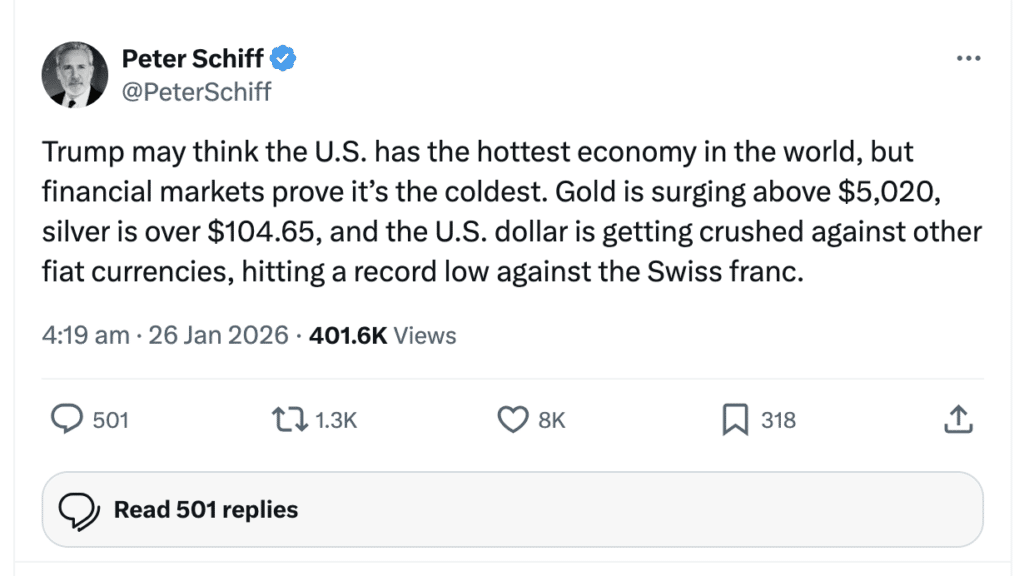
Recent market signals are underscoring growing stress on the U.S. dollar as gold and silver rally sharply. Analysts and influential voices, including posts from prominent market observers like NoLimitGains, highlight these moves as more than standard hedging, they reflect a macro confidence shift that directly intersects with the Bitcoin US China economic deal crypto narrative. As capital moves toward hard assets, liquidity pressures increase across risk markets, amplifying the ongoing bitcoin liquidity crisis. This trend reinforces broader discussions around China de‑dollarization Bitcoin and the evolving Bitcoin US China relations market outlook.

Peter Schiff Flags Dollar Risks as China’s De‑Dollarization Shapes Bitcoin Markets
China’s de‑dollarization shift is part of a broader global trend. Prominent economist Peter Schiff has highlighted rising concerns over dollar confidence, noting surging precious metals and a shift among BRICS nations as a signal of de‑dollarization pressures. Such dynamics are critical to the Bitcoin US China economic deal crypto story, as investors increasingly weigh macroeconomic turbulence and liquidity risks when positioning in Bitcoin.
Bitcoin Market Risk Sentiment: Fear, Uncertainty, and Opportunity
Market sentiment shaped by macro developments such as China’s bond strategy and trade negotiations — exerts a powerful influence on Bitcoin price movements. In risk‑off environments, Bitcoin can behave similarly to other speculative assets, encountering sell‑offs when global markets tighten. Recent patterns show that macro headlines can trigger exaggerated responses in crypto markets, sometimes sending prices lower even when fundamentals remain robust.
This sensitivity highlights the Bitcoin market risk sentiment factor: short‑term fear may exacerbate declines into technical zones, while longer‑term investors might perceive these episodes as buying opportunities. Whether investors adopt a risk‑on or risk‑off stance amid these evolving conditions largely drives Bitcoin’s short‑term price action.
Comparative Impact: Trade Optimism vs Liquidity Squeeze
It’s instructive to contrast two macro currents affecting Bitcoin US China economic deal crypto today. On one side, Will US China trade deal boost Bitcoin remains a speculative but meaningful bullish impulse. Positive trade outcomes historically have lifted Bitcoin market risk sentiment, helping BTC rally. On the other side, shrinking traditional liquidity, manifesting as bond sales and retreating dollar demand, presents a real tension that can exacerbate the bitcoin liquidity crisis and dampen gains in the Bitcoin US China trade deal impact.
These competing forces create a complex backdrop for crypto markets. Unlike isolated Bitcoin events, this dynamic is inherently comparative: trade optimism may buoy markets, but concurrent liquidity squeezes can undermine upside by making capital more expensive and risk aversion more pronounced. This duality lies at the heart of today’s Bitcoin US China relations market puzzle.
Conclusion
Bitcoin’s narrative today sits at the crossroads of macro economics and geopolitical shifts. The Bitcoin US China economic deal crypto environment marked by China’s retreat from U.S. Treasuries and ongoing trade negotiations, signals heightened macro stress and market sensitivity. Ultimately, while trade dialogue could offer bullish catalysts, systemic liquidity pressures and evolving global reserve strategies pose substantive risks that could shape Bitcoin’s trajectory in the months ahead.
Investors should monitor developments in trade negotiations and bond market behaviour closely, as these factors remain deeply intertwined with Bitcoin price dynamics.
Appendix: Glossary of Key Terms
Bitcoin US China economic deal crypto: Macroeconomic narrative linking Bitcoin price with economic negotiations or deals between the US and China.
Bitcoin liquidity crisis: A situation where Bitcoin market depth and institutional buying falter amid broader financial stress.
Bitcoin China Treasury: Refers to Bitcoin market sensitivity to China’s actions regarding U.S. Treasury holdings.
China US debt reduction crypto: The narrative around China reducing its U.S. debt holdings and potential impacts on crypto markets.
China de‑dollarization Bitcoin: Long‑term shift away from the U.S. dollar by China and its implications for Bitcoin.
BTC macroeconomic pressure: External economic forces affecting Bitcoin price and investor sentiment.
Bitcoin bond market connection: Relationship between global bond markets and Bitcoin price action.
Frequently Asked Questions About Bitcoin US China Economic Deal Crypto
How does a US‑China economic deal affect Bitcoin price?
US‑China economic deals can influence market sentiment, liquidity, and risk appetite, which in turn may impact demand for Bitcoin.
Is China selling US Treasuries good or bad for Bitcoin?
Raises liquidity concerns that could create short‑term volatility, though some see de‑dollarization as a potential long‑term narrative boost.
Could Bitcoin benefit from de‑dollarization?
It’s debated: some view Bitcoin as a non‑dollar asset that could thrive in a de‑dollarizing world, but macro pressures complicate this view.
Will a trade deal boost Bitcoin?
Positive trade outcomes could enhance risk sentiment and support higher BTC prices.
Reference