





Crypto traders love complicated charts, but some of the most useful signals are surprisingly simple. Bitcoin dominance is one of them. It shows how much of the total crypto market value belongs to Bitcoin compared with the rest of the market. In plain English, it tells investors whether capital is leaning toward the market’s largest asset or spreading into altcoins, stablecoins, and higher-risk sectors.
That does not make it a magic indicator, no single chart can explain the full crypto market. Still, Bitcoin dominance helps traders read risk appetite, capital rotation, fear, confidence, and the early signs of an altcoin cycle. Used with price action, volume, liquidity, and macro context, it can become one of the cleaner market signals on the board.
Bitcoin Dominance: The Single Most Watched Market Signal
Bitcoin dominance matters because Bitcoin still acts as the market’s anchor. When new money enters crypto, it often starts with BTC. When fear rises, many traders rotate back into BTC or stablecoins. When confidence expands, capital often moves further out on the risk curve into ETH, SOL, gaming tokens, AI tokens, meme coins, and smaller caps.
This is why dominance is watched like a weather report. A rising reading can mean Bitcoin is gaining strength against the rest of the market. A falling reading can mean altcoins are catching up. But context is everything. If BTC is rising and dominance is rising too, Bitcoin is leading the market higher. If BTC is falling and dominance is rising, traders may be dumping altcoins faster than Bitcoin.
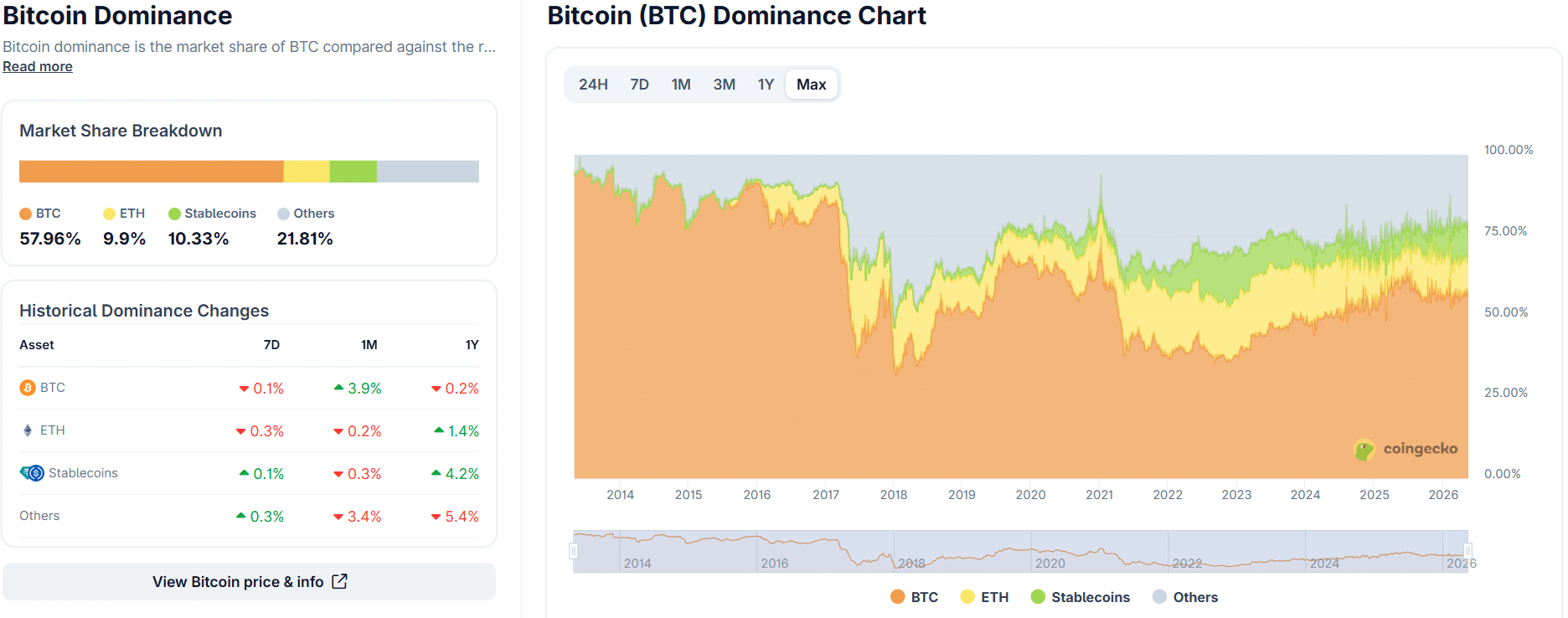
In May 2026, market data showed BTC holding around the high-50% range, with one live market-share reading near 58% and stablecoins above 10%. That tells traders Bitcoin remains the main center of gravity while liquidity is still selective across the broader market.
How BTC.D Is Calculated and Where It Falls Short
The basic formula is simple: Bitcoin market cap divided by total crypto market cap, multiplied by 100. In theory, that gives a clean picture of Bitcoin’s share of the total digital asset market. One widely used charting method calculates coin dominance as a market-cap ratio against the cumulative market cap of listed crypto assets, then turns that ratio into a percentage.
The problem is that the crypto market is not as clean as the formula looks. Bitcoin dominance can be affected by stablecoin growth, wrapped assets, inactive tokens, low-liquidity coins, and newly launched tokens with stretched valuations. A small token with thin trading can inflate total market cap even if real liquidity is limited.
Stablecoins also complicate the picture. When traders move into USDT, USDC, or other dollar-linked assets, BTC’s market share can fall even if altcoins are not truly gaining strength. That is why experienced traders often compare BTC.D with the total crypto market cap, total market cap excluding BTC, ETH/BTC, stablecoin supply, and Bitcoin’s own price trend.
High Dominance vs Low Dominance: What Each Phase Means
High dominance usually means capital is concentrated in BTC. This often happens during uncertain periods, early recovery phases, or moments when institutions prefer the most liquid crypto asset. In early 2026, BTC’s share was reported around 58% to 60%, helped by institutional demand, ETF-driven flows, and a preference for larger, more regulated exposure.
Low dominance usually means the market is more willing to take risk. Capital starts moving into ETH, large-cap altcoins, and then smaller sectors. This can be healthy in a broad bull market, but it can also become overheated when low-quality assets rise only because liquidity is loose.
So the better question is not whether high or low is good. The better question is what is happening at the same time. Is Bitcoin breaking higher? Are altcoins outperforming with real volume? Is stablecoin liquidity rising? Are funding rates too hot? Is the move supported by spot demand or mostly leverage? Those details separate a real rotation from a crowded trade.
BTC.D and Altcoin Season: The Historical Relationship
Altcoin season usually begins when Bitcoin stops absorbing most new capital and traders become more comfortable moving into higher-beta assets. This often appears as a falling BTC.D chart while the total crypto market cap keeps rising. In that setup, Bitcoin may still perform well, but altcoins begin to outperform it.
Bitcoin dominance does not create altcoin season by itself. It reflects the rotation after it starts. Historically, traders have watched for a few clues: BTC slows after a strong move, ETH begins to outperform BTC, large-cap altcoins rise on stronger volume, and smaller sectors follow later. It often feels like a relay race. Bitcoin runs first, then passes the baton.
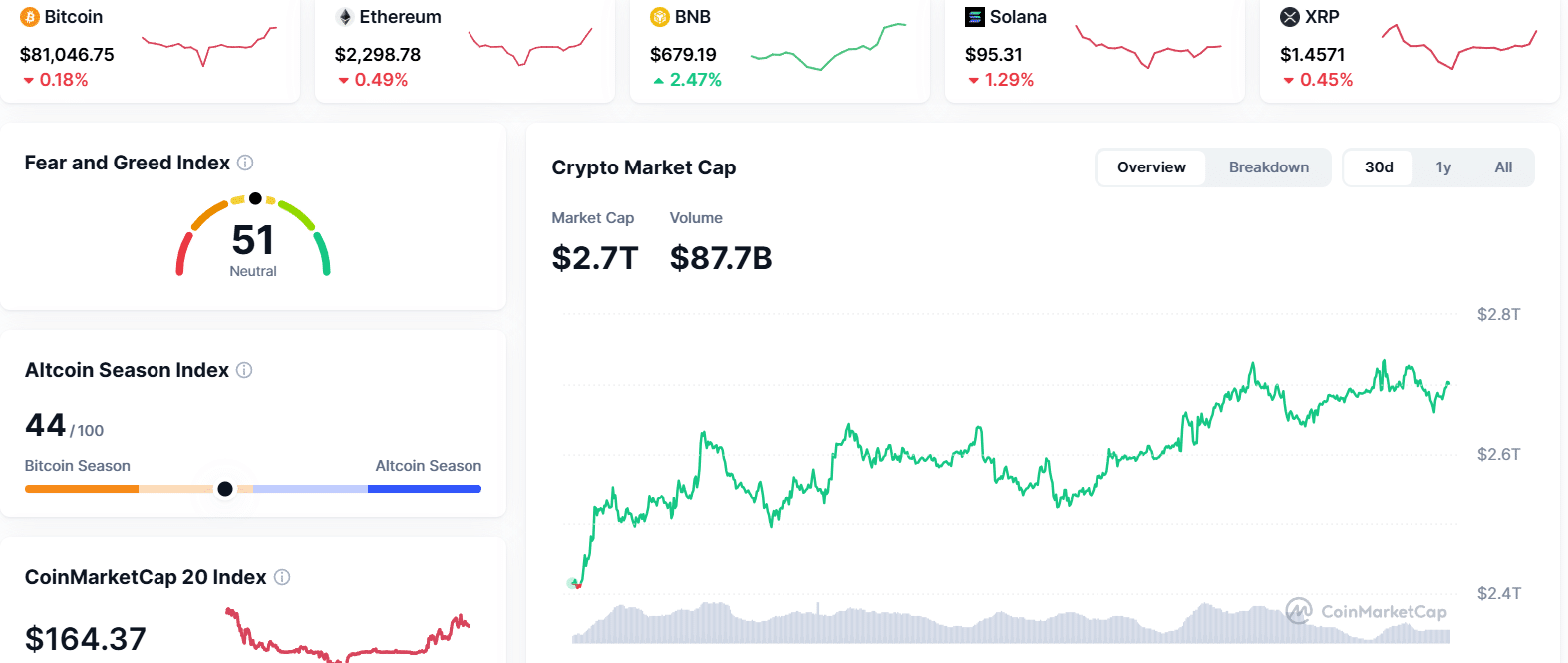
In 2026, the altcoin signal has remained mixed. One market dashboard recently showed the altcoin season reading at 45 out of 100, which placed the market between clear Bitcoin leadership and broad altcoin strength rather than in a confirmed altcoin season.
Reading Dominance With Price: 4 Market Scenarios
The first scenario is BTC price up and dominance up. This is Bitcoin-led expansion. It usually means institutions, large traders, and cautious capital are favoring BTC first. Altcoins may rise too, but they lag.
The second scenario is BTC price up and dominance down. This is often the classic altcoin rotation setup. The market is rising, but capital is spreading beyond BTC. Traders usually watch ETH/BTC and total market cap excluding BTC for confirmation.
The third scenario is BTC price down and dominance up. This is defensive behavior. It often means altcoins are getting hit harder than Bitcoin. In rough markets, this setup can be painful because small caps may lose liquidity quickly.
The fourth scenario is BTC price down and dominance down. This can mean traders are leaving crypto altogether or moving heavily into stablecoins. It is one of the messier setups because weakness is broad, but BTC is not acting as a strong shelter either.
These four scenarios make Bitcoin dominance more useful than a standalone percentage. The same 58% reading can mean different things depending on whether BTC is breaking out, ranging, correcting, or losing momentum.
Bitcoin Dominance in 2026: Current Levels and What They Signal
By mid-May 2026, Bitcoin dominance was still elevated compared with many altcoin-heavy periods from past cycles. A live market-share breakdown showed BTC around 57.72% to 58.4%, ETH near 10%, stablecoins around 10%, and the rest of the market near 21% to 22%.
That mix points to a market that has not fully rotated into speculative altcoins. Bitcoin remains the main liquidity magnet, ETH has not reclaimed a much larger share, and stablecoins still represent a meaningful pool of sidelined capital. In practical terms, that means traders may be interested in risk, but many are still keeping one hand near the door.
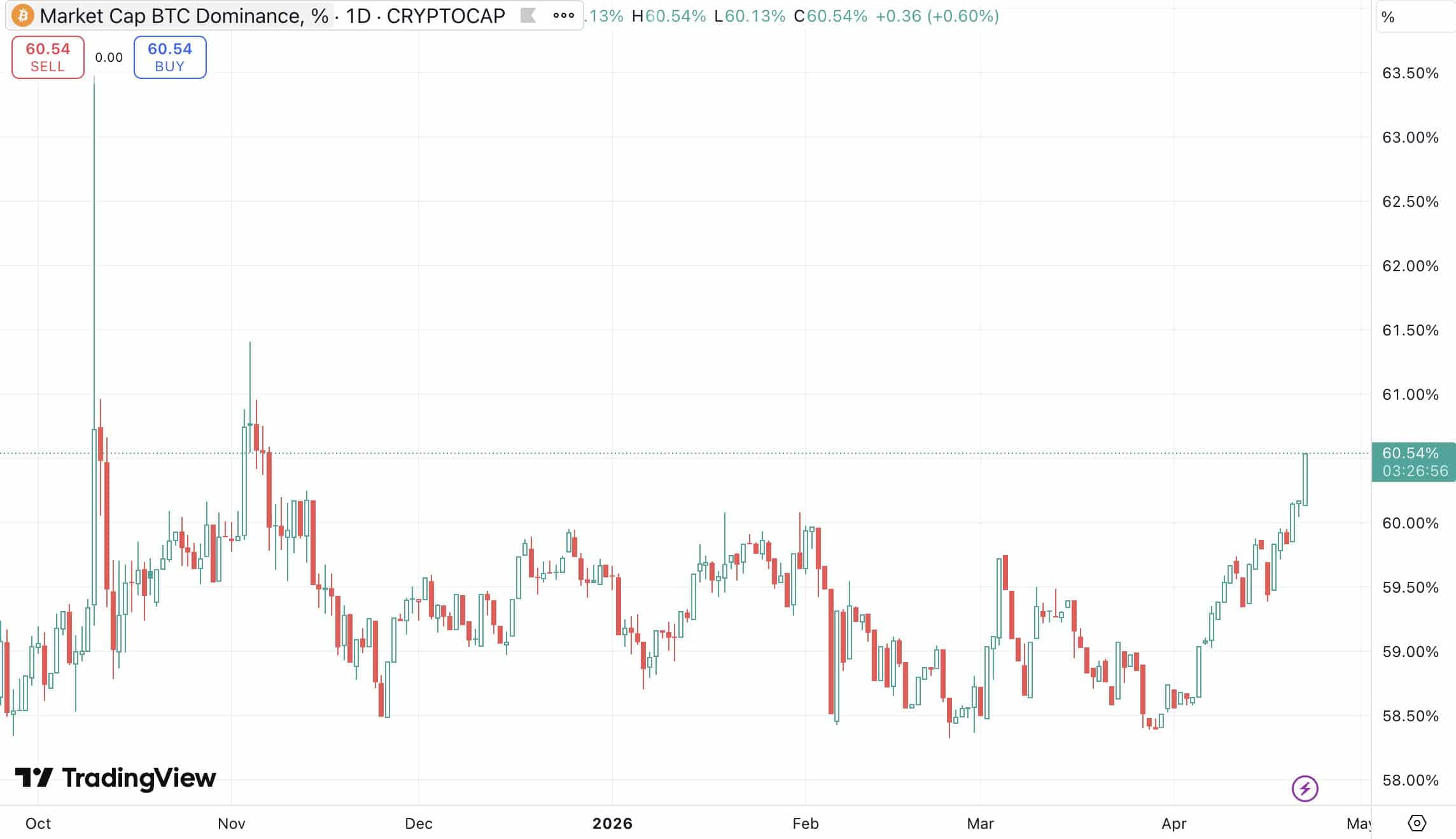
There were also signs of BTC testing higher dominance levels earlier in 2026. One late-April market update showed BTC.D moving above 60% as Bitcoin traded near $80,000, underlining how strongly capital had favored BTC over the broader altcoin market during that phase.
How Traders Use Dominance Without Overusing It
A smart trading process does not treat Bitcoin dominance as a buy or sell button. It treats it as a filter. If dominance is rising and BTC is strong, traders may focus more on BTC setups or only the strongest altcoins. If dominance is falling while the total market is rising, they may look for altcoin sectors showing volume, relative strength, and clean catalysts.
Risk management still matters. Dominance can shift slowly for weeks, then reverse sharply when liquidity changes. Traders should watch support and resistance on BTC.D, but they should not ignore invalidation levels on actual assets. A dominance chart cannot protect a bad entry.
It is also useful to compare dominance with key crypto indicators. Volume shows whether a move has participation. Open interest shows leverage. Funding rates show whether futures traders are crowded. Stablecoin supply shows available liquidity. Exchange reserves can hint at selling pressure. Realized price, ETF flows, and macro rates can shape Bitcoin demand. Together, these indicators give a wider view than one chart alone.
Key Indicators That Strengthen the Signal
Price trend is the first indicator. If BTC is above major moving averages and dominance is rising, buyers may be choosing quality and liquidity. If price is weak and dominance is rising, the market may simply be hiding in BTC while altcoins bleed.
Volume is the second indicator because it shows conviction. A breakout without volume can fade quickly. A dominance move supported by strong spot volume is more credible.
Liquidity is third. Crypto does not move well without fresh capital. Stablecoin supply, exchange balances, and ETF demand all help traders judge whether the market has enough fuel.
Relative strength is fourth. ETH/BTC, SOL/BTC, and total market cap excluding BTC can show whether altcoins are truly outperforming or just bouncing.
Sentiment is fifth. Funding rates, social activity, search trends, and options positioning can show when a trade becomes too crowded. When everyone expects the same move, the market has a habit of making life uncomfortable.
Conclusion
Bitcoin dominance remains one of the simplest ways to read crypto market structure, but simple does not mean shallow. It shows where capital is sitting, how much risk traders are willing to take, and whether Bitcoin is leading or losing ground to the wider market.
In 2026, the signal points to a market still shaped by Bitcoin leadership, selective altcoin demand, and a meaningful stablecoin buffer. That can change, of course. Crypto cycles rarely move in straight lines. The best use of Bitcoin dominance is not prediction. It is perspective. It helps traders ask better questions before they act.
Frequently Asked Questions
What does BTC.D mean?
BTC.D means Bitcoin’s market share compared with the total crypto market. It is another way of tracking Bitcoin dominance through a chart.
Is high BTC.D good or bad?
It depends on context. High BTC.D can be healthy when Bitcoin is leading a strong market higher, but it can also show fear when altcoins are falling faster than BTC.
Does falling dominance always mean altcoin season?
No. Falling dominance can support an altcoin season, but traders also need to see rising total market value, stronger altcoin volume, and real outperformance against BTC.
Why do stablecoins affect dominance?
Stablecoins add to total crypto market value. When stablecoin market share rises, BTC’s share can look lower even if altcoins are not gaining much real strength.
Can traders use BTC.D alone?
No, Bitcoin dominance works best with price action, volume, liquidity, funding rates, market cap trends, and relative strength charts.
Glossary of Key Terms
BTC.D: The ticker often used for Bitcoin’s dominance chart.
Market Cap: The total value of an asset, calculated by price multiplied by circulating supply.
Altcoin Season: A period when many altcoins outperform Bitcoin over a sustained window.
Stablecoins: Crypto assets designed to track fiat currencies, usually the U.S. dollar.
Liquidity: The amount of available capital and trading depth in a market.
Relative Strength: A comparison showing whether one asset is outperforming another.
Funding Rate: A futures-market payment that helps show whether leveraged traders are leaning long or short.
Total Market Cap Excluding BTC: A metric used to track the value of the crypto market without Bitcoin.
Sources
Disclaimer: This article is for educational and informational purposes only. It is not financial advice, investment advice, or a recommendation to buy or sell any digital asset.