







This article was first published on The Bit Journal.
Bitcoin is showing some signs of stability above the $60,000 support level but there is still plenty of uncertainty going on behind the scenes. On-chain data reports that institutional investors are accumulating Bitcoin in large amounts, while others are still selling off.
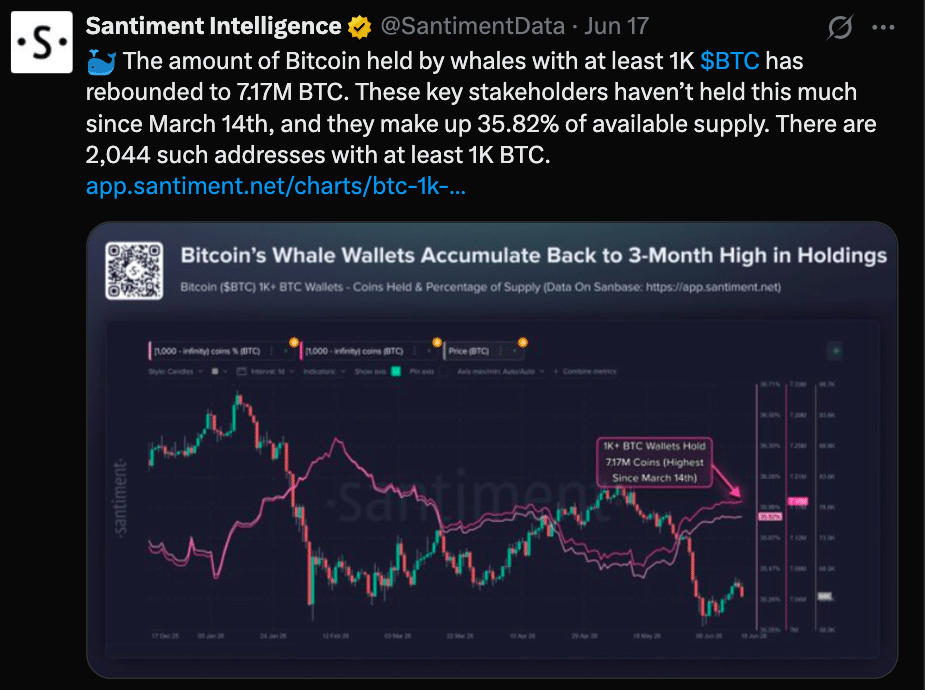
Recent numbers from Santiment show that the wallets holding over 1,000 BTC are now in control of approximately 35.82% of all the Bitcoin, a total of 7.17 million coins.
This is the highest level seen in three months and it is not surprising given how far the price of BTC plummeted in June. Still, analysts are warning that whale buying alone may not be enough to turn the sentiment for the whole market.
Bitcoin Whale Accumulation Signals Confidence Near Key Support
The $60,000 to $70,000 price range has become most closely watched zones in the current cycle.
On-chain data shows that around 20% of all Bitcoin has changed hands in this price range over the past while, which is one of the biggest handovers from weak hands to strong hands in Bitcoin’s history, according to market watchers.
Santiment’s latest figures reports that big wallets holding 1,000 BTC or more are now sitting on 7.17 million Bitcoin. Many large investors view the $61,500 area as a major buying zone rather not a level to exit positions.
One notable example of a long term buyer is Strategy. They continued adding to their Bitcoin holdings even during the recent market troubles.
Based on previous cycles, one might expect that periods of strong Bitcoin whale accumulation like this would always lead to a market recovery but unfortunately, the current situation is very different from what was seen before.
The Miner Problem Isn’t Going Away Any Time Soon
One of the biggest obstacles facing Bitcoin is still the problem of miner selling.
With mining becoming less profitable over the past few months, many miners have had to sell off their reserves just to keep themselves afloat. That added fresh supply to the market and reports say that publicly traded mining companies alone sold off over 32,000 BTC in the first quarter of this year, which is more than they sold in the whole of 2025.
Analysts also note that the current cycle has not yet entered what some on-chain models classify as an “extreme bear phase.” That means forced selling pressure could persist if prices remain weak.
The irony of it all is that while Bitcoin whale accumulation is occurring, miners continue distributing coins into the market.
ETF Outflows Continue to Weigh on Sentiment
There’s also the problem of institutional flows. Spot Bitcoin ETFs recently recorded one of the worst streaks of outflows in their history.
Investors withdrew more than $4.3 billion during a 13-day outflow streak between mid-May and early June, removing a significant source of demand from the market.
Although things have picked up a bit in recent sessions, institutional demand is still nowhere near where it was earlier in the year. One big reason for Bitcoin’s inability to hold on to gains above key resistance level is because of some huge ETF outflows.
Exchange reserves also keep going down. That means fewer coins are available for immediate sale on the exchanges which is generally viewed as a positive long-term signal, but it has not yet been enough to offset the broader selling pressure.
Gold Is Winning Out in The Safe-Haven Stakes
Crypto analyst Axel Adler Jr recently pointed out how both Gold and Bitcoin reacted to the Federal Reserve’s decision to leave interest rates unchanged. Gold dipped down to $4,220 but then quickly bounced back up to $4,300, whereas Bitcoin couldn’t really hold support near $64,000.
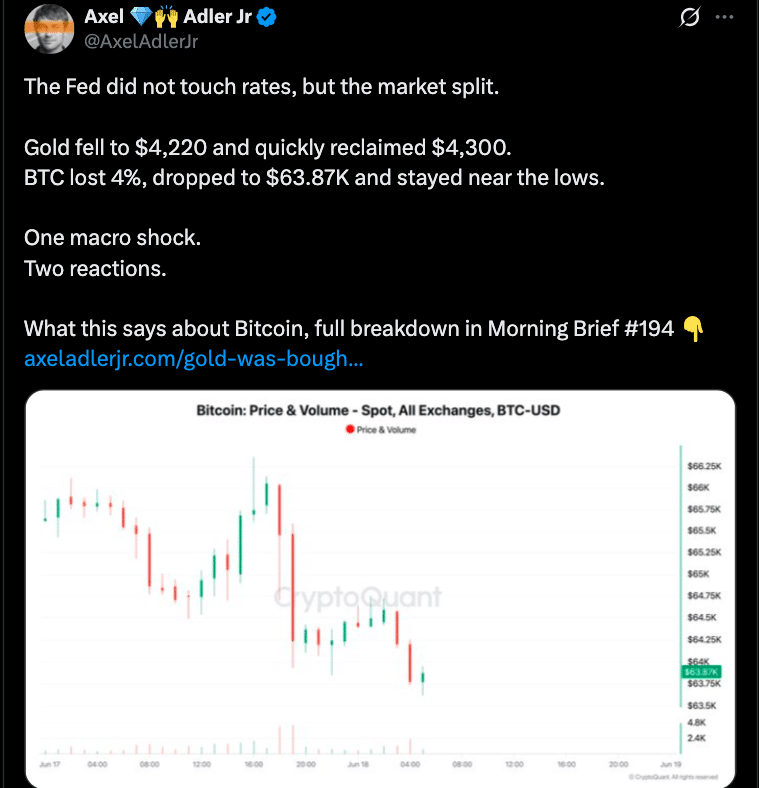
Investors seem to be preferring traditional safe-haven assets to riskier ones.
If gold keeps attracting capital and Bitcoin is still stuck hovering around the $60,000 mark, then it will just reinforce the idea that market participants are choosing safety over growth right now.
For Bitcoin bulls, the situation is straightforward: there is some encouraging Bitcoin whale accumulation but the rest of the market demand still needs to pick up before anything really changes.
Conclusion
Bitcoin whale accumulation is at its highest in three months with the large holders now controlling 35.82% of the circulating supply and holding 7.17 million worth of the coins.
There’s definitely confidence coming from some of the biggest investors in the market. But on the other hand, continued selling by the miners, ETF outflows and Bitcoin’s poor performance against gold all suggest caution. Unless there is real improvement in demand beyond just the whales, then Bitcoin’s recovery from that $60,000 support level could be in trouble.
Glossary
Bitcoin Whale Accumulation: The process of big investors increasing their Bitcoin portfolio positions.
BTC Whale: A wallet or person with at least 1,000 Bitcoin in it.
Spot Bitcoin ETF: An investment fund that owns the actual Bitcoins itself.
Miner Capitulation: A period when miners sell holdings due to declining profitability.
Exchange Reserves: The amount of Bitcoin held on the centralized exchanges
Frequently Asked Questions About Bitcoin Whale Accumulation
What is Bitcoin whale accumulation?
It is when large investors decide to buy up on more BTC, usually wallets holding over 1,000 Bitcoin.
How much Bitcoin are the whales holding now?
Santiment says the whales are now holding 7.17 million worth of Bitcoin and that is 35.82% of all the circulating coin.
Why does Bitcoin whale accumulation matter?
Whale activity often implies long-term investor sentiment because large holders typically accumulate during periods of market weakness.
What is putting pressure on Bitcoin prices right now?
A combination of things: Miner selling, ETF outflows, cautious institutional sentiment, and competition from traditional safe-haven assets like gold are all contributing factors.
References