

Real on-chain activity on Ethereum continues to shatter records despite heavy selling pressure and price weakness. This paradox where usage soars but price stagnates, reveals a market at a deadlock.
The Ethereum network is processing record volumes of transactions, smart contracts are being deployed on a scale never seen before and participation in staking has reached new all-time highs. However, in relation to Bitcoin, ETH’s price action has been subdued.
On-Chain Activity on Ethereum Network Surges to New Highs
Despite the bearish price action, in February alone, the network handled almost 70 million monthly transactions, a multi-year high after years of consolidation in the 30 million to 40 million range.
NFT volume also puts Ethereum ahead, with $12.6 million flowing through the network. DApp activity shot up by a whopping 1,135% to $180 billion weekly. According to data provided, this bullish surge shows consistent utility from traders, applications and decentralized services.
Usage on Layer-1 alone is remarkable, with over 17.3 million transactions per week, demonstrating that although most activity has shifted to Layer-2 solutions, overall, the primary Ethereum chain is still a strong settlement layer.
With staking participation above 30 % of circulating supply, confidence in the protocol’s long-term security model is apparent.
This type of real network activity of both transactions and staking points to the fact that Ethereum is not a fading technology, and its platform is being utilized heavily even when speculative demand is low.
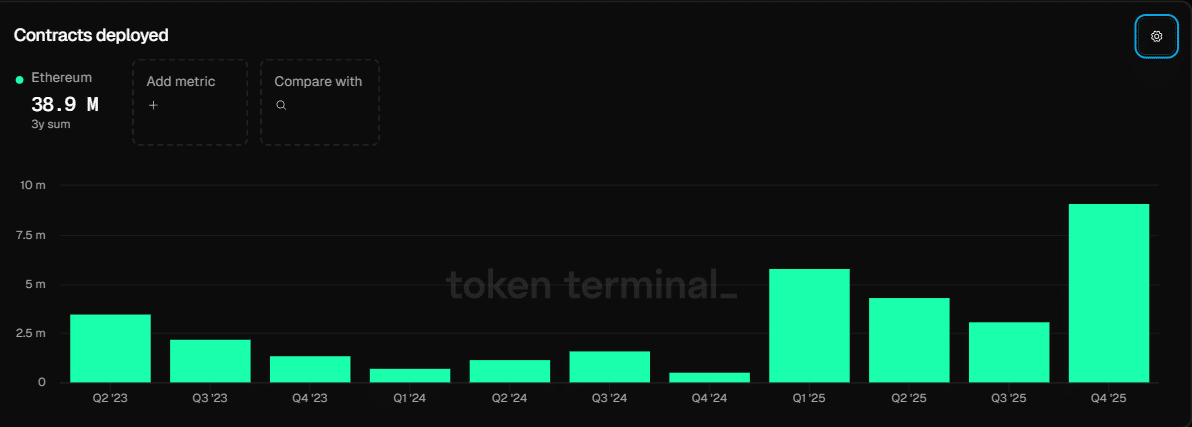
Developer Engagement and Expansion of Smart Contracts
This story of growth is supported by record developer activity. In Q4 2025 Ethereum reached an all-time high of 8.7 million smart contracts deployed, pointing to the continued growth of a flourishing ecosystem of distributed apps, tools and services built on top of Ethereum’s infrastructure.
Moreover, over the same time period, daily active addresses have also demonstrated a major increase, consistently doubling year on year and increasing to over 1.2 million addresses at times; indicating that Ethereum users always return.
This level of developer and user activity shows a distinction between usage and price. As opposed to previous cycles which are purely speculative, ETH’s present growth is supported by real transactional demand and continued ecosystem investment.
However, even with this kind of on-chain activity, Ethereum still falls behind Bitcoin by nearly 1.5x.
Price Conditions vs Use Cases
The network appears to be doing well, while Ethereum’s price performance paints a different picture. ETH has been sliding along with overall crypto weakness too, and trades around $1,900 as of late February 2026. Investors also favor Bitcoin as it tends to take capital out of altcoins during times of macro stress.
Bitcoin and Ethereum prices have both faced challenges in the current macro environment amid global risk-off sentiment. Bitcoin recently traded around $63,000 after investors withdrew from risky assets; dropping enthusiasm across crypto including ETH.
Meanwhile, the Ethereum Foundation has completed in-house initiatives such as staking commitments to enhance long-term fundamentals. Recently announced plans to stake 70,000 ETH from the foundation’s treasury sent a positive signal to markets and encouraged derivatives interest as price remained under further downward pressure earlier in the week.
The Disconnect: Price Lagging Fundamentals
A contrast between on-chain adoption and price action has remained constant this year for Ethereum network growth compared to Bitcoin.
Despite potential, analytics indicate that such strong usage figures have failed to translate into positive price momentum because capital has rotated towards Bitcoin and safe haven assets during the wider economic uncertainty.
Part of this centers on investor psychology. Traders often view Bitcoin as a safety hedge in risk-off windows, leaving ETH and other altcoins behind to underperform even when foundational metrics are strong.
Traders on social media and community forums are pointing out how ETH underperforms Bitcoin; as ETH/BTC ratios reach all time lows, suggesting that capital flows prefer to go into Bitcoin than Ether.
In summary; although Ethereum may be generating real usage and developer value, price curves are still responding more to macro factors and sentiment than fundamentals.
What This Means Going Forward
Moving forward, the divergence between Ethereum network growth and Bitcoin shows two main implications. To start, Ethereum’s strength, proven in transactions, staking and contracts; offers a lasting foundation for long-term growth. This means Ethereum is a functional global settlement and application platform.
Secondly, price recovery may trail use-cases until a more stable market sentiment is achieved. Investors need clear visibility around regulation, macro outlooks, and macro trends like interest rates and risk appetites before reallocating capital from Bitcoin back into altcoin ecosystems.
Conclusion
Ethereum network is being utilized more than ever, with transactions reaching all-time highs, the amount of staked Ethereum increasing day over day and new smart contracts being deployed.
However, despite these factors, price remains weak against BTC, while macro pressures keep landing on ETH’s market performance. This reflects the many layers of crypto markets as they exist today. Fundamentals matter, but so do sentiment and capital flows in framing price outcomes.
The growth of real usage and engagement on Ethereum network shows that it is thriving globally beneath the surface of price.
Glossary
Staking: Locking ETH to secure the network and get paid in return.
Layer-1 (L1): The base blockchain (Ethereum mainnet) responsible for settlement and core transactions.
Smart contracts: A code that gets deployed on the blockchain and executes agreements automatically without intermediaries.
Frequently Asked Questions About Ethereum Network Growth Vs. Bitcoin
Why is the price of Ethereum so weak despite growing usage?
Ethereum’s price is generally correlated with macro sentiment and the risk appetite of investors. But even strong usage has not directly translated into price appreciation when capital rotates to other assets, such as Bitcoin.
What does Ethereum network growth vs. Bitcoin actually show?
It shows that Ethereum’s actual technical and adoption metrics have bloomed more than price performance, which hasn’t followed suit with Bitcoin.
What does high on-chain activity mean for Ethereum?
Growing transactions and engagement show that the network is being utilized for real value transfer and applications.
Can Ethereum price recover if usage is strong
The long term fundamentals are improved by strong network activity, but price moves will probably play out through overall market trends and sentiment.
Does staking help Ethereum’s future?
Yes. Network security is strengthened and it is a sign of holder confidence.
References
NullTX
The Tradable
Pintu
Arrow Algo
The Currency analytics