
For months, the XRP conversation has revolved almost entirely around exchange-traded funds and whether Wall Street would keep buying in. But somewhere along the way, a different corner of the ecosystem grew into something far bigger, and almost nobody was talking about it. The XRP RWA market, built around tokenized real-world assets on the XRP Ledger, has swelled to roughly 4 billion dollars, dwarfing the 1 billion dollar ETF sector by a factor of four. That gap says a lot about where the real institutional appetite might actually be heading.
What’s Driving the XRP RWA Market Right Now
The numbers tell a fairly blunt story. More than 500 tokenized products now sit on the XRP Ledger, spanning treasuries, credit instruments, and other asset classes that institutions have historically kept locked away in traditional custodial systems.
That’s not a pilot program anymore, it’s a functioning marketplace. And the growth of the XRP RWA market hasn’t happened in a vacuum either. It’s tracking a broader industry shift where banks and asset managers are testing blockchain rails not because it’s trendy, but because settlement times and costs are genuinely better.
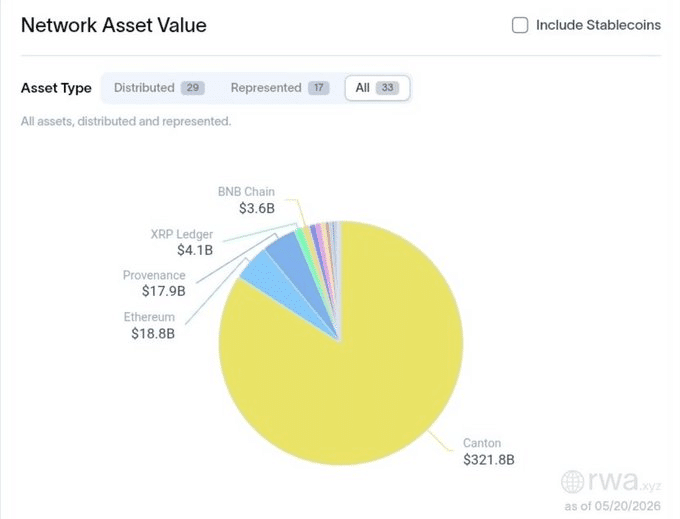
Ripple has spent years positioning XRPL as infrastructure for exactly this kind of use case, and the tokenization figures suggest that groundwork is starting to pay off. Where ETFs depend on retail sentiment, fund flows, and macro conditions, the XRP RWA market runs on something steadier: actual institutions parking actual assets on-chain because it solves a real operational headache.
The JPMorgan Moment That Changed the Narrative
One transaction in particular gave this trend some teeth. Earlier this year, JPMorgan Chase, Ondo Finance, and Mastercard settled a tokenized treasury redemption on the XRP Ledger in roughly four seconds.
Compare that to the multi-day settlement windows traditional finance still deals with, and it’s easy to see why that single trade got circulated so widely among people who track blockchain infrastructure for a living. It wasn’t a proof of concept dreamed up in a lab. It was three major financial names actually using the rails.
That kind of validation tends to matter more than a headline price pump, because it points to sticky, recurring demand rather than a one-time trade. Institutions don’t build repeat workflows around infrastructure they don’t trust, and that’s precisely the kind of trust the XRP RWA market appears to be earning.
ETFs Still Have Momentum, Just Not the Spotlight
None of this means the ETF story has fizzled out. Spot XRP ETFs notched eight consecutive weeks of inflows, pulling in around 23 million dollars in the final week of June alone and pushing cumulative inflows past 1.47 billion dollars. XRP ETF flows reportedly even outpaced both Bitcoin and Ethereum ETFs over that stretch, which is no small feat given how much attention those two dominate.
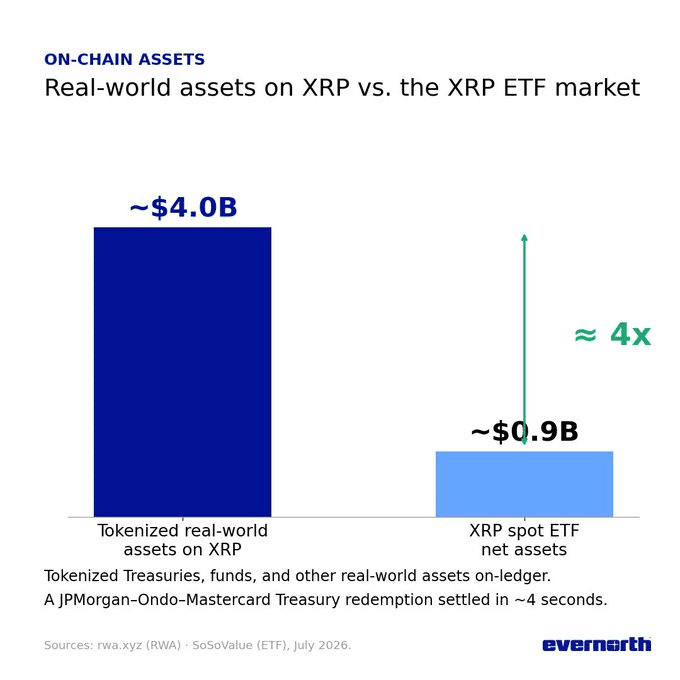
XRP itself climbed more than 8 percent in June, a move that likely reflects both the ETF inflows and the growing chatter around tokenization. But the size differential is what makes this moment worth pausing on. When a use case built on actual settlement activity grows four times larger than the speculative wrapper built around the same asset, it usually means the underlying technology is doing something the market values on its own merits.
Why This Distinction Matters Heading Into Q3
Retail investors tend to watch ETF flows because they’re easy to track day to day. Institutions, on the other hand, tend to watch tokenization volume because it reflects genuine adoption curves rather than sentiment swings. The XRP RWA market’s rise suggests that the more consequential story for XRP’s long-term positioning isn’t happening on trading desks at all. It’s happening in back-office settlement systems where banks are quietly testing whether blockchain rails can replace decades-old infrastructure.
Heading into the third quarter, that distinction could shape how analysts frame XRP’s next chapter. A currency with strong ETF demand is interesting. A currency underpinning a genuine tokenization ecosystem worth four times that demand is a different conversation entirely, one rooted in utility rather than speculation.
Conclusion
The XRP RWA market’s rapid climb past the ETF sector doesn’t diminish what ETFs have accomplished this year. It simply reframes where the more durable growth is coming from. Tokenized treasuries settling in seconds, institutions repeating transactions, and a product count north of 500 all point toward infrastructure adoption that’s harder to fake than a fund inflow chart. Whether that momentum holds through Q3 remains to be seen, but for now, the XRP RWA market looks like the more telling indicator of where real demand sits.
Frequently Asked Questions
What is the XRP RWA market?
It refers to real-world assets like treasuries and credit instruments that have been tokenized and issued on the XRP Ledger.
How big is the XRP RWA market compared to XRP ETFs?
It’s roughly 4 billion dollars, about four times larger than the 1 billion dollar XRP ETF sector.
What was the JPMorgan settlement about?
JPMorgan Chase, Ondo Finance, and Mastercard settled a tokenized treasury redemption on XRPL in about four seconds.
Are XRP ETFs still seeing inflows?
Yes, spot XRP ETFs recorded eight straight weeks of inflows, totaling around 1.47 billion dollars.
Glossary of Key Terms
RWA (Real-World Asset): A physical or traditional financial asset, such as a treasury bond, represented as a digital token on a blockchain.
Tokenization: The process of converting rights to an asset into a digital token recorded on a blockchain ledger.
Spot ETF: An exchange-traded fund that holds the underlying asset directly rather than derivatives tied to its price.
Settlement: The final step in a financial transaction where ownership of an asset officially transfers between parties.
XRPL (XRP Ledger): The blockchain network on which XRP operates and on which tokenized assets in this market are issued.
Sources