


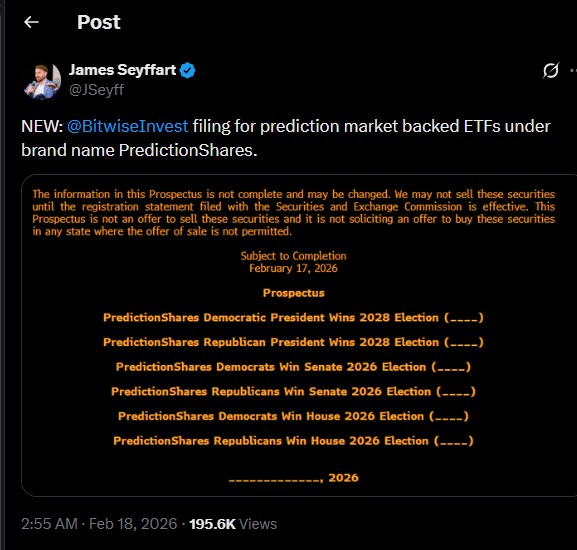
Prediction market ETFs are edging closer to mainstream finance as Bitwise files to launch election-linked funds under its new PredictionShares brand. The move marks the firm’s latest push into alternative investment products, signaling how rapidly political forecasting is merging with regulated market structure.
According to the source, the preliminary prospectus dated Feb. 17 and first highlighted by Bloomberg ETF analyst James Seyffart confirms a strict limitation:
“The offering is incomplete and securities cannot be sold until the registration statement becomes effective.”
That single sentence captures the regulatory tension now surrounding prediction market ETFs.
Real Elections, Not Company Stocks, Sit At the Core
The proposed structure ties fund performance directly to measurable U.S. political outcomes. Separate products would track whether Democrats or Republicans win the 2028 presidential election, along with control of the House and Senate in the 2026 midterm elections.
Unlike thematic or sector ETFs, these funds would hold event-based contracts from regulated trading venues rather than shares of related companies. Returns would depend entirely on verified election results. This design places prediction market ETFs in unfamiliar territory between securities, derivatives, and regulated forecasting tools.
Why Prediction Market ETFs Are Testing Regulatory Limits
Because of that structure, approval remains uncertain. U.S. authorities must determine whether election-linked exposure fits current securities law or requires new oversight. Until effectiveness is granted, prediction market ETFs cannot launch or accept investors.
For Bitwise, the initiative reflects rising institutional curiosity. Chief investment officer Matt Hougan said prediction markets are expanding in both size and relevance, making them difficult for asset managers to ignore. He added that client demand played a central role in pursuing the products, framing PredictionShares as a response to measurable investor interest rather than speculation alone.
Competition Grows, But Approval Remains Zero
Other firms are racing toward the same idea. Roundhill Investments has filed for similar election-focused ETFs, while GraniteShares has submitted competing proposals. None of these filings has received regulatory clearance, leaving the entire category in a holding pattern.
This absence of approval is critical. It shows prediction market ETFs remain experimental despite growing attention. The first authorization, if it arrives, could define leadership across a new corner of the ETF industry.
Rising Attention Meets Sharp Criticism
Prediction markets themselves are drawing heavier trading during major political events. Platforms such as Polymarket have reported strong activity, reinforcing the belief that real-time markets may capture public sentiment faster than traditional polling.
Yet skepticism remains strong. Ethereum co-founder Vitalik Buterin has warned that prediction markets can behave like high-risk speculative bets rather than reliable forecasting tools. Analysts echo that concern, noting funds tied to single outcomes could lose most of their value if predictions fail.
These competing narratives leave prediction market ETFs balanced between innovation and controversy.
Conclusion
Prediction market ETFs are still unapproved, but their implications already stretch across finance, regulation, and democracy. By introducing PredictionShares as part of a broader alternative-investment strategy, Bitwise has forced regulators to confront whether political probability belongs inside public markets.
If approval emerges, prediction market ETFs could transform expectations into tradable financial signals. If rejected, firm boundaries between speculation and regulated investing will remain intact. Either outcome will shape how future markets measure risk, truth, and collective belief.
Glossary of Key Terms
Prediction market ETFs: Funds linked to contracts that pay out based on real-world political outcomes.
Event-based contracts: Financial instruments whose value depends on whether a defined event occurs.
PredictionShares: Bitwise’s proposed ETF platform for regulated political forecasting exposure.
Registration effectiveness: Regulatory approval is required before securities may be sold publicly.
FAQs About Prediction Market ETFs
Are prediction market ETFs approved yet?
No. Regulators have not granted effectiveness to any filing.
Which elections would PredictionShares track?
Current proposals reference the 2026 midterms and 2028 presidential race.
Why is Bitwise pursuing this strategy?
Leadership cites rapid market growth and strong client demand.
What is the biggest investor risk?
Incorrect forecasts could quickly erase most of a fund’s value.
Sources and References