

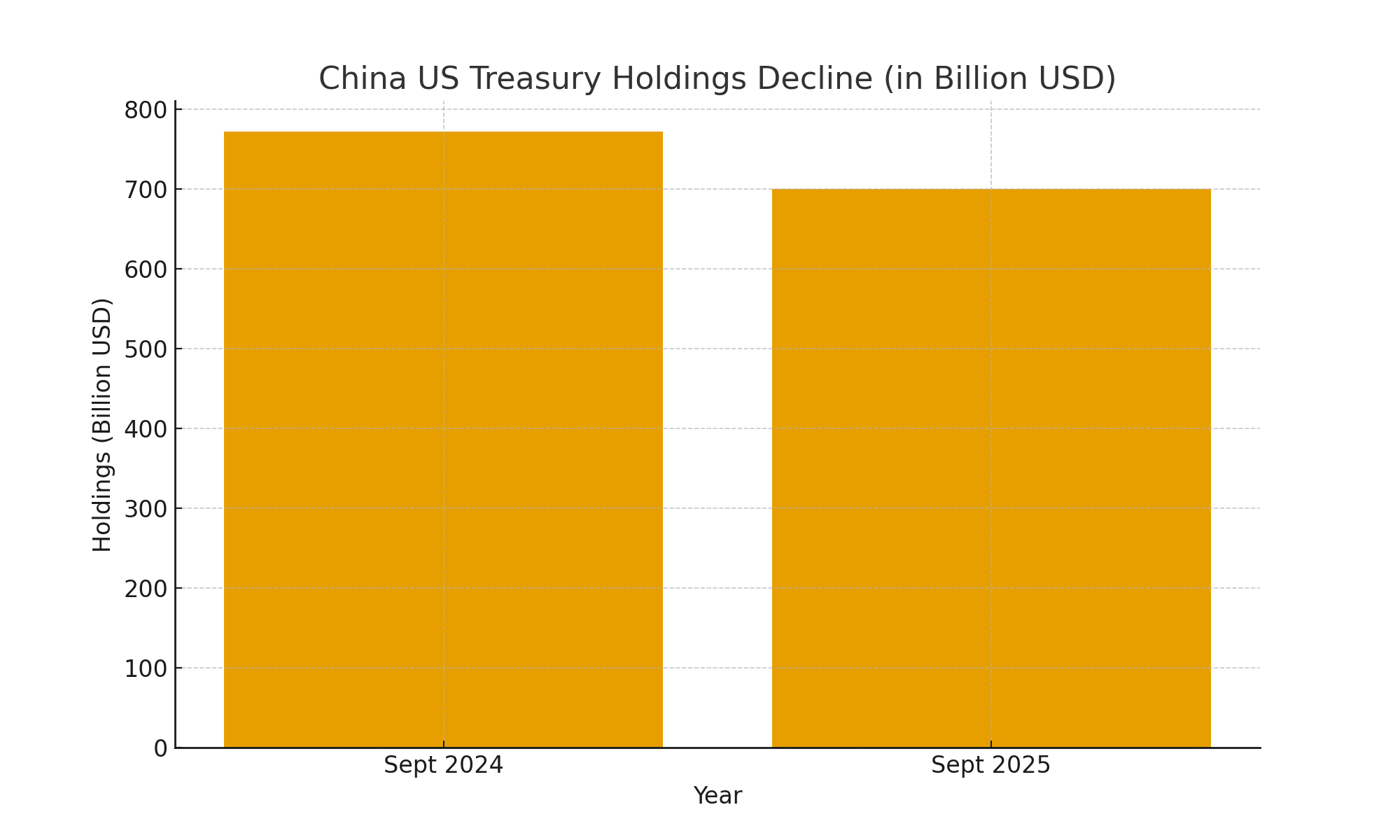
China trimmed about $71.5 billion from its US Treasury holdings over the past year. The move barely caused a ripple in bond markets. In crypto circles, however, it landed like a thunderclap.
For years, Bitcoin supporters have framed every sign of “dedollarization” as proof that a global shift toward digital money is inevitable. Less US debt on central bank balance sheets, the theory goes, should mean more space for Bitcoin as a sovereign hedge.
But the real story unfolding behind China’s Treasury move tells a far more grounded tale. Instead of rushing toward crypto, central banks are sticking to a playbook built around liquidity, stability, and assets that have survived generations of turmoil. In that world, gold still reigns. Bitcoin is still waiting outside the vault.
What China’s Treasury Reduction Really Means
Over the past twelve months, China’s US Treasury holdings slipped from roughly $772 billion to around $700.5 billion. That is not a symbolic adjustment. It reflects years of cautious repositioning that started long before the current crypto market cycle.
China is not alone. Other large emerging economies have also trimmed exposure to US government debt as global politics grow more complex and supply chains continue to fracture along geopolitical lines. These moves reflect a desire for flexibility more than rebellion.
Still, the bigger picture matters. While some central banks were selling, total foreign ownership of US Treasuries actually increased. Global investors, funds, and institutions were willing to step in and absorb the supply. The market did not flinch.
This detail often gets lost in online debates. The reduction looks dramatic in isolation, but it did not trigger stress in bond markets. That alone explains why central banks still see Treasuries as essential tools rather than outdated relics.

The Dollar Is Still Very Much in the Room
Despite years of talk about the decline of the dollar, it remains the backbone of global reserves. More than half of disclosed foreign exchange reserves worldwide are still held in dollars. No other currency even comes close.
The idea that the dollar is losing ground rapidly is often fueled by charts that do not adjust for currency price swings. When exchange rates are factored in, the long term decline in the dollar’s share looks slow, not sudden.
Central banks are diversifying, yes. But diversification does not mean abandonment. It means spreading risk across gold, other major currencies, and different maturities of debt. The structure of the system remains intact, even as the world edges toward a multipolar financial order.
Gold, Not Bitcoin, Is the Real Winner of This Shift
If central banks are trimming Treasuries, where is the money going? The answer is not hidden on the blockchain. It is sitting in vaults.
Gold purchases by central banks have surged to levels not seen in decades. Year after year, official buyers have added hundreds of tonnes to their reserves. The message is quiet, but it is consistent. When uncertainty rises, gold still earns the first call.
Gold works for policymakers because it solves multiple problems at once. It is liquid. It is universally recognized. It carries no default risk. It can be used as collateral. It does not depend on software, miners, or regulators agreeing on frameworks.
From a central banker’s chair, gold is not exciting, but it is dependable. That reliability still matters more than narratives built on future potential
Bitcoin’s Safe Haven Story Meets Hard Constraints
Bitcoin has come a long way. A decade ago, it was dismissed as a fringe experiment. Today, it trades alongside major global assets, supported by regulated investment products and deep derivatives markets. That evolution is real.
Yet central banks do not chase upside the way hedge funds do. They focus on worst-case scenarios. They ask what happens during war, sanctions, grid failures, and system wide liquidity crises. Bitcoin’s history, while impressive, is still short by sovereign standards.
Price swings remain large. Regulatory clarity varies sharply by region. Political acceptance is still fragile. These issues do not make Bitcoin irrelevant, but they explain why it remains outside the inner circle of reserve assets.
The China Treasury story highlights this divide. Crypto markets interpret the move as confirmation of long term distrust in fiat systems. Central banks interpret the same move as routine risk management.
What the Crypto Market Is Quietly Signaling
Bitcoin’s behavior during this reserve reshuffling offers subtle clues.
Market dominance remains elevated, suggesting investors continue to favor the most liquid and established digital asset when uncertainty rises. Exchange balances have declined as more supply migrates into long term storage and structured products. That supports price floors but also concentrates influence among fewer holders.
Real yields in bond markets continue to shape the battlefield. When inflation-adjusted yields rise, interest-bearing assets regain appeal. When yields fall, the opportunity cost of holding Bitcoin drops sharply. This tug of war often moves Bitcoin far more than any single geopolitical headline.
Liquidity remains the deeper force. When money is easy, Bitcoin thrives. When it tightens, narratives alone cannot carry prices.
A Maturing Role for Bitcoin in a Changing System
China’s Treasury reduction reflects a world in transition. Trust is becoming more fragmented. Political alliances are less stable. Governments want optionality. That is not a fringe idea anymore. It is mainstream policy thinking.
Bitcoin fits into this world, but not in the way many once imagined. It is not replacing Treasuries inside central bank vaults. It is finding relevance among private investors, corporations, asset managers, and even some public funds that operate with more flexibility.
Its role today looks less like sovereign insurance and more like a strategic alternative. A digital asset that sits outside the traditional financial system, offering both risk and refuge depending on the moment.
Conclusion
China’s $71.5 billion shift away from US Treasuries sounds like the kind of move that should ignite Bitcoin’s safe haven narrative. In reality, it exposes the distance that still exists between crypto optimism and central bank conservatism.
The global financial system is changing, but it is not tearing itself apart. Treasuries remain essential. Gold remains dominant. Bitcoin remains disruptive, but not yet sovereign.
For investors, that truth may be more useful than any viral headline. Understanding where Bitcoin actually fits today, not where it is hoped to be tomorrow, is what turns speculation into strategy.
Frequently Asked Questions
Why did China reduce its US Treasury holdings
The move reflects long term diversification, geopolitical caution, and the desire to reduce concentration risk in a single issuer.
Did this move weaken the dollar globally
No immediate impact followed. The dollar remains the dominant reserve currency despite gradual diversification.
Are central banks investing in Bitcoin instead of bonds
There is no reliable evidence of meaningful central bank Bitcoin accumulation at this stage.
Glossary of Key Terms
Treasuries
Debt securities issued by the US government and used globally as core reserve assets.
Foreign exchange reserves
Assets held by central banks to stabilize currencies and manage financial shocks.
Real yield
Bond yield adjusted for inflation, a major driver of capital flows between risk assets and safe assets.
Safe haven asset
An asset expected to hold value during financial stress, traditionally led by gold.
Bitcoin dominance
The share of total crypto market value represented by Bitcoin, often used to measure market risk appetite.
References
- What China’s Treasury Reduction Really Means
- The Dollar Is Still Very Much in the Room
- Gold, Not Bitcoin, Is the Real Winner of This Shift
- Bitcoin’s Safe Haven Story Meets Hard Constraints
- What the Crypto Market Is Quietly Signaling
- A Maturing Role for Bitcoin in a Changing System
- Conclusion
- Frequently Asked Questions
The price predictions and financial analysis presented on this website are for informational purposes only and do not constitute financial, investment, or trading advice. While we strive to provide accurate and up-to-date information, the volatile nature of cryptocurrency markets means that prices can fluctuate significantly and unpredictably.
You should conduct your own research and consult with a qualified financial advisor before making any investment decisions. The Bit Journal does not guarantee the accuracy, completeness, or reliability of any information provided in the price predictions, and we will not be held liable for any losses incurred as a result of relying on this information.
Investing in cryptocurrencies carries risks, including the risk of significant losses. Always invest responsibly and within your means.
For advertising inquiries, please email . [email protected] or Telegram