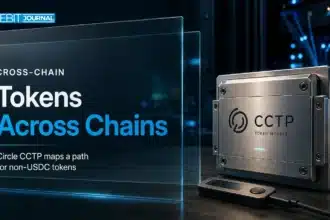


Circle CCTP guidance outlines how issuers could transfer ERC-20 tokens other than USDC across supported networks using a burn-and-mint process. NewsBTC reported on November 1 that Circle published the developer guide on October 30. The guide includes an Arc Testnet example, which describes a technical route but does not establish universal production availability.
Why it matters
The guide presents Circle’s cross-chain infrastructure as an option for issuers seeking to maintain one token identity across multiple networks. It does not establish support for every token or chain. Issuers remain responsible for operational controls, legal obligations and transfer risks.
What we know
How Circle CCTP transfers work
According to NewsBTC’s account of Circle’s October 30 developer guide, the approach uses Circle’s Cross-Chain Transfer Protocol infrastructure for issuer-operated ERC-20 assets beyond USDC. In the USDC flow, tokens are burned on a source network and native USDC is minted on a destination after message verification. The non-USDC route uses a different set of components.
In the described design, a source contract burns the amount being moved and emits a message. Circle’s Iris service attests to that message. A destination contract receives the attestation and mints the corresponding amount. The guide describes use of CrossChainTokenService and an associated token manager for issuer-operated tokens.
Circle CCTP’s described approach uses a common token identity across chains, rather than treating a wrapped bridge token as an entirely separate economic instrument. That could help address fragmentation in liquidity, accounting and asset tracking when an issuer represents a token on more than one chain. It does not establish that the asset has the same liquidity or utility on each network.
The guide includes an Arc Testnet walkthrough and an example involving another supported EVM network, NewsBTC reported. It describes configuring roles, caps, rate limits, trusted domains and ownership. Developers need to verify contracts and quote fees for a specific route, since this transfer path differs from USDC’s TokenMessengerV2 flow.
The design could be relevant to payments, collateral management and treasury rebalancing, where assets may need to move between applications or networks. The guide describes implementation tooling, not a forecast of adoption.

What is still unclear
Circle CCTP’s technical guide is not a statement of broad production support. NewsBTC reported that the Arc example is on testnet, and the available information does not establish that every ERC-20 can move across every network. The guide also does not provide an adoption forecast or confirm which issuers will use the tooling in live services, or which particular assets and routes have production support.
Implementation details depend on each deployment. Developers should test domain trust settings, fees, rate-limit behaviour, decimal consistency and recovery from failed transfers before moving material value, according to the guide as described by NewsBTC. The evidence identifies attestations, administrative roles and third-party services as areas where issuers should assess risk.
Circle says it is not the issuer or guarantor of third-party tokens, NewsBTC reported. Token issuers remain responsible for their permissions, legal obligations and transfer risks. Public, private and hybrid networks can also involve different expectations around access, settlement finality and oversight. Circle CCTP does not make those environments identical.
How markets and analysts reacted
The report describes technical guidance, not a token launch or a forecast of market demand. The supplied research contains no analyst price target or direct market response attributed to Circle CCTP. Broader crypto prices provide context, but do not show that the guide caused a market move.
At 10:13 UTC on November 1, Bitcoin was $78,073, up 0.87% over 24 hours, while Ethereum was $2,270.70, up 1.25%, according to CoinGecko market data. Both were down over the prior seven days, with Bitcoin falling 2.84% and Ethereum 2.72%. The Crypto Fear & Greed Index was 34, classified as Fear, on November 1, according to Alternative.me.
These figures describe broader market conditions, not demand for CCTP or for any particular issuer’s token. The supplied reporting contains no evidence of a market-wide repricing tied to the guide’s publication.

What Circle CCTP means for investors
What to watch in Circle CCTP deployments
For investors, interoperability is infrastructure rather than an automatic change to a token’s value. A transfer mechanism may make an asset available to applications on another network, but that alone does not alter its supply, governance rights, cash flows or legal status. The commercial question is whether issuers adopt the tooling for payment, treasury or collateral uses, and whether those uses justify the costs and risks.
Circle CCTP also involves trust boundaries: smart contracts, Circle’s attestation service, issuer permissions and controls governing minting and burning. The guide highlights attestations, administrative roles and third-party services as risks to consider. It recommends testing relevant configurations before moving material value.
Developments worth watching include production deployments, the networks and tokens issuers actually support, and evidence of sustained transaction use. Circle’s guide does not say that all chains are available for all assets, so announcements and implementation details will matter more than a testnet demonstration.
Circle CCTP could offer issuers a controlled alternative to operating separate wrapped representations, but implementation quality and issuer decisions will determine whether that approach is meaningful. Cross-chain availability alone is not evidence of liquidity, utility or adoption.
Bottom line
Circle’s guide describes how issuers could use CCTP infrastructure to burn and mint non-USDC ERC-20 tokens between supported networks. Its testnet example shows a technical path, while the production support available for specific assets and routes, issuer uptake and the risks of each deployment remain questions for developers and issuers to assess.
Sources
This article is for informational purposes only and does not constitute financial or investment advice. Cryptocurrencies are highly volatile; always do your own research before investing.