






For most industries, the rules are boring, and that is the point, as crypto in the United States has operated without that comfort. Because basic questions about who regulates what have been answered through enforcement, settlements, and court fights that arrive after the money is already moving. The CLARITY Act is a bid to flip that sequence by putting a market structure framework on paper that exchanges, token issuers, and investors can read before they take a risk.
It has already cleared one hurdle as the House of Representatives passed the bill on July 17, 2025, and the Senate later received it and referred it to the Committee on Banking, Housing, and Urban Affairs, so the next chapter is political, not technical.
The asset classification idea that could change everything
The legal fight inside US crypto has often come down to one argument: whether a token is effectively a security, a commodity, or something that shifts depending on when and how it is used. The CLARITY Act tries to reduce that ambiguity by creating a framework for “digital commodities” and by setting conditions under which secondary trading can be treated differently from the original fundraising.
A key concept is the “mature” blockchain standard, built around decentralized control rather than a project’s popularity. In the bill summary, a token can qualify for exchange trading if its blockchain is mature or if the issuer files specified reports, which is meant to turn vague expectations into a compliance gate that can be assessed and, if needed, enforced.
Supporters say the CLARITY Act reduces the uncertainty premium that has pushed activity offshore and kept traditional institutions cautious. Critics argue that definitions can still miss edge cases, especially where decentralized finance blends software, governance, and economic rights in ways that do not resemble familiar financial instruments.
What the bill would require from platforms and intermediaries
On the ground, market structure lives in registration, supervision, and customer protections. The CLARITY Act directs the Commodity Futures Trading Commission to build an expedited registration process for digital commodity exchanges, brokers, and dealers, including provisional status while key rulemakings are completed, which is a practical attempt to move firms from informal operations into a supervised perimeter.
It also leans into basic market safeguards. Trade monitoring, recordkeeping, and restrictions around commingling customer assets are framed as standard expectations, not optional best practices. The bill summary further indicates that covered intermediaries are subject to the Bank Secrecy Act for anti-money laundering and related purposes, reinforcing that compliance obligations are intended to sit at the points of control, not vanish behind technical jargon.
Another notable policy choice is its treatment of certain non controlling blockchain developers and service providers. The section-by-section explanation describes an effort to avoid treating builders as money transmitters solely for providing infrastructure or services, which is an attempt to focus regulation on custody and control rather than on writing code.
Stablecoins, banking signals, and why this debate looks different in 2026
Stablecoins are not the center of this bill, because the United States enacted a federal payment stablecoin framework in July 2025. That law states that payment stablecoins issued by permitted issuers are not securities under federal securities laws and are not commodities under the Commodity Exchange Act, which narrows the market structure debate by taking one big asset type out of the Securities and Exchange Commission versus commodities regulator fight.
With a stablecoin regime established, the policy spotlight shifts toward trading venues, custody controls, and disclosure discipline, and the CLARITY Act becomes a test of whether Washington can standardize those basics without freezing innovation.
Key crypto indicators to watch as politics turns into market pricing
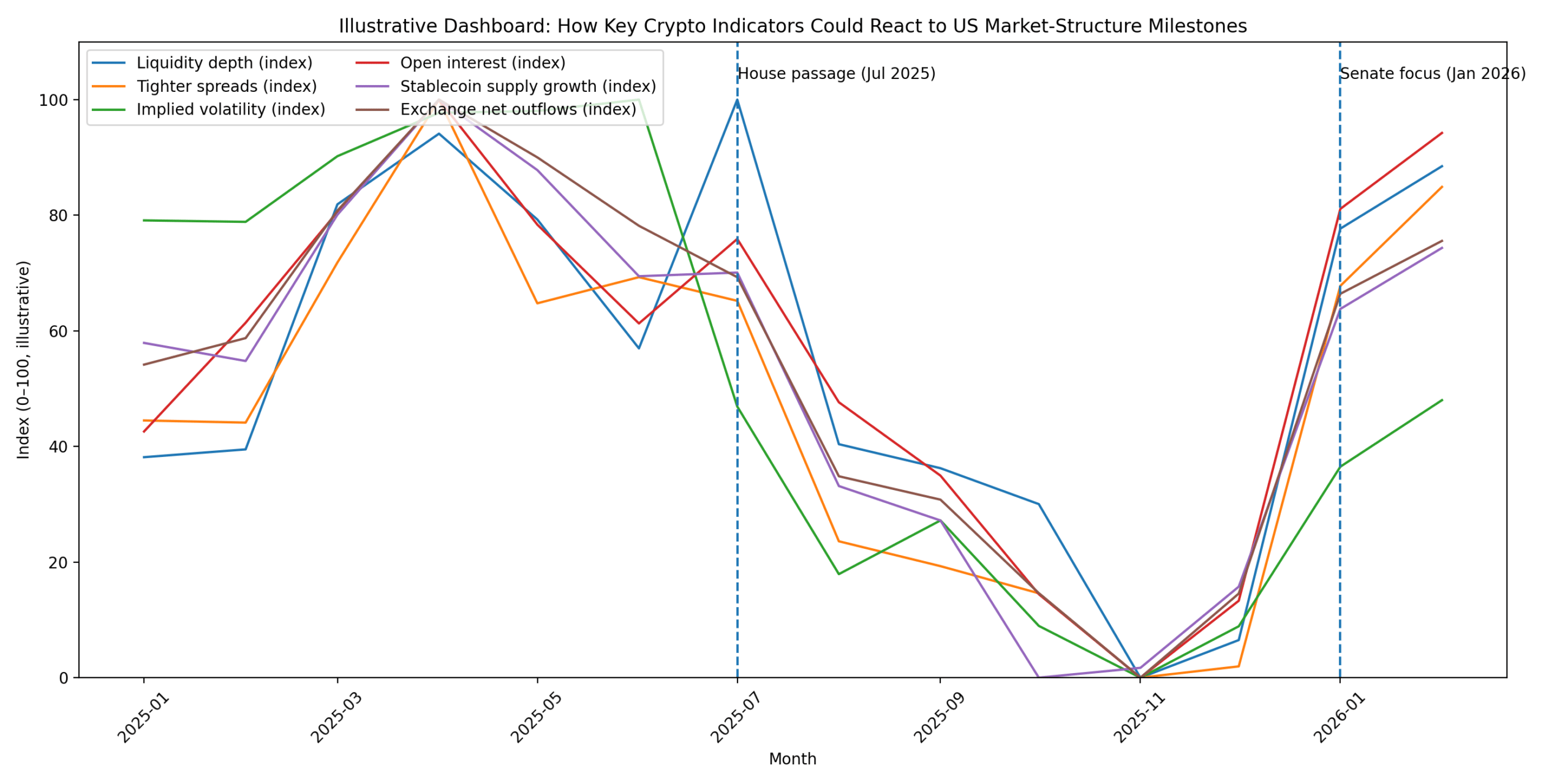
Even when a bill is not yet law, probabilities move, and markets price probabilities. If the CLARITY Act looks more likely to advance, the first visible shifts often appear in liquidity and derivatives rather than in headlines.

Funding rates in perpetual futures can show whether optimism is being expressed with leverage or whether traders are paying to hedge. Open interest can rise for healthy reasons, like deeper participation, or for fragile reasons, like crowded positioning, so it matters most when read alongside liquidation bursts and the shape of the futures curve.
Options implied volatility can add another layer, especially when short-dated volatility jumps while longer-dated volatility stays calmer, which often signals event risk being priced in.
Spot market signals are quieter but still useful. Market depth and bid-ask spreads reflect whether liquidity providers trust that operations will remain stable, because tighter spreads usually show confidence.
Exchange net inflows and outflows can hint at intent, since rising inflows often precede sell pressure, while persistent outflows can support a holding narrative. Stablecoin supply growth is also watched as a proxy for deployable liquidity, particularly when it coincides with improving market depth.
Conclusion
The CLARITY Act will not solve every dispute in crypto, and it will not make speculative projects suddenly credible. What it can do is replace a decade of interpretive fights with a clearer set of lanes for secondary trading, platform registration, baseline disclosures, and the compliance perimeter around centralized intermediaries.
If the Senate advances it, the near term impact is more likely to be a slow repricing of regulatory risk, reflected in spreads, volatility, and where liquidity chooses to sit. If the CLARITY Act stalls, the uncertainty tax remains, and markets usually pay that bill in the form of thinner liquidity during the next stress test.
Frequently Asked Questions (FAQs)
What is the main purpose of the bill?
It seeks to establish a consistent market structure for digital commodities, clarify oversight boundaries, and push more activity into registered venues with standard safeguards.
Does it remove securities law from crypto?
It does not. The framework aims to separate fundraising from many forms of secondary trading, while keeping investor protection and disclosure obligations relevant where they belong.
Why do traders care before any Senate vote?
Crypto markets price probability, so changing odds can shift liquidity, volatility, and risk limits even when the text has not become law.
What indicators tend to react first?
Derivatives positioning, spreads, and market depth often adjust before spot prices do, because leverage desks reprice uncertainty quickly.
Glossary of key terms
Digital commodity
A category used for certain digital assets that rely upon a blockchain for their value, paired with a framework that generally assigns spot market regulation to the commodities regulator.
Mature blockchain
A standard tied to decentralized control that helps determine whether a digital commodity can qualify for exchange trading or specific compliance treatment.
Open interest
The total number of outstanding derivatives contracts, commonly used to gauge positioning and leverage in futures markets.
Funding rate
A periodic payment mechanism in perpetual futures designed to keep contract prices aligned with spot markets, often used as a sentiment signal.
Implied volatility
A market derived estimate of future volatility embedded in option prices, widely used as a proxy for event risk.
References