











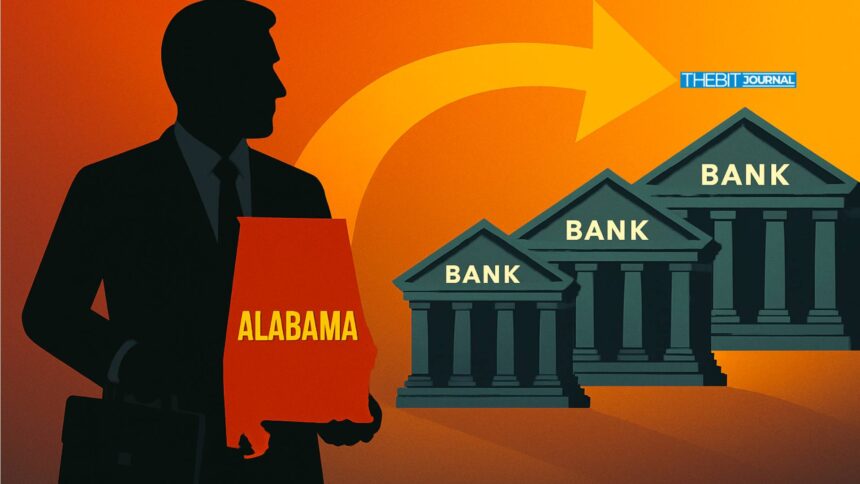

Senator Concerned About Alabama’s GENIUS Act
The newly enacted Alabama GENIUS Act has sparked fierce discussion about its possible impact on local financial institutions. Alabama State Senator Keith Kelley issued a sharply worded statement warning that the proposal might unintentionally hurt community banks.
He emphasized that local banks are the backbone of small-town economies, giving loans to farmers, small companies, and families who frequently cannot access big-bank funding.

“The concern is that stablecoin platforms will siphon deposits from local banks, drying up funds that keep our communities thriving,” according to Kelley. His caution comes as the bill approaches implementation, pending precise rules from the Treasury and Federal Reserve.
Stablecoin Loophole Causes Concern
The debate revolves around a potential loophole in the Alabama GENIUS Act. While the legislation forbids stablecoin issuers from paying direct interest on holdings, it does not specifically restrict crypto platforms or their affiliates from providing yield-based benefits. This technological loophole may allow digital platforms to draw deposits away from local banks, promising better yields under a different name.
Banking groups believe that this will create an unfair playing field. Small banks that rely on deposits to provide local loans may lose out if global crypto platforms establish a firmer presence. According to one banking policy researcher, “If left unaddressed, the loophole could destabilize the entire small-bank ecosystem.”
Community Banks are at Risk
Alabama’s community banks are already under strain as the banking sector consolidates. For many communities, these institutions are not only lenders, but also sources of trust and economic stability. The Alabama GENIUS Act might hasten consolidation if deposits convert to digital assets on a large scale.
According to reports from financial think tanks, up to $6.6 trillion in deposits might possibly transfer in worst-case circumstances. Even a tiny outflow from rural Alabama’s small banks might restrict lending capacity for mortgages, agricultural loans, and small-business development. Kelley warned that this might have a “domino effect,” threatening both the local economy and financial access.
National and Industrial Reactions
The Alabama GENIUS Act debate extends beyond state lines. Industry experts and former regulators have voiced worry that ambiguous terminology like “comparable regulatory regime” might allow overseas issuers to avoid US monitoring. This might lead to multinational stablecoin suppliers competing directly with domestic banks without the same level of regulatory oversight.
Market observers say this raises larger issues about the future of financial regulation. On X, one commenter stated, “The GENIUS Act promotes innovation but risks eradicating local banks. “Balance is key.” If the Treasury and Federal Reserve fail to tighten the restrictions during implementation, lawmakers have already signaled future revisions.
Conclusion
The Alabama GENIUS Act has swiftly become one of the most contentious pieces of financial legislation in 2025. While the intention was to create a clear structure for stablecoin use, detractors believe that it may undermine community banking.
With rules still pending, the onus is on federal agencies to resolve gaps and preserve deposit stability. As November approaches, small banks, digital platforms, and politicians are preparing for a battle that has the potential to change the relationship between traditional banking and the digital asset sector.
FAQs for Alabama GENIUS Act
Q1: What is the Alabama GENIUS Act?
The Alabama GENIUS Act is a law aimed at regulating stablecoins, signed into law in July 2025, and awaiting detailed federal rules.
Q2: Why are small banks worried about it?
Community banks fear losing deposits to crypto platforms that could exploit regulatory gaps to offer yield-like products.
Q3: Does the Act allow stablecoin interest payments?
It bans direct interest payments by issuers but does not explicitly block affiliated platforms from offering reward-style yields.
Q4: What happens next?
The Treasury and Federal Reserve must issue final regulations before full implementation, which may address the loophole.
Glossary
Stablecoin: A cryptocurrency pegged to a stable asset like the U.S. dollar.
Community Bank: A smaller, local financial institution serving specific regions or towns.
Yield: Earnings generated on an investment, often through interest or rewards.
Consolidation: The merging of smaller banks into larger institutions, often due to financial pressure.
Treasury: The U.S. government department responsible for financial policy and regulation.
Regulatory Regime: The framework of rules and oversight governing financial activities.