






This article was first published on The Bit Journal.
RLUSD stablecoin has finally rolled out in Japan, following approval from the country’s strict Financial Services Agency (JFSA). This gives Ripple access to one of the world’s most tightly regulated digital asset markets.
With this approval, SBI VC Trade, a subsidiary of SBI Holdings, is now allowed to offer the US dollar-backed stablecoin to both institutional and retail customers via their VCTRADE platform.
This launch fulfills the strategic partnership that Ripple and SBI announced back in August 2025 and really ups crowns Ripple’s efforts to get RLUSD beyond North America and Europe and into Asia.
Japan Opens the Door to RLUSD
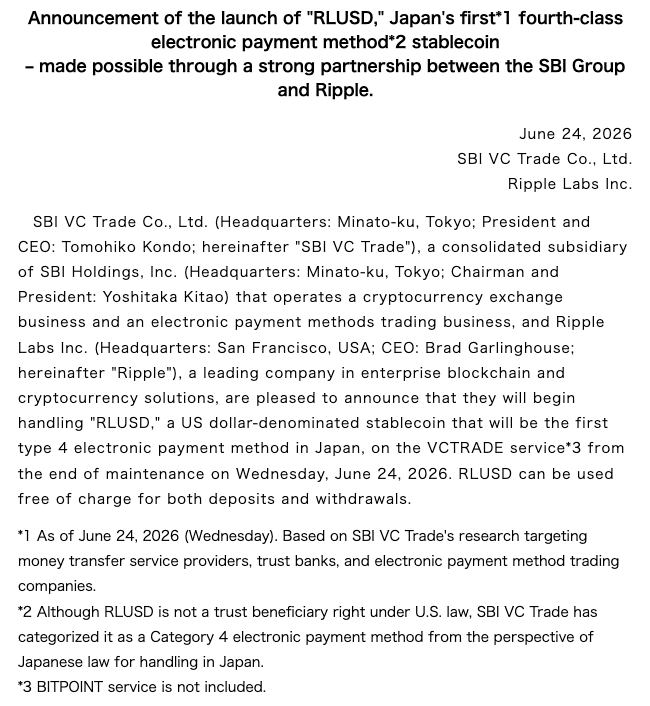
Ripple and SBI announced the launch on the 24th of June, after Japanese regulators approved RLUSD as a new type of electronic payment instrument under Japan’s Payment Services Act. The new classification applies specifically to foreign-issued stablecoins that meet Japan’s tough regulatory requirements.
The reason this is noteworthy is that Japan has spent years developing one of the strictest stablecoin frameworks. Unlike other jurisdictions where stablecoin regulation is still unclear, Japan demands clear reserve backing, strict compliance standards and oversight mechanisms before any digital payment instruments can be offered to the public.
SBI VC Trade describes RLUSD stablecoin as the very first foreign-issued dollar stablecoin to get approval under this new framework. The exchange has already integrated the asset into its platform, making it available for deposits, withdrawals, and trading.
Ripple’s Long-Term Partnership With SBI Pays Off
Ripple and SBI have actually been working together since 2016 on cross-border payment infrastructure and different blockchain-related services in Asia. In August 2025, the two companies signed a memorandum of understanding which aimed at bringing RLUSD to Japan once the regulatory conditions were satisfied.
That process finally come to a head this week, with full regulatory clearance being granted.
According to Ripple, the RLUSD stablecoin is designed to help people make payments, manage collateral, and tokenized assets activity. In a statement accompanying the launch, Ripple Senior Vice President of Stablecoins Jack McDonald said the token will help connect Japanese businesses to global liquidity networks.
The company sees RLUSD as a component of its enterprise-focused financial infrastructure not a rival to XRP itself.
Institutional Adoption Is the Real Goal
Unlike other stablecoins which grew out of crypto trading, RLUSD stablecoin is being aimed primarily at regulated financial use.
Ripple has repeatedly emphasized settlement, treasury operations, tokenization and cross-border payments as the token’s primary use cases. RLUSB stablecoin is fully backed by US dollar deposits, Treasury securities and cash equivalents, and they do regular third-party reserve attestations every month.
Recent regulatory moves in the US, Europe and Asia have really started to drive demand for compliant stablecoins that can work within traditional financial systems. Ripple has also made some progress on getting European licences for RLUSD and payment services this week.
For Ripple, Japan presents a prime testing ground because the country has an established regulatory framework that financial institutions trust.

Can RLUSD Compete with USDT and USDC?
USDT and USDC are still firmly in the lead when it comes to global stablecoin activity, due to their deep liquidity, wide-ranging exchange integrations, and the fact that so many establishments have come to accept them across decentralized finance and trading.
Even after strong growth since its late-2024 debut, the RLUSD stablecoin remains relatively small at around $1.7 billion in market capitalization.
Recent market data suggests the token has experienced some serious growth over the past year, but it still lags behind in terms of scale, representing only a fraction of the volume handled daily by its larger competitors.
Next up for Ripple is the challenge of proving that this regulatory credibility can translate into transaction volume, institutional adoption, and cross-border payment activity because Japan’s approval has given RLUSD the legitimacy it was missing.
Conclusion
The RLUSD stablecoin has managed to clear one of the most daunting regulatory hurdles in the digital assets space which is getting approved in Japan.
The approval strengthens the partnership between Ripple and SBI, expands the token’s reach across Asia, and puts it right at the heart of one of the best-developed stablecoin frameworks in the world.
But despite all this, the token is still a long way behind USDT and USDC in terms of size and liquidity.
Glossary
Stablecoin: a digital asset that has been designed to keep a stable value by being linked to a fiat currency or some other reserve asset.
RLUSD: Ripple’s US dollar-backed stablecoin.
JFSA: the Japanese authority that regulates finance in the country.
Tokenization: the process of taking real assets and representing them on a blockchain.
Electronic Payment Instrument: a type of regulated payment that is approved under Japanese law – covering stuff like approved stablecoins.
Frequently Asked Questions About RLUSD Stablecoin in Japan
What is RLUSD?
RLUSD is Ripple’s US dollar-backed stablecoin designed for use in payments, settlement of trades, collateral management and tokenized assets.
Who can get access to RLUSD stablecoin in Japan?
Both individuals and institutions can use RLUSD in Japan via SBI VC Trade’s VCTRADE platform.
How big is RLUSD compared to USDT?
RLUSD has a market cap of about $1.7 billion, while USDT has roughly $186 billion.
Is RLUSD somehow connected to XRP?
RLUSD is a separate product from XRP. Ripple markets it primarily as a regulated stablecoin for enterprise financial applications.
References